Uncertainty reigns in China-US relations


 |
| The Chinese navy hold a drill on the South China Sea in this file photo.[Photo/Chinanews.com] |
South China Sea
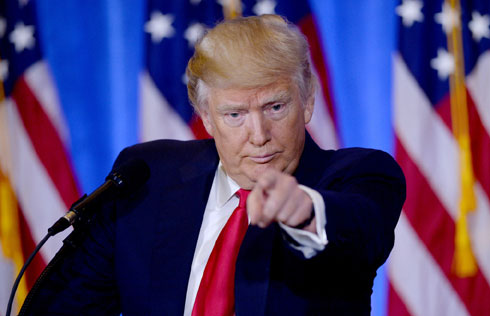
Trump, known for his loose talker, said during the presidential campaign that "we have rebuilt China, and yet they will go in the South China Sea and build a military fortress the likes of which perhaps the world has not seen."
But the real attention on Trump's views on South China Sea was focused last week when Tillerson described China's land reclamation in the South China Sea as "akin to Russia's taking of Crimea".
"We are going to have to send China a clear signal that, first, the island-building stops," he told lawmakers during the hearing. "And second, your access to those islands also is not going to be allowed."
Tillerson's words drew a sharp response from Beijing, with Foreign Ministry spokesman Lu Kang saying that the tension in the South China Sea has cooled down, and China and countries in the region have returned to two-way talks.
It is hoped outsiders to the region will "respect this consensus" on bilateral talks, Lu said.
On Tuesday, Ben Rhodes, Obama's deputy national security adviser, expressed US concern over the South China Sea, but he said "we've not thought that military confrontation would be the right approach to the South China Sea," a clear rebuke to Tillerson's suggestion.
China has long regarded the US as biased in its words and deeds regarding the maritime territorial disputes between China and some of its neighbors in a bid to bolster US influence in the region where China is the top trade partner for most economies. The US was believed to be behind the Hague ruling last July on the South China Sea in a case brought about by the Philippines.
However, the new Philippine President Rodrigo Duterte, unlike his predecessor Benigno Aquino III, has chosen to distance his country from the US and has sought closer ties with China.
Just last week, Nguyen PhuTrong, general secretary of the Communist Party of Vietnam (CPV) paid a four-day trip to China where he had "a candid exchange of views" on maritime issues, according to a communique issued. In Beijing, Nguyen met both President Xi, Premier Li Keqiang and other senior Chinese officials.
China's warming relationship with both the Philippines and Vietnam also came at a time when Trump announced to withdraw from the 12-nation Trans-Pacific Partnership (TPP) trade agreement. Trump, and Ross, the secretary of commerce nominee, argued that the US will benefit more from bilateral agreement instead of multilateral agreement.
TPP, signed last February, has long been regarded by the Obama administration as the essence of its rebalance to Asia strategy. Trump's planned cancelation and his anti-trade rhetoric has raised serious doubts in other 11 partners about the US commitment.
China, meanwhile, is pushing forward the Regional Comprehensive Economic Partnership (RCEP) between 10 ASEAN (Association of Southeast Asian Nations) and six other countries. China also hopes its newly launched Asian Infrastructure Investment Bank (AIIB) and One Belt One Road (OBOR) initiative could help the region develop its infrastructure and economy.
Before quitting his job as senior adviser to the Trump transition team, James Woolsey Jr, a former CIA director, said that the Trump administration might join the AIIB and have an interest in participating in the One Belt One Road Initiative.
"I think there is every potential for the US and China to work together, coopting AIIB, OBOR, and other big initiatives under Xi Jinping administration into a common agenda in the Asia-Pacific region," said Paal of Carnegie Endowment for International Peace.
"There're certainly infrastructure requirements for the region. The US has something to offer. China has a lot to offer. We ought to be doing more on the common agenda, rather than picking apart at each other's objectives."
Contact the writer on chenweihua@chinadailyusa.com