China persists with other FTAs after US leaves TPP


Beijing said on Tuesday it will support ongoing deliberation of two free trade arrangements in the Asia-Pacific region after the US quit the Trans-Pacific Partnership.
Beijing has been an advocate of the Regional Comprehensive Economic Partnership (RCEP) and the Free-Trade Agreement on the Asia-Pacific. Foreign Ministry spokeswoman Hua Chunying said China will stay committed to pressing ahead with the economic integration process in the region.
Some observers and media have said the Trump administration's quitting the TPP will give China more chance to play a bigger role and even assume political or economic leadership in international affairs. In response, Hua said the word "duty" is more accurate than "leadership".
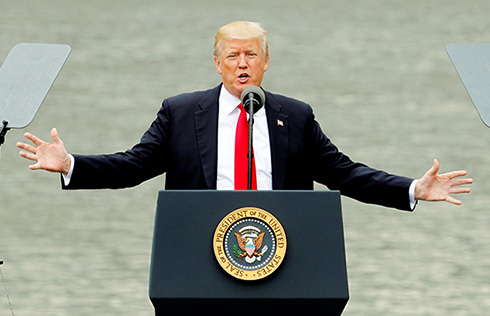
American allies are weighing what role the US will play in ongoing global trade negotiations.
Leaders of some of the 11 other economies besides the US in the Trans-Pacific initiative said they hoped to push ahead with some type of trade agreement. Australian Prime Minister Malcolm Turnbull said he had discussed the pact's future with the leaders of Japan, Singapore and New Zealand and believed it could survive without the US.
TPP was signed in 2016 by the US and 11 other Pacific Rim economies. The pact aimed to deepen economic ties between the economies by slashing tariffs and fostering trade to boost growth.
Wayne Morrison, a specialist in Asian trade and finance at the Congressional Research Service, said the idea of TPP was to create a "high standard" agreement that would focus on a number of issues important to the US economy, such as intellectual property rights protection and digital trade.
It was envisioned that other countries would join the TPP and that this would be a template for broader FTAs and eventually a multilateral agreement in the World Trade Organization.
?
"While some have argued that a US-led TPP was conceived as a strategy to counter growing Chinese economic influence, I believe that it was intended to draw China in as an eventual TPP member, because doing so could be a way to induce China to significantly reform its economy and reduce trade barriers," he said in an email.
"The economic implications of pulling out of the TPP are significant. There is now an issue of credibility for the United States because of the withdrawal from TPP and plans to renegotiate the North American Free Trade Agreement (NAFTA). Will countries still want to negotiate FTAs with the United States now? We will have to wait and see," Morrison said.
Jeffrey Schott of the Washington-based Peterson Institute for International Economics said that TPP is much more comprehensive than the existing trade pacts in terms of both trade liberalization and new rulemaking.
"So the US withdrawal means that American firms and workers will lose those additional benefits. And other TPP countries will lose the new opportunities created by the TPP in the US and other markets," he said.
Meg Lundsager, public policy fellow at the Wilson Center and a former US executive director at the International Monetary Fund, said Japanese officials hope to change President Trump's mind on TPP.
"That signals that Japanese leaders view TPP as very much to their country's benefit, although as far as bilateral trade goes, the US would have gained substantially by opening up Japanese agricultural and other markets, had the US ratified TPP," wrote Lundsager in an email.
"A US-Japan bilateral could start by replicating TPP terms. Mexico and Canada are very dependent on trade with the United States, with supply chains deeply linked across borders."
"When NAFTA renegotiation is raised, I suggest the US ask our two North American partners to agree to the terms in TPP. That could be a very quick negotiation and would benefit all three members," said Lundsager.
Schott noted that seven of the 12 TPP signatories already participate in the talks on RCEP, a proposed free trade agreement between the member states of the Association of Southeast Asian Nations (ASEAN) and the six states with which ASEAN have existing free trade agreements.
(China Daily USA?01/25/2017 page2)