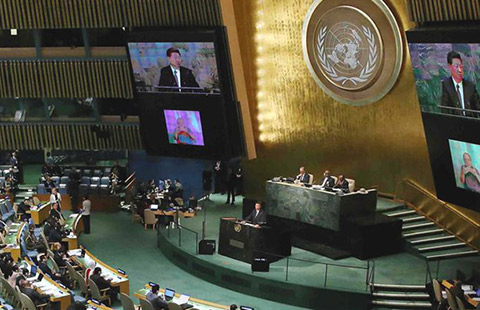
The Obama administration and its national security advisers, to a point, are responsible for the widening fissures in the Beijing-Washington partnership for safeguarding cyberspace. And as the top decision-maker of the US national strategy, Obama has failed to make insightful judgments on cybersecurity, especially on how to work with China without being distracted by domestic politics.
To better understand the China-US cybersecurity relationship, one has to understand both countries' comprehensive strategies and the ever-changing post-Cold War world order. In essence, the US-proposed free flow of data, along with and the de facto US control over multi-stakeholders' system, is designed to serve and strengthen the US' hegemony in cyberspace.
In contrast, reiterating its commitment to multilateral, democratic and transparent Internet governance that applies to all regions, China has made it clear that it wants to further the "new type of major-power relationship" with the US and pursue a higher level of multi-polarization in cyberspace. Xi's emphasis on better global cooperation and greater respect for sovereignty in the virtual world at the first World Internet Conference in Wuzhen, East China's Zhejiang province, last year is an apt example of China's commitment.
Beijing would like to see Xi and Obama succeed in making things right during their meetings later this month. But to rebuild mutual trust, Washington needs to make more efforts.
On one hand, the US has to stop being a cyberspace hegemony, and try to understand what the Internet really needs to work efficiently. On the other, it has to avoid being misled by some short-sighted, ill-intentioned American interest groups and seek revenge on China.
As two influential cyber powers, China and the US are supposed to work closely to resolve their disputes over cybersecurity, and that can be done only through efficient cross-border cooperation. In particular, to set a proper example for countries facing similar issues, the US should abandon its hawkish stance on China when it comes to cybersecurity and, instead, thrash out a benign cooperative mechanism.
The author is an associate professor in the Department of International Politics at Fudan University in Shanghai.
Related Stories
Copyright 1995 - . All rights reserved. The content (including but not limited to text, photo, multimedia information, etc) published in this site belongs to China Daily Information Co (CDIC). Without written authorization from CDIC, such content shall not be republished or used in any form. Note: Browsers with 1024*768 or higher resolution are suggested for this site.
License for publishing multimedia online 0108263 Registration Number: 130349