The anti-fascist front
 |
|
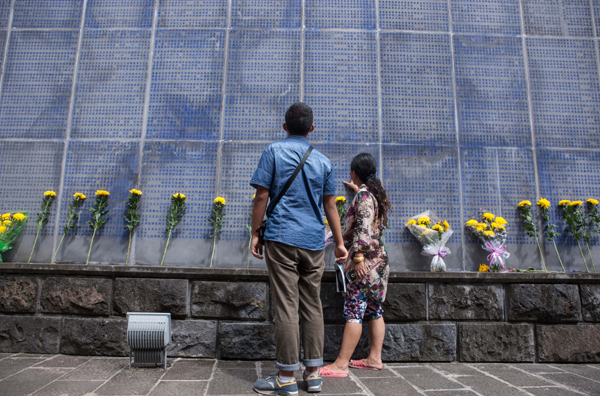
Visitors read the names of the heroes of the China Expeditionary Force at the cemetery. [Photo/Xinhua] |
The outbreak of the war in the Pacific in December 1941 saw the Japanese launch attacks across Southeast Asia. They quickly occupied several countries, including the Philippines, Thailand and Malaysia, and also threatened the safety of Myanmar (then known as Burma) and Southwest China.
"On Jan 1, 1945, China, the United States and 24 other countries reached an agreement to establish an international anti-fascist front. In March, the 100,000-strong CEF was formed to fight alongside the British army in Myanmar and to defend China's southwestern regions," said Wu Baozhang, professor of history at Yunnan Normal University.
"However, misunderstandings and mutual suspicions hindered the operations, and the expedition failed. The CEF was forced to withdraw to India, which meant Myanmar and large parts of western Yunnan fell into Japanese hands," he added.
The situation entered a stalemate as Chinese and Japanese forces faced each other across the Nujiang River until the middle of 1944.
"May 1944 to January 1945 was the time of the great counterattack. About 200,000 soldiers, mainly from the (Kuomintang) 11th and 20th group armies, re-formed the CEF to launch a counterattack. After more than eight months of fierce fighting, the CEF successfully performed a pincer movement with US troops and retook Mongyu, a town in Myanmar, on Jan 27. That marked the final victory in the war in Dianxi," Wu said.
The Battle of Laifeng Mountain is one of the best-known encounters from the period.
According to Li, military archaeologists began excavating the mountain's old defenses in November. "So far we have excavated four Japanese frontline positions, which have been codenamed 'Pine', 'Bamboo', 'Plum' and 'White Tower'," he said.
"In addition to bomb craters, three trenches and a number of pits used by the CEF, we have found many spent bullets, shell cases and bombs. Some of them are displayed at the Dianxi Anti-Japanese Memorial Hall," he added.
The differing sizes, shapes, directions and depths of the trenches suggest that they had different functions, indicating that the Japanese had prepared fully for the forthcoming battle, according to Li.
"Thanks to the valor of the men involved and the cover provided by the US air force, the Japanese were kicked off the mountain after three days of intense fighting," he said.
"The mountain was the Japanese army's last line of defense at Tengchong, and the retaking of the mountain was a major step toward recapturing the entire county. Tengchong was founded during the Ming Dynasty (1368-1644), and most of the buildings were made from stone, not wood. Once the Japanese had fortified the buildings, the county became a fortress. The CEF paid a high price in deaths and casualties to regain control," he said.
A cemetery at the northern foot of Laifeng Mountain, about 200 kilometers from the China-Myanmar border, contains rows of tombstones that bear the names and ranks of the dead.
The 53,300-square-meter grave-yard, which was opened in 1945, is the final resting place of the 10,000 CEF troops and 19 US liaison officers who died in the battle to retake Tengchong. Their bodies were cremated en masse, and the ashes were buried on the summit near a small monument.
Wu said the victory inspired the CEF troops. "Tengchong was the first county to be recaptured from the Japanese during the invasion, which was a great boost to the soldiers' confidence."
The victory was anything but easy, though. The two armies engaged more than 40 times in 127 days, resulting in the deaths of 7,757 Japanese troops.

Copyright 1995 - . All rights reserved. The content (including but not limited to text, photo, multimedia information, etc) published in this site belongs to China Daily Information Co (CDIC). Without written authorization from CDIC, such content shall not be republished or used in any form. Note: Browsers with 1024*768 or higher resolution are suggested for this site.
License for publishing multimedia online 0108263 Registration Number: 130349