The ancient Silk Road that originated in China spurred many great contributions to the world through the linkages it created between the civilizations along its route.
The Silk Road began in China's ancient capital of Chang'an - today's Xi'an in Shaanxi province - and covered more than 4,000 kilometers within China. The road then continued westward through India and onward to Turkey and the eastern coast of the Mediterranean, providing access to ancient Rome.
The Silk Road served as an important bridge between the East and West, facilitating economic and cultural exchanges between the Chinese, Indian, Persian, Arab, Greek and Roman civilizations.
In the 21st century, we are looking at a revival of this ancient trade route with China's Belt and Road Initiative - the Silk Road Economic Belt and the 21st Century Maritime Silk Road - which would see linkages on both land-based and sea-based routes.
The Silk Road Economic Belt would link China with Europe through Central and Western Asia, while the 21st Century Maritime Silk Road would link China with Southeast Asian countries, Africa and Europe. Whether to develop their economies, improve citizens' livelihoods or deal with crises, many countries share common interests. The Belt and Road Initiative is intended to promote these two new Silk Roads and help serve the common interests of the connected countries.
Country's boom
Located on the ancient Silk Road, Turkey is sometimes referred to as "the cradle of civilizations" because of the ancient Mesopotamian civilization that thrived there.
Modern-day Turkey can lay claim to 13 major civilizations on its land over a period of 6,500 years, with the more recent ones including the Byzantine and Ottoman Empires. Its geographical position is very important as it is at the crossroads of Europe and Asia.
Turkey has just begun in recent years to realize the true value of its position in the world.
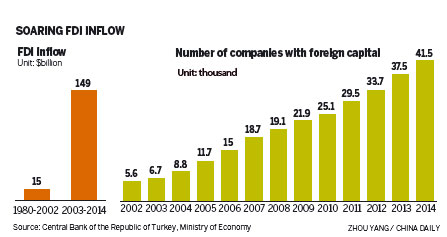
Turkey rebounded amazingly well from a financial meltdown at the start of this century. Subsequent economic reforms led to an economic boom with per capita gross national product jumping from $3,492 to $10,404 between 2002 and 2014. From 2003 to 2014, Turkey attracted $149 billion in foreign direct investment. The number of foreign-funded businesses now exceeds 40,000.
Opportunities
Turkey's land area is more than 780,000 square kilometers and it has a population of over 77 million. Turkey boasts a young population with a national average age of 30 years.
In order to accelerate economic development through FDI, then Turkish Prime Minister Recep Tayyip Erdogan established the Investment Support and Promotion Agency of Turkey in 2006. ISPAT's main work is to promote investment opportunities in Turkey to the global business community and to assist companies and individuals before, during and after their investment by providing support and assistance at government level.
Turkey is now considered one of the world's most promising market centers. Within four hours by air from Istanbul one can reach more than 56 countries with a combined population of 1.5 billion and combined GDP of $26 trillion.
With the centenary of the founding of the Republic of Turkey fast approaching in 2023, the Turkish government introduced a 10-year master plan in 2013 that it dubbed the 2023 Vision. This plan calls for an increase in GDP from its current $800 billion to $2 trillion by 2023 and a per capita GDP rise from the current $10,404 to $25,000.
Detailed plans have been made for many of Turkey's sectors, including infrastructure, energy, medicine, education, manufacturing and tourism. The government has earmarked $100 billion for mega projects such as a third airport in Istanbul, a third bridge across the Bosphorus, a canal connecting the Black and Marmara seas, and a major expansion of highways and the rail network.
In the energy sector, Turkey plans to add 10,000 megawatts of capacity to its grid through the construction of three nuclear power plants. It will also bring online the Trans-Anatolian Natural Gas Pipeline in 2018, which should reach a maximum annual discharge of 180 billion cubic meters. Total installed power generation capacity will rise from 60,000 mW in 2014 to 120,000 mW in 2023. Renewable sources such as hydroelectric, wind, solar and geothermal energy will feature prominently in the expansion of Turkey's power generation capabilities. Total investment in the energy sector is expected to reach $130 billion.
Turkey-China ties
Turkey is very much aware of the geopolitics of the region and its relations with neighboring countries are based on the principles of mutual respect and total development.
Turkey and China, despite being far apart geographically on the Asian continent, have historically maintained close contact. In the past 10 years the rapidly growing bilateral relations have entered a new stage of strategic partnership.
In recent years, the rapid growth of trade has been a remarkable achievement. Bilateral trade volume soared from $1.2 billion in 2000 to $28 billion in 2014. By 2013, China had become Turkey's second-largest source of imports after Russia, and its third-largest trading partner overall. In the first quarter of 2015, bilateral trade amounted to $6.97 billion.
At the APEC Summit in November 2014, President Xi Jinping urged more economic integration among the APEC members and referred to China's Belt and Road Initiative as a means to promote this integration.
Xi announced China would contribute $40 billion towards a Silk Road infrastructure fund. The Silk Road fund would provide investment and financing support to countries along the proposed route for projects related to infrastructure, resource development and industrial cooperation. This was good news for the Chinese businesses that were considering investments in Turkey.
Turkish President Recep Tayyip Erdogan arrived in China on Tuesday. We sincerely hope that this visit will be a new milestone in the development of relations between the two countries. It will also be an opportunity to further enhance and strengthen bilateral cooperation. We welcome and look forward to meeting more and more Chinese enterprises wishing to invest in Turkey.
This article is provided by the Investment Support and Promotion Agency of Turkey.
|
A transcontinental city in Eurasia, Istanbul is the largest city in Turkey, constituting the country's economic, cultural and historical heart. Provided to China Daily |
(China Daily 07/30/2015 page6)
Copyright 1995 - . All rights reserved. The content (including but not limited to text, photo, multimedia information, etc) published in this site belongs to China Daily Information Co (CDIC). Without written authorization from CDIC, such content shall not be republished or used in any form. Note: Browsers with 1024*768 or higher resolution are suggested for this site.
License for publishing multimedia online 0108263 Registration Number: 130349