President takes detour on state visit to France
Updated: 2014-03-21 08:14
By Li Xiang in Paris (China Daily Europe)
Comments Print Mail Large Medium Small
|
The campus of the Sino-French Institute in Lyon. President Xi Jinping will visit the institute during his state visit to France. Li Xiang / China Daily |

Xi Jinping's first stop will come as a surprise to many
When Chinese President Xi Jinping arrives in France on a state visit on March 25, he won't be headed to the Elysee Palace; instead, his first destination is a humble university residence in Lyon.
The choice may seem puzzling, but those familiar with Lyon's historic connection with China will immediately understand.
The Sino-French Institute was located there from 1921 to 1946 and hosted nearly 500 Chinese students who went there to study, hoping to modernize their own country by learning from the West.
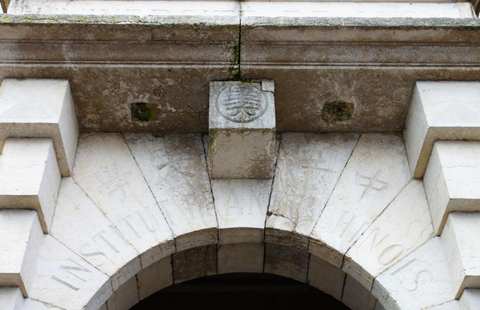
Today the golden characters of the institute's name carved in stone above the main entrance are still clearly visible. And the appearance of the yellow brick buildings of the old dormitories has barely changed since the early 1920s.
Chinese students in France in the 1920s included the future leaders Zhou Enlai and Deng Xiaoping; the future vice-premier and foreign minister Chen Yi; one of 10 marshals of China, Nie Rongzhen; and one of the earliest leaders of the Communist Party of China, Cai Hesen. They were frequent visitors to Lyon, drawn to the institute to engage in discussions about political ideas and to contribute to local student movements.
A Sino-French institute in the city was first proposed in 1919 in a meeting between Chinese social activist Li Shizeng, who was the initiator of the Work and Study Movement in France, and Paul Joubin, the dean of the University of Lyon. The period after World War I was a time when new ideas were flourishing in China and young students were looking to the West for ideas on modernizing and revitalizing the country.
The institute's founders chose Lyon largely because of its special ties with China over hundreds of years. The city has long been considered the western end of the Silk Road because of its textile trade and commercial relations with the East. It was also the first French city to introduce courses on Chinese literature at university level, in 1913.
Christophe Meunier, deputy director of the international relations office of Lyon, says: "Lyon has always played a role in disseminating Chinese culture in Europe as it used to be the first city that translated Chinese documents into French and European languages."
After the institute opened, it served more as a preparatory school than a university, where Chinese students studied basic French language, history and science as they prepared to enter French universities.
To many, the institute is a remarkable example of the city's close ties and long-lasting friendship with China as many of the graduates returned to China and later become the elite of the country in fields such as literature, art, economics and engineering.
Although the Sino-French Institute has ceased to function as an educational entity, its buildings continue to provide accommodation for a rapidly growing number of international students from China and the rest of the world.
About 3,000 Chinese students are enrolled in universities and higher educational institutions in greater Lyon. China will be the main source of international students in the city in the coming academic year, Meunier says.
Liu Yinan, a third-year college student who resides in one of the dormitory buildings of the institute for a university exchange program, says: "My Chinese classmates and I were unaware of the existence of the institute and its history until we arrived here. I feel honored to be studying and living in a place Zhou Enlai and Deng Xiaoping frequently visited."
The institute was closed after World War II mainly due to financial difficulties. But the documents, books and periodicals in it were later transferred and kept at the municipal library of Lyon, valuable references for scholars, researchers and the public to study China in the first half of the 20th century.
The local tourism office has initiated a project to promote the institute as a tourist attraction, and guided tours are now offered.
Meunier says that he hoped Xi's visit would help trigger a number of new initiatives dedicated to China in Lyon.
"We know that the site where the institute is located has a lot of significance to the Chinese people. We have decided to make the old student activity hall of the institute into a center dedicated to promoting relations between Lyon and China," he says.
"People from economic, cultural and academic circles could come over here to attend special activities, conferences and workshops with the themes related to China," he says.
lixiang@chinadaily.com.cn