

From mainland to 'made in Vietnam'
Updated: 2014-04-10 07:11
By Emma Dai (China Daily)
|
||||||||||


"We can't find enough pairs of hands even with our levels of pay," he said.
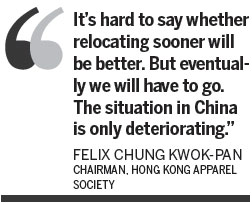
Meanwhile, an appreciating currency is biting into profits. The yuan has risen more than 30 percent against the US dollar from 2005. Although there was an adjustment during the Spring Festival, the Chinese currency is still expected to rise in the medium to long term. "The impact is huge. We are taking in US dollars and paying out yuan," Chung said.
|
 |
 |
Many former fellow entrepreneurs in Dongguan have now departed, leaving empty factory buildings behind - and a lot of them are seeking new bases in Southeast Asia, Chung said, adding that those staying are mostly downscaling their operations.
Although Southeast Asia has been on the radar of manufacturers for many years and there are many choices for relocation, it is challenging trying to identify a clear winner.
"The situation is evolving very fast," said Dickson Ho, principal economist at Hong Kong Trade Development Council. "I would have recommended Cambodia two years ago, but the country has been trapped in nationwide strikes since October. People died in clashes with police in January. And now another major strike is looming."
Common wisdom dictates it takes four to five years for a new factory to break even. Investing demands a deliberated decision. Ho indicated it's important to assess rates of wage growth, which lead to cost pressures. It's also critical to know whether they will transform into counter-productive behavior - for example, stealing during strikes, which puts factories in great danger.
"A stable environment is critical," Ho said. "The government should control the influence of labor unions and wages. Changes should not affect daily operations. But when salaries cannot keep pace with inflation, there will be a problem. You have to raise wages in those instances.
 "In the past year, Vietnam has become more attractive as a low-cost production base in the region. Many Hong Kong manufacturers have moved to Indonesia, too. But Vietnam is much closer. Hanoi is less than two hours by air. It's also convenient to visit by highway from the Guangxi Zhuang autonomous region."
The minimum monthly wage in Vietnam was raised at the end of 2013 to around $130.
"It's higher than Cambodia and Myanmar, but Vietnam's advantage is stability. There are fewer strikes. Furthermore, salaries there are not shooting up as fast as other countries," Ho said. "In the future, when environmental rules become stricter in China, some processes involved in making garments such as washing and dyeing may move there.
"It's not just Hong Kong factories: Some large mainland weaving mills were also moved last year to Mong Cai, a coastal border city in northern Vietnam. It's easy to arrange a supply chain. The owners plan to make cloth from spinning there so the product can be recognized as of Vietnamese origin and enjoy preferential tax policies in trade with the United States under the Trans-Pacific Partnership."
Having been in the Pearl River Delta for so many years, relocation is not an easy task. There, all supporting facilities are at hand - at a price. They will have to be rebuilt from scratch.
"Many manufacturers actively considered relocation last year, but many also chose to wait and see," Ho said. "Three decades ago they were in their 30s and 40s. Now they are too old. It's impossible to carry on if the younger generation is not willing to take over or trustworthy managers are too hard to find."
|
 |
 |
| China's top 10 richest cities |