 |
|
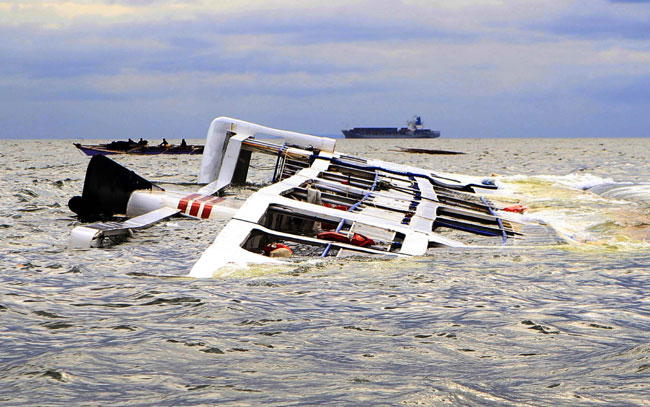
A fishing boat passes the Super Shuttle Ferry 7 which capsized in strong winds and huge waves unleashed by Typhoon Kalmaegi, locally named Luis, in Manila Bay September 15, 2014. All 15 crew of the ferry were rescued. A strong typhoon slammed into the rice-producing Philippine northern region on Sunday, cutting power and communications lines and forcing people to flee to higher ground, national disaster agency officials said. [Photo/Agencies] |
It wasn't the first typhoon to cause devastation and certainly won't be the last. So, who names typhoons and what's the reasoning behind the process?
The word typhoon is an alteration influenced by Cantonese daaih-fung (daaih big + fung wind) of touffon, an Arabic word, according to Merriam-Webster dictionary.
But the word typhoon is not used universally.
In the Atlantic and Northeast Pacific, the phenomenon is termed "hurricane." The same type of disturbance in the Northwest Pacific is called a "typhoon" and in the South Pacific and Indian Ocean it is known as a "cyclone."
Whatever it's called, the basic characteristics are same: a pre-existing weather disturbance, warm tropical oceans, moisture and relatively light winds. When these ingredients mix with the right conditions, they result in stormy winds, huge waves, rain and floods.
These storms used to be named based on latitude and longitude of the location. Then they began to be termed arbitrarily. For instance, a storm in the Atlantic was named after a boat whose mast was ripped apart by the accompanied wind. After that they began to call Atlantic storms by feminine names.
Since these naming conventions were not efficient and organized, meteorologists started looking for a more seamless process for the Atlantic storms. They finally decided to use names alphabetically. Which meant the first typhoon of the year began with A.
The list of the names is maintained and updated by the World Meteorological Organization, which uses six lists in rotation. Due to the rotation process, the list is repeated every six years.
While Atlantic storms follow this process, tropical cyclones are named under a completely different structure.
In the Western North Pacific and South China Sea, it's the Regional Specialized Meteorological Center in Tokyo that names a tropical cyclone from a list of names that is maintained by all countries in the zone. Some of the nations that contribute names to the list are: China, United States, Japan, Thailand and Malaysia.
Unlike Atlantic storms that are named alphabetically, tropical storms in this region are named sequentially. For example, if the last storm was called Fengshen then the next one will be identified based on the name listed after Fengshen, which in this case is Kalmaegi.
The center in Tokyo only names those cyclones that are of tropical strength or above. The reason why typhoons, hurricanes and cyclones are given names is because it makes it easy for media to report, for alerts to be issued and to help those living in the danger zone to be prepared.
While most names are repeated after a certain period, some are never used again if the storm associated with the name was devastatingly destructive.
Some of the names to have been consigned to history due to their sensitivity include Katrina, a hurricane that left a trail of destruction and death in 2005, and Mitch, a hurricane that devastated Honduras in 1998.

Copyright 1995 - . All rights reserved. The content (including but not limited to text, photo, multimedia information, etc) published in this site belongs to China Daily Information Co (CDIC). Without written authorization from CDIC, such content shall not be republished or used in any form. Note: Browsers with 1024*768 or higher resolution are suggested for this site.
License for publishing multimedia online 0108263 Registration Number: 130349