|
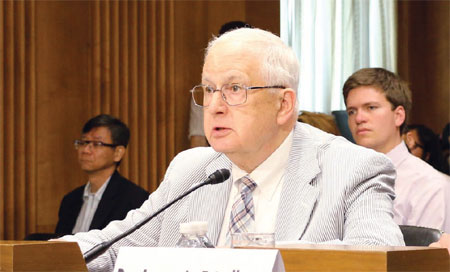
J. Stapleton Roy, the former US ambassador to China, talks about the future of US-China relationship at a hearing before the US Senate Foreign Relations Committee in Washington on June 26. Chen Weihua / China Daily |
Born and raised in China, Roy knows the 5,000-year-old Asian nation far better than most Americans.
"When you would like to see changes in other countries, where you have only very limited ability to actually force them to make the change you would like to see, you need to have patience," Roy told the senators in a hearing on the future of US-China relations on June 26.
To Roy, it is natural that only countries that produce intellectual property are the ones most devoted to protecting it, and countries not producing intellectual property tend to rip off others. And he has witnessed this in his life-long diplomatic missions to other places.
However, Roy is optimistic in the long term that China will move toward great respect for intellectual property. "Because unlike some of the countries I have served in, China has big ambitions about becoming a creator of intellectual property. And if you create intellectual property, you cannot do so effectively if you don't protect it," said Roy, now a distinguished scholar at the Washington-based Kissinger Institute on China and the United States at the Wilson Center.
He said that companies, such as Microsoft Corp, have witnessed the progress China has made in that regard, although the progress is not enough.
The 79-year-old believes it's unrealistic to expect things to change overnight. He cited slavery, a gross violation of human rights once embedded in the US Constitution. It took more than a century to change that after failed political process and bloody civil war.
"If United States takes centuries to improve and deal with fundamental human rights problems, why should we expect other countries to deal with them overnight," he said, recalling his days as ambassador to China in the early 1990s when the US linked Most Favored Nation trade status to China's human rights, demanding major improvements in seven areas in one year.
"If other countries set the goal during the 19th century of forcing the US to give up slavery, would it have been helpful? What actions would they have taken?" he asked.
Roy believes that Britain, which abolished slavery in 1833, had set a behavior pattern that influenced thinking in the US. "I have found that power of example is much more useful in dealing with other countries on human rights issues, on intellectual property right protection issues, than simply haranguing them," he said.
The US has been under attack for its human rights practices on multiple fronts lately, from drone attacks that violate other countries' sovereignty and killed innocent civilians as collateral damage to the Guantanamo detention center where prisoners are held without trial to racial disparities in its criminal justice system. These issues were mentioned in a blistering report by the United Nations Human Rights Committee in March this year on the US government's role in perpetuating injustices both within its borders and abroad.
In China, Roy has seen exciting signs following the Third Plenum of the 18th Communist Party of China Central Committee last November, when words like checks and balances, rule of law and putting power in a cage are used.
He believes generational change in China, where more young people are educated in the West, will have a profound impact on the society in the long term.
"But we're talking about changes in a period of decades. That's why I talked about the need for patience and perseverance in dealing with China," he told the lawmakers.
Roy is among the first who have shown deep concern for the growing strategic rivalry between China and the US. But he feels fortunate that top leaders in both countries have concluded that unchecked strategic rivalry between the two countries is not in the interest of either.
"They have set the strategic goal of striking a stable and sustainable balance between competition and cooperation in the US-China relationship," he said.
The message was reflected this week in both Presidents Xi Jinping and Obama's messages to the sixth China-US Strategic and Economic Dialogue (S&ED) held in Beijing. Both emphasized the importance of building a new type of major country relationship by expanding practical cooperation and effectively managing differences.
To Roy, conventional diplomacy will not be sufficient to limit and hopefully reverse the strategic rivalry and avoid the historical pattern of confrontation between rising powers and established powers.
"After all, it is the normal responses of human nature that have led to confrontation throughout history," he said, citing the unfolding crisis in Europe over Ukraine and the growing tensions between China and Japan.
Roy described it as "unconventional behavior" on the part of China and the United States 42 years ago that achieved the breakthrough and led to the establishment of their diplomatic ties.
He also saw that type of unconventional behavior in Chinese leader Deng Xiaoping. "It took a leader of Deng Xiaoping's courage and foresight to state 35 years ago that territorial problems between China and Japan are too complicated for the current generation to handle and should be left for future generations to resolve," he said.
By taking that unconventional approach, Roy said Deng helped achieve a positive development of China-Japanese relations over the next quarter century. "We need to be equally daring in our approach to stabilize our relations with China," he said.
Just a week before Roy's testimony before the Senate Foreign Relations Committee, he wrote an op-ed article on the Huffington Post, arguing that the "American Dream "and China Dream" are compatible.
To Roy, the China Dream talked about by Xi for the rejuvenation of the Chinese nation is not a new departure.
"For over a century, the dream of Chinese reformers has been to restore the country's wealth and power, not so that China could aggrandize itself at the expense of other countries but so that it could protect itself, restore national dignity, and ensure the economic security for its people," he said.
Roy said for many decades this dream remained a vain hope and it is only in recent years that the realization of the Chinese dream of a strong nation and a prosperous people has come within China's grasp.
Born as the son of an American missionary in China in the 1930s, Roy grew up in western China during the turmoil of World War II. He was a high school student in Nanjing and Shanghai during China's civil war and communist revolution and left the country only after the eruption of the Korean War.
Roy returned to China during the upheavals of the "culture revolution" (1966-76), accompanying three US Congressional delegations. He later lived in Beijing for seven years as a US diplomat.
"China's bumpy road to modernity has been filled with pitfalls, but the contrast between the poverty and misery of my early years in China and the rising prosperity one now sees throughout the country is astounding," he said.
Roy is aware that people in both nations worry whether Chinese and American dreams are compatible. He likes the concept of a new type of relationship, describing it as a "difficult but achievable task".
"We must constantly ask ourselves: Are Chinese and American dreams more likely to be compatible if we let differences dominate the relationship or if we expand cooperation, contain frictions, and build on common interests," said Roy.
"The noblest dream of any country is to have strength that contributes to the peace, security, wealth and happiness of all nations. That is the dream that China and the United States should share."
chenweihua@chinadailyusa.com

Copyright 1995 - . All rights reserved. The content (including but not limited to text, photo, multimedia information, etc) published in this site belongs to China Daily Information Co (CDIC). Without written authorization from CDIC, such content shall not be republished or used in any form. Note: Browsers with 1024*768 or higher resolution are suggested for this site.
License for publishing multimedia online 0108263 Registration Number: 130349