|
|
Protesters rally in Tokyo on Thursday against a plan to reform Japan's Constitution to allow military involvement in overseas conflicts. [Photo/Agencies] |
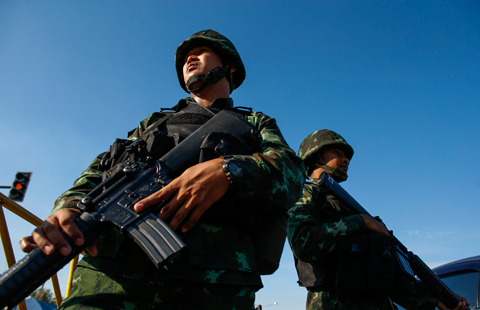
Japanese soldiers may need to brace themselves for the prospect of death or injury abroad, as Japan's prime minister, Shinzo Abe, is pushing hard for changes to the country's pacifist Constitution that would allow collective self-defense through renewed military forces.
That prospect has been met with consternation not only by many in Japan but also the international community because of its serious regional and global implications.
In a report submitted to Abe on Thursday by his hand-picked Advisory Panel on Reconstruction of the Legal Basis for Security, the Japanese government was called upon to change the definition of "international disputes" in Article 9 of the Constitution to "international armed conflicts in which Japan itself is directly involved".
The change would relax the supreme law's ban on military action overseas and open Article 9 to interpretation by political leaders, such as the Cabinet, experts say. For example, collective security measures taken under United Nations Security Council resolutions could be viewed as falling outside the category of direct involvement.
In urging the Abe Cabinet to reinterpret the Constitution, the report cited as potential threats China's increasing defense spending and the development of ballistic missiles by the Democratic People's Republic of Korea.
The report proposed that the Japanese government should participate in the implementation of UN resolutions calling for countries to join hands in imposing sanctions on those that disrupt peace.
If the definition of "international disputes" is changed to "conflicts in which Japan itself is involved", Japan's Self-Defense Forces will be able to take part in all punitive military activities, including combat operations, in many disputes to which Japan itself is not a party.
Abe faces challenges from his opponents, including the Democratic Party of Japan, the Communist Party of Japan and the Social Democratic Party.
"This is a big issue that concerns debates on Japan's security after World War II," Hiroshi Hoshi, senior staff writer at The Asahi Shimbun, wrote in Weekly Toyo Keizai.
Based on the new interpretation, Japan will revise the guidelines of its security cooperation with the United States, on the premise that Japan can increasingly defend itself, Hoshi said.
The right to collective self-defense, which could place Japanese soldiers in battles overseas, has triggered protests by Tokyo residents as well as legal scholars aghast at the idea of undercutting the law that has maintained Japan's peace since 1945.
It also arouses the concern of Asian neighbors, including China and the Republic of Korea, which were devastated by Imperial Japan's aggression in the 1930s and 1940s.
Chinese Foreign Ministry spokeswoman Hua Chunying said on Thursday that Asian countries have very good reason to be suspicious of the true motives behind Japan's unprecedented activity on the military front since Abe took office.
Liu Junhong, a researcher at the Japan Institute of the China Institute of Contemporary International Relations, said Abe is actually taking steps to "return to the starting point", to revive the glory of the prewar Japanese army and overthrow the pacifist constitutional system and even the postwar order.
"Japan's repeated calls for a 'normal' country have revealed its untold ambition in denying and getting rid of all that has been imposed by the international community after World War II," Liu said.
Lyu Yaodong, a researcher on Japanese studies with the Chinese Academy of Social Sciences, said the junior ruling partner in Japan, the New Komeito Party, may take some measures to lobby the Cabinet to tweak or give up the plan.
Yet it is "unlikely" that New Komeito - a minority in the parliament and even in the ruling coalition - will be able to finally stop the ambitious Abe and his Cabinet from reinterpreting the constitution, Lyu said.
Meanwhile, "the Self-Defense Forces have initiated a range of publicity campaigns domestically and overseas - including promotional videos - to boost its image," Lyu said. "This serves as a part of Abe's diplomatic initiative to beautify his security slogan of 'proactive pacifism'," Lyu said.
Contact the writers at caihong@chinadaily.com.cn and zhangyunbi@chinadaily.com.cn

Copyright 1995 - . All rights reserved. The content (including but not limited to text, photo, multimedia information, etc) published in this site belongs to China Daily Information Co (CDIC). Without written authorization from CDIC, such content shall not be republished or used in any form. Note: Browsers with 1024*768 or higher resolution are suggested for this site.
License for publishing multimedia online 0108263 Registration Number: 130349