Miguel de Cervantes, Spain's greatest writer, was a soldier of little fortune. He died broke in Madrid, his body riddled with bullets. His burial place was a tiny convent church no larger than the entrance hall of an average house.
No more was heard of the 16th-century author until the rediscovery of a novel featuring an eccentric character called Don Quixote rescued him from oblivion.
By then, nobody could remember where his grave was. Four centuries later, Spain intends to do the great man justice.
A team that will search for Cervantes' remains began excavations on Monday and final conclusions - should the search succeed - will be known by the end of the year. The estimated cost of the operation is 100,000 euros ($139,000).
A three-phase search will take place at the Convent of the Barefoot Trinitarians in Madrid's historic Barrio de las Letras - or Literary Quarter.
When Cervantes moved to Spain's capital in 1606, he had already published the novel that was to change Spanish literature - The Adventures of the Ingenious Nobleman Don Quixote of La Mancha.
Although the book enjoyed some success, it did not make him famous - the author was better known in Spain as an ill-fated soldier.
Cervantes had been wounded in battle and spent years captive in Algiers. He had been seized by Turkish pirates who boarded the ship on which he was returning to Spain after fighting in a war against the Ottoman Empire.
The Trinitarian order negotiated his release and helped pay a ransom that ruined Cervantes' family.
Cervantes was compelled to live as an errand-runner for the convent to give thanks for his deliverance.
He lived in a neighborhood of narrow streets, small houses and taverns full of artists and hustlers, where wine flowed and tapas were served. Other authors of Spain's golden age of literature, such as Francisco de Quevedo, Lope de Vega and Luis de Gongora, ignored him.
In 1616, at the age of 69, he was buried. Years later the chapel was expanded to its current - still modest - proportions.
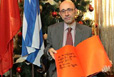
Fernando Prado, the historian in charge of the project, said just five people, including a child and Cervantes, are buried there.
"We know he is buried there," Prado said. "History teaches us that churches never throw bones away. They might relocate them under roofs and vaults if necessary, but no one would dare throw them into a common ossuary."
The first phase of the search will consist of underground exploration using radar, with radar operator Luis Avial saying, "We will clearly see if there is altered terrain that will give us clues." His report will be ready in a month.
The investigation will then turn to Spanish forensic anthropologist Francisco Etxeberria, who took part in the autopsy that confirmed the suicide of former Chilean president Salvador Allende.
Forensic identification will be the last - and possibly most delicate - part of the process. Any bones found may have been mixed up. Prado said that with no living Cervantes descendants, DNA analysis is unlikely to lead anywhere.
The investigation will refer to the author's portraits and his own stories, in which he relates that shortly before dying he only had six teeth.
But the most obvious marks will be the battle wounds that Cervantes sustained. In 1571, the writer was wounded in the Battle of Lepanto, which pitted Ottoman Turkish forces against the Holy League, led by Spain. Aboard the ship La Marquesa, Cervantes was hit by three musket shots, two in the chest and one in his hand.
He spent several months in a hospital in Sicily, but managed to recover.
Although historic texts often speak of the "one-armed man of Lepanto," doctors never amputated his limb. He did, however, completely lose its use.
Should the bones be found, they will be returned to the church. "He will be reburied there, but with a plaque to remember his name and who he was," Prado said.

Copyright 1995 - . All rights reserved. The content (including but not limited to text, photo, multimedia information, etc) published in this site belongs to China Daily Information Co (CDIC). Without written authorization from CDIC, such content shall not be republished or used in any form. Note: Browsers with 1024*768 or higher resolution are suggested for this site.
License for publishing multimedia online 0108263 Registration Number: 130349