Comments
  Print
Print  Mail
Mail  Large Medium Small
Another year, another Davos. Last year's World Economic Forum was overwhelmingly about Europe's existential crisis. But Europe has quieted down, at least for now, and so we're entering the first non-crisis Davos in years. But that doesn't mean things have settled into, as Mohamed El-Erian puts it, a 'new normal'. It remains difficult to find markets with good risk/return, or an area of the world without serious geopolitical tensions. Faced with this 'new abnormal', where the only certainty is that shocks will arise from unexpected places, what is this year's Davos about?
Everything and nothing. The United States, the Middle East, emerging markets, Japan - all of these are on the agenda, but they're not all necessarily connected. The emissaries at Davos are in the midst of their own locavore movement - their agendas are remarkably domestic.
Faced with this, the World Economic Forum has made its 2013 theme "resilient dynamism". According to the WEF, in the wake of turmoil, successful organizations "demonstrate strategic agility" and "possess risk resilience," prepared for whatever new risks might emerge. The idea is that when there's too much uncertainty in the world, too much volatility, too much new, you should be sure you can adapt quickly to the unknown. At least, this is what good institutions - be they companies, countries, etc. - should strive for.
This idea of "resilient dynamism" is strikingly similar to Nassim Nicholas Taleb's concept of "antifragility," which I wrote about last week. As emerging markets lead us into the future, they're leaving questions in their wake about just how antifragile, or resiliently dynamic, they are. How flexible and assertive can developing countries be when many of them are saddled with paranoid, foundering, or challenged regimes?
So what is the greatest threat to these emerging economies and to political and business leaders who are gathered in Davos?
The spread of information, and the difficulty in controlling it.
Ironic, then, that this is the most interactive WEF I've ever been to. One of the first things you notice when you arrive in Davos is a massive screen displaying the tweets of all those present, with a leaderboard for those squawking the most (I plead guilty on this front). The major panels are streaming on the WEF's website. There is even an iPhone app for events this year.
The WEF's embrace of all this interactive gadgetry reflects the extent to which technology has transformed the political and economic environment for everyone present. Just look at the havoc (and freedom) information has wrought. The News Corp phone-hacking scandal showed how an unscrupulous lust for news can become the news itself. In India, widespread reporting on a gang rape has led to massive protests that have convulsed the country, forcing the government to address deeply-ingrained gender inequality in Indian society.
It's when inequality is mixed with the spread of information that things become the most volatile. The political, economic, and media elites in Davos are increasingly seen as not serving their constituents well. Growth in GDP, profits, and consumption is not translating into increases in quality of life. Just because economies have recovered from the financial crisis does not mean that they've bridged the income gaps that were created during the boom and laid bare during lean years. Whether it be the increase in US corporate profits despite stagnant wages, or the culture of ignorance that allowed a wealthy BBC newscaster to take advantage of helpless girls, the flow of information can have severe - and often unpredictable - impacts.
The test going forward, then, is how the countries and companies represented in Davos respond to this new, riskier environment. They'll need resilient dynamism themselves in this era of increasingly vulnerable leaders.
Special coverage:

 The world in photos: May 29 - June 4
 Beijing puts its best foot forward on Belt and Road
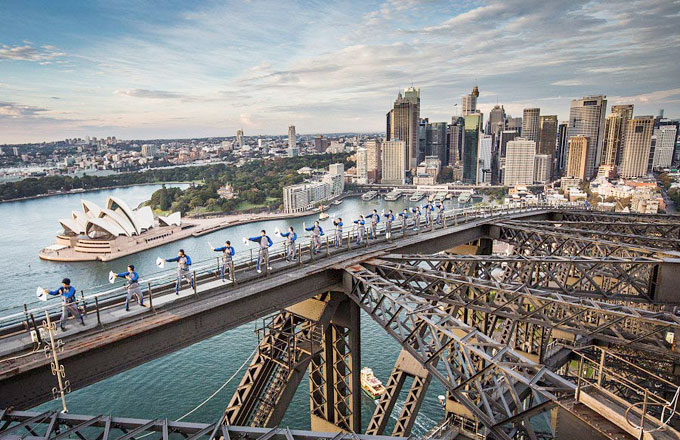 Tai chi takes over Sydney Harbour Bridge
 World in photos: April 24 - May 1
 Chinese ships pay visit to Philippines
 Princess Charlotte about to turn 2
 Cherry blossoms in full bloom in New YorkMay 'not in different galaxy' over Brexit
 Incredible! Australian girl with cerebral palsy climbs Great Wall
 Baby Asian elephant train for release into the wild
 UK voters head for polling booths as country's general election gets under way
 Polls on eve of UK election suggest PM May will boost majority
 Nadal into French Open semi-finals, Thiem dismantles titleholder Djokovic
 China beats Switzerland 3-0 at Montreux Volleyball Masters


Copyright 1995 - . All rights reserved. The content (including but not limited to text, photo, multimedia information, etc) published in this site belongs to China Daily Information Co (CDIC). Without written authorization from CDIC, such content shall not be republished or used in any form. Note: Browsers with 1024*768 or higher resolution are suggested for this site.
License for publishing multimedia online 0108263 Registration Number: 20100000002731