City of hidden charms


To avoid the touristy crowds and the hustle and bustle that today's Rome is, visit three rarely visited museums for their beauty, oddity and beguiling atmosphere, writes Francine Prose.
One of the joys of Rome is its ability to make you feel that it has spent centuries accumulating layers of beauty and history, patiently waiting just for you to arrive. Even when the city is filled with tourists shuffling behind their guides' upheld umbrellas, there are sites where you can enjoy Rome's cultural riches in relative comfort. For those who tire of jostling for enough space to fling a coin into the Trevi Fountain, or who, lining up outside the Colosseum, find themselves wondering if the lines at Disney World might have been shorter, Rome offers plenty of opportunities to escape the crowds.
I find refuge in Rome's museums as fascinating and rewarding, if not necessarily as spectacular, as any of the must-see spots on the traveler's itinerary. Of course, there are many other sublime places in this ancient city where you can find solitude and isolation. In the thick shade of the Protestant Cemetery, you can commune in privacy with the spirits of Keats, Shelley and the other bright stars of art and literature buried along its serene, well-tended paths.
But Rome is known for its museums, which can provide a meditative, unhurried way to take in the city through its works of art. And it has hidden gems that even the most intrepid travelers may not stumble across.
|
Rome's cultural riches can satisfy any discerning travelers, either along the well-tended paths or in less-known parts of the city. Photos provided to China Daily |

On a recent visit, I was once again delighted by three rarely visited museums, each of which could hardly be more different from the others. What they share is beauty, oddity, charm, the possibility of privacy and the welcome freedom from having to make a reservation, as you do at Galleria Borghese, or from having to join the crowds trudging up the steps of Piazza del Campidoglio to see the Capitoline collections.
|
Museo di Palazzo Doria Pamphilj is a Baroque palace whose walls are covered with art. |

Museo Di Palazzo Doria Pamphilj
Conveniently located between Piazza Navona and Piazza Venezia, the Museo di Palazzo Doria Pamphilj lets you leave the pedestrians overflowing the narrow sidewalks of Via del Corso and the traffic buzzing past, and step into a peaceful setting, a Baroque palace whose walls are covered with art.
Although it was restored in 1996, the palace gives the sense of not having changed much since the 18th century, when the Pamphilj family moved in, installed and added to the collection that Prince Camillo Pamphilj had begun curating a century before.
Of the more than 700 paintings and sculptures on display, perhaps the most famous is Velazquez's portrait of Pope Innocent X as a stern, intimidating figure, a portrait so highly individualized and so persuasively authentic that one can easily believe the story that its subject remarked, "It is too true!"
Nearby is Bernini's marble bust of the same pope - looking considerably less ferocious and more preoccupied than scary.
The collection includes two Caravaggios: the seductive and swooning Penitent Magdelene as well as his beautiful The Rest on the Flight Into Egypt. There are canvases by Hans Memling, Titian, Rubens, Guercino, Correggio, Claude Lorrain, Tintoretto and Lorenzo Lotto.
But you may have to persevere to discover them amid the hundreds of paintings done by less-well-known artists, canvases hung salon-style and covering nearly every inch of wall space.
You can, if you wish, let the helpful audio guides included with the price of admission usher you from room to room, or else you can buy the little booklet (a bargain at 1 euro, about $1.30) that lists the paintings by gallery and number.
Alternatively, you can locate the Velazquez and the Bernini and the Caravaggios and then surrender to the experience of seeing art the way it was shown for centuries before the advent of the modern museum's more restrained and spare approach to exhibition design.
The way I most like to experience the museum is to forget about seeking out the "name" painters and focus on paintings I like - only afterward checking the booklet to see who created them.
In that way you can more deeply appreciate works with which you are only vaguely acquainted. Better yet, you can discover artists with whom you are entirely unfamiliar but whose works speak to you in a very personal way, as does the setting in which they are shown.
|
Tourists jostle to fling coins into the Trevi Fountain, one of Rome's must-see spots. |

Museo delle Anime dei Defunti
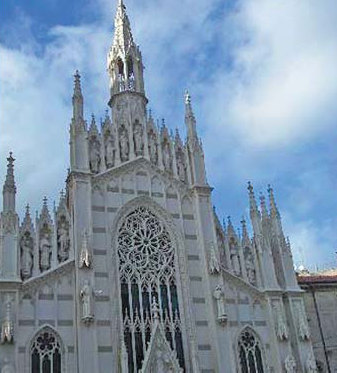
The smallest, by far the strangest, and in my experience, the least likely museum in Rome at which you are likely to meet another visitor is the Museo delle Anime dei Defunti in Sacro Cuore, said to be the city's only neo-Gothic church.
On the banks of the Tiber, not far from the Castel Sant'Angelo, the church borders the residential Prati neighborhood, which I like for the Parisian ambiance of its stately apartment buildings and for its specialty grocery shops where you can join the Romans deciding between varieties of artisanal honey and salumi brought in from the provinces. The museum's name can be translated roughly as the "Museum of Souls in Purgatory".
The legend is that in 1897 a fire broke out in one of the chapels of the church, after which the priest saw the face of a soul in pain - an image that the flames had scorched into the wall behind the altar.
The priest naturally concluded that the face belonged to one of the unquiet dead desperate to get in touch with the living, and he began to make a collection of objects that proved his theory.
The tiny collection (an exhibit occupying one wall of a side chapel) offers documentary evidence of cases in which the dead used fire to make their wishes known - to persuade their family and friends to say more prayers for them and thus hasten their release from purgatory.
Included in the collection are hand- and fingerprints scorched into a variety of humble objects: a sleeve, a chemise, a prayer book, a pillow, a nightcap and an apron. Wall texts, translated into several languages, explain the particular circumstances that surrounded each of these unearthly visitations.
I find this intimate and peculiar collection to be powerfully affecting and touching. And it will give you something to tell your friends at home, who may have visited the Sistine Chapel but are far less likely to have discovered the Museum of Souls in Purgatory.
|
Museo delle Anime dei Defunti is said to be Rome's only neo-Gothic church. |
Centrale Montemartini
My cabdriver had never heard of Centrale Montemartini, and when he called his dispatcher, the voice squawking over the radio too didn't have any idea where it was.
In fact, it's not terribly hard to find - a brief bus ride or a somewhat longer walk along the Via Ostiense from the Ostiense train station, which lies at the base of the Aventine Hill and at the edge of the Testaccio neighborhood.
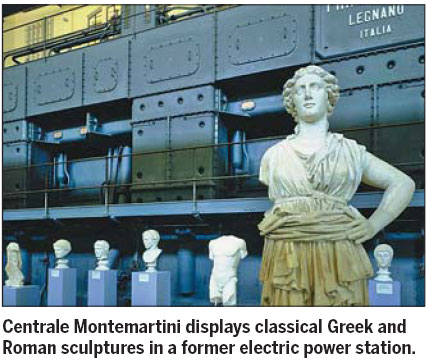
With its magnificent collection of classical Greek and Roman sculptures housed in a former electric power station built just after the turn of the 20th century, the museum ingeniously brings together the aesthetic of two eras widely separated by time - and persuades you that these two very distant and dissimilar groups of objects were made to be shown with (and complement) each other.
Opened in 1912, the thermoelectric plant, founded by the Franco Tosi Co, grew throughout the 1920s as more of Rome became electrified; various theories have been offered to explain why it remained in operation through World War II, when other plants and factories were destroyed.
In 1997, the Greek and Roman sculptures were moved from the Capitoline Museums in central Rome to the industrial space to create more room in the city's older museums. Later it was decided to make the Centrale Montemartini a permanent installation for these acquisitions from the Capitoline Museums - to celebrate, and take advantage of, the striking ways in which the heavy, dark machinery contrasts with, and highlights, the delicacy and whiteness of the stone statuary.
Centrale Montemartini is a museum of industrial archaeology in itself. Much of the plant's original interior has been preserved; furnaces, pipes, conduits, scaffolding, ladders, metal balustrades, condensers, wrenches and gauges remain.
Consequently, strolling through the museum feels rather like navigating the interior of a gorgeously sculptural Art Deco turbine - a churning engine of modernism full of classical masterpieces that are as serene as the machinery is propulsive.
In the Machine Room are full figures and portrait busts, sections of a (431 BC) Temple of Apollo, and fragments from the colossal statue of the Goddess of Fortune that was originally in Rome's Largo Argentina.
In the final room is an enormous mosaic of a hunt scene from the 4th century. You can climb a staircase to a platform for a more comprehensive aerial view of the chaotic, detailed, beautifully rendered - and gory - image of a hunter spearing a wild boar while his frenzied dogs snarl at their prey.
Not far away is a tranquil and extraordinary lovely statue of a muse, possibly Polymnia, wrapped in a shawl, leaning on a column.
Nearby sat a young woman, a visitor to the museum, alone, studying the statue. She remained there for the entire length of our visit - undisturbed, contemplative, peaceful, enjoying the sort of experience that one can have in these less heavily populated but nonetheless remarkable secret corners of Rome.
New York Times
(China Daily 09/20/2013 page10)