Comments
  Print
Print  Mail
Mail  Large Medium Small
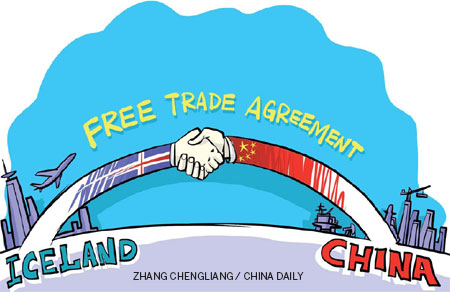
Negotiating free trade agreements with China is complicated, but Iceland proves it can be done
When China wants to try something new, it usually launches a pilot program. If that runs well, it is declared to be a demonstration project aimed at being a model of its type.
Iceland became that recently in terms of Europe's free trade history with China, the world's largest exporter.
On April 16, Iceland became the first European country to sign a free trade agreement with China, which is tipped to be the world's largest trader.
The agreement covers little trade, but its significance is profound. The value of bilateral trade was worth $180 million (137 million euros), with China running a small surplus of $6.43 million, last year. Trade with Iceland is negligible against China's total foreign trade of $3.87 trillion last year.
However, the agreement amply illustrates China's goodwill in compromising on principles it used to stick to.
It is exempting Icelandic aquatic products from tariffs and is allowing the country's geothermic technologies to enter China almost unrestricted. The moves are generous, given that Beijing always deems agriculture and high-tech as strategic industries that can be open to foreign investors in limited circumstances.
Iceland's aquatic exports have been subject to tariffs of 10 percent to 12 percent. In 2011, $45 million, or almost one-third, of its total exports to China were aquatic goods. Since these can now enter China duty free, the FTA's benefit to Iceland is obvious.
Of course, the deal works the other way, too, Chinese machines and vehicles being able to enter Iceland duty free.
Iceland approached China for a deal after Chile and China implemented a free trade agreement in 2006, partly because Iceland saw the attractions of a similar deal, both Iceland and Chile exporting ocean fish in great numbers.
China and Iceland began talks in 2008 and had four rounds of negotiations that year, but these were suspended after Iceland applied to join the European Union. The talks were resumed in April last year and went very well. After two more rounds, a deal was reached.
The Ministry of Agriculture was initially the only Chinese government department that was unhappy with a deal with Iceland. The worry was that Icelandic sea fish might hurt local industries. But that worry dissipated because Iceland's volume of aquatic exports to China, mainly mackerel, is insignificant.
Except for mackerel, Iceland and China are not in any direct competition globally, so Iceland did not push hard for China to compromise on its investment rules and market access.
In this case, China has displayed two of its philosophies in signing FTAs.
One is that it tends to strike deals with countries that have less competition with Chinese industries. The other is that China welcomes partners that do not aggressively push it to open its strategic sectors.
Some argue that the deal with Iceland is too small to be representative, and that another European deal that is in the making may offer more clues to China's attitude toward FTAs. The deal in question is with Switzerland, Europe's ninth-largest economy.
FTA talks between China and Switzerland are proceeding rapidly. The eighth round of negotiations, which began a little more than two years ago, ended in March.
According to the Ministry of Commerce, the two countries have reached a consensus on the big issues.
Switzerland runs a decisive surplus in its trade with China, its exports to China in 2011 being worth $27.2 billion and its import from China $3.7 billion.
The advantage was based on Switzerland's shipments of timepieces and precision machinery, which accounted for about 40 percent of its exports to China.
There is strong domestic opposition to imports of Swiss watches, but that is not a big obstacle in the talks as Chinese policymakers develop a more sophisticated understanding of global competition.
The Chinese mainland is the world's third-largest buyer of Swiss watches, trailing Hong Kong and the United States. Swiss watches accounted for 76 percent of China's imports of all watches last year.
Now Swiss timepieces are subject to an import tariff ranging from 11 percent to 20 percent. If the tariff is waived, Swiss watches will have an advantage in the Chinese market. That is why Chinese watchmakers have been lobbying for special protection since the FTA talks began.
But Chinese negotiators are convinced that reducing or even removing the taxes is no big deal, because watches are not a strategic sector and China will have to import high-end watches from elsewhere even if Swiss products were blocked from entering China.
Indeed, Chinese and Swiss watch industries are closely linked, with Switzerland importing a large number of parts from China, assembling them in Switzerland and then selling them to the world. China also imports core parts from Switzerland.
Because of a difference in market orientation, the two countries are more complementary than competitive with watches, and Chinese negotiators have come to accept that.
This case shows that China can well accept an FTA partner which competes with China at a certain level. But the FTA has never been a purely economic issue. In most cases, it has been as well political.
Countries that enjoy a high level of political rapport will find it easier to forge an FTA. The European Union and the North American Free Trade Agreement are the best examples of that.
Take the China-ASEAN FTA, for instance. China and the Association of Southeast Asian Nations compete against each other as they both host scores of the world's largest factories. But China pushed for an FTA with ASEAN in 2001 as part of Beijing's strategy to extend its clout in the Asian-Pacific region. As for ASEAN, it wanted to advance its ties with China to balance other powerhouses, which already had a strong presence in the region. The mutual political needs have prompted the birth of the FTA.
Apart from Iceland, the Chinese mainland has signed FTAs with 18 other countries and regions, namely Hong Kong, Macao, Taiwan, Pakistan, Chile, New Zealand, Peru, Costa Rica and the 10 members of the ASEAN. According to Commence Ministry figures, a quarter of the Chinese mainland's foreign trade is with its FTA partners.
China is also talking with the Gulf Cooperation Council, Australia, Norway, Switzerland, the Southern African Customs Union, South Korea and Japan.
In selecting its FTA partners, politics has played a decisive role.
Most of China's established FTAs are with those who have very good political ties. They are either good friends of China, such as Pakistan, or countries having no disputes with China, such as Chile, New Zealand and Peru.
The Chinese mainland also tends to use FTAs to push for ties with economies that are not always friendly but of great political significance to it. Japan can best represent this group. But this rule only applies to partners that are of great international and geopolitical significance to China.
This explains why Norway, whose economy is highly complementary with China's, has not been successful in sealing an FTA with it. It also explains why Switzerland, which started FTA talks more than two years later with China than Norway, is surpassing Norway in negotiations.
Politically, Switzerland, as a neutral county, has no disputes with China. Indeed, China is very grateful to Bern's recognition of the People's Republic in 1950, one of the first Western countries to do so.
If the political atmosphere is bad, the chances of sealing good economic deals are slim.
The author is a financial analyst in Shanghai. The views do not necessarily reflect those of China Daily. He can be reached at luojiexin2008@gmail.com
(China Daily 05/03/2013 page8)
 US honors its veterans with ceremonies, parades
 Carnival season kicks off in Cologne
 Typhoon Haiyan hits Vietnam
 UK's Royal Air Force marks ties with Bahrain
 Red Cross Red Crescent holds meetings in Sydney
 Intl space crew returns Olympic torch to Earth
 Philippines storm kills estimated 10,000
 Games of Indigenous People kicks off in Brazil

Copyright 1995 - . All rights reserved. The content (including but not limited to text, photo, multimedia information, etc) published in this site belongs to China Daily Information Co (CDIC). Without written authorization from CDIC, such content shall not be republished or used in any form. Note: Browsers with 1024*768 or higher resolution are suggested for this site.
License for publishing multimedia online 0108263 Registration Number: 20100000002731