Comments
  Print
Print  Mail
Mail  Large Medium Small
|
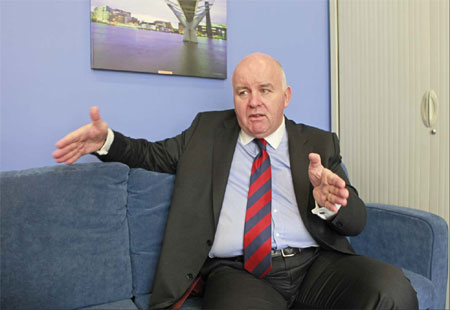
Bob Grace, president of Jaguar Land Rover China, says China is the company's main market. Zhang Chunyan / China Daily |
Luxury car-maker accelerates from a profit of zero to $7.6 billion in three years
When Bob Grace went to China in 2010 to manage a new wholly owned foreign enterprise, he says he felt as though he was boarding a high-speed train.
"Back then, it was clear to me there was something amazing going on in terms of growth of automotive consumption in China," says Grace, president of Jaguar Land Rover China.
"It was happening then and is still happening. And the attitude of my employees is to just go for it."
In 2003 Jaguar Land Rover sold just 431 cars in China; last year it sold 71,940, 71 percent more than in 2011.
This figure made China Jaguar Land Rover's single largest market, followed by Britain, the United States, Russia and Germany. Over the same period, the company sold 357,773 vehicles worldwide, up 30 percent on 2011.
In just three years, Jaguar Land Rover China's revenue rose from zero to 5 billion pounds ($7.6 billion; 5.8 billion euros) last year. Grace's team has also grown from 40 to 300, in charge of managing car imports, distribution, servicing and providing support to its network of more than 130 dealers across China.
To further capitalize on China's growing car market, Jaguar Land Rover set up a 12 billion yuan ($1.9 billion; 1.5 billion euros) joint venture with the Chinese automaker Chery last year. Together they will build a new factory in Changshu, a city in Jiangsu province 100 kilometers from Shanghai.
The plant is expected to be completed by July next year and is expected to produce 130,000 vehicles a year. It will become Jaguar Land Rover's first manufacturing base outside Britain. Its only other factory, in India, is used for car assembly only.
Grace says models that can benefit from mass production will be made in Changshu, including Land Rover SUVs and Jaguars. The joint venture will also build a research and development center to refine products to local tastes, he says.
At least 40 percent of components for the cars built in Changshu will be localized, he says, including the engine, but core design will remain in Britain to maintain the brand's British appeal.
He says one benefit of partnering with Chery is access to local technology, component sourcing and expertise, one example being the two companies' current collaboration to develop better technology in using aluminum as a manufacturing material.
Using an aluminum car body makes vehicles stiffer, stronger and safer, and reduce weight, bringing fuel consumption and hence carbon emissions down, he says.
However, Jaguar Land Rover's road to success was by no means smooth, and some say it represents one of the most astonishing recoveries the car industry has seen.
Land Rover and Jaguar, two British brands dating back to 1905 and 1922 respectively, were brought together in 2008 when Tata Motors of India bought the two struggling brands from Ford, which was in financial straits in its US home market.
Soon after the merger between Land Rover and Jaguar, the financial crisis hit. Jaguar Land Rover sales fell a third and cost Tata an estimated 375 million pounds in losses in its first year. The company was also forced to make 2,000 workers redundant.
But in the third quarter of 2009, the company's loss turned into profit, which China's insatiable demand for British luxury cars clearly contributed to.
The company's international growth has since created more than 10,000 additional jobs at Jaguar Land Rover's three factories, in Solihull and Castle Bromwich, in the English Midlands, and Halewood, near Liverpool.
"We've been trying to do the right things since we were purchased by Tata Motors," Grace says. "My part of the ingredient is to do the same in China."
Grace says his team is also cultivating new talent in China. It has partnered with five Chinese polytechnic schools to host automotive programs for Chinese students from the ages of 16 to 20.
Jaguar Land Rover would provide the schools vehicles for teaching use, and help the graduates find jobs either at its own offices or within its dealership network.
Grace says he appreciates Chinese employees for their local market knowledge. Seven out of 12 senior-level employees who directly report to Grace are Chinese, and he says this could rise as non-Chinese employees retire.
Many analysts have pointed out that automotive companies now find it difficult to recruit experienced employees to fill senior positions.
"It's absolutely true," Grace says, adding that he has created an employee development committee to cultivate leadership talent and interpersonal skills.
"It's a voluntary group of 15 people who receive a budget to run a series of activities. It could be PowerPoint courses, presentation skills courses, or basic English practice sessions."
Grace also acknowledges that employers need to put in an extra effort to engage with employees in China's competitive labor market. Examples include corporate dinners, shopping vouchers and holiday weekends away with family.
"Recently, we launched our All-New Range Rover, and we took journalists and dealers to Sanya for a test drive. Then, we took our employment committee to Sanya to say thank you, to allow them to enjoy a long weekend with family, drive Range Rovers and enjoy the sunshine."
Grace also holds a one-to-one meeting with each new employee, regardless of position.
"I talk to them about me, about my family, about my values, and my expectations of the company, and ask them to talk to me as Bob, and not as the boss."
His team's staff turnover was 10 percent last year, half the average in the luxury automotive industry, he says.
His team also recruited two Chinese executives who had worked for the China subsidiaries of two German competitors. "We're able to get talent. They see our experience in a positive way."
The company's headquarters is employing an increasing number of Chinese to facilitate smooth communication with his team, he says.
Grace says that many products have been altered slightly to suit the needs of Chinese consumers. For example, diesel engines are replaced by petrol engines, as petrol stations are more commonplace in China.
Some products have been enlarged for the Chinese market, as those Chinese living with extended families would need a car that takes more passengers. Other changes include seat control, message functions, heating and cooling and entertainment selection.
To attract China's new generation of technology-savvy luxury consumers, Jaguar Land Rover is engaging heavily with social media tools like Weibo and WeChat, Grace says.
"China's luxury consumers are typically 10-15 years younger than in the UK, are consuming luxury for the first time, or certainly with little experience of it, and want to try lots of brands. They make decisions quickly, and use social media to share ideas with friends."
One successful campaign, he says, was spending 18 months talking to Chinese consumers on social media about the Range Rover Evoque before it was put on the market in November 2011. The eagerness created for the product paid off, and 20,000 Evoques were sold in the country in the 12 months after launch.
Grace is confident about Jaguar Land Rover's growth in China, believing that a constant striving to implement the best technology can overcome market competition and regulatory challenges.
He says one example is the recent implementation in Beijing of tougher emissions standards on vehicles, which hit car sales hard but had no impact on Jaguar Land Rover because its vehicles already complied with the standard.
Beijing municipal government statistics showed that only 1,400 out of 2,000 car models for sale in Beijing met the new standard.
"There are always lots of challenges in any big market," Grace says. "We'll keep adapting our products, technologies and range of products available in the market place."
Contact the writers at
cecily.liu@chinadaily.com.cn and zhangchunyan@chinadaily.com.cn
(China Daily 03/22/2013 page20)

 Hawaii legalizes gay marriage
 Graduation celebration for Santas
 One World Trade Center deemed tallest US skyscraper
 US honors its veterans with ceremonies, parades
 Carnival season kicks off in Cologne
 Typhoon Haiyan hits Vietnam
 UK's Royal Air Force marks ties with Bahrain
 Red Cross Red Crescent holds meetings in Sydney

Copyright 1995 - . All rights reserved. The content (including but not limited to text, photo, multimedia information, etc) published in this site belongs to China Daily Information Co (CDIC). Without written authorization from CDIC, such content shall not be republished or used in any form. Note: Browsers with 1024*768 or higher resolution are suggested for this site.
License for publishing multimedia online 0108263 Registration Number: 20100000002731