Three-nation FTA is high priority for Tokyo


 |
|
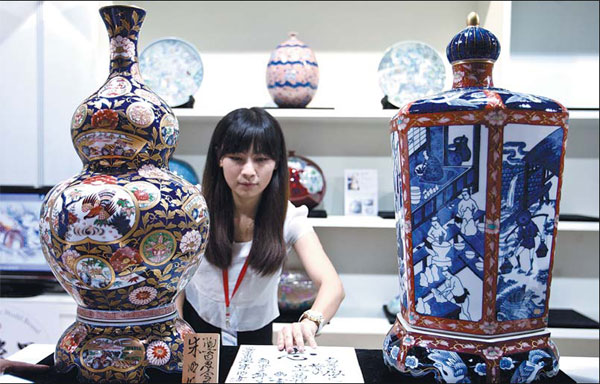
A worker arranges a Japanese porcelain exhibit at a trade fair in Beijing. China, Japan and South Korea are pushing for progress on trilateral free trade agreement talks, according to a Japanese trade official. Provided to China Daily |
Japan will give a higher priority to the establishment of a free trade area between the country, China and South Korea than discussions surrounding the Trans-Pacific Partnership Agreement, or TPP, a Japanese trade official said on Thursday.
"Compared with the TPP, the China-Japan-South Korea free trade agreement is more feasible and can be achieved earlier, because it's easier for the three countries to communicate with each other and reach consensus on crucial issues including the problem of tariffs for sensitive industries," said the official, who declined to be named.
Media reports said on Thursday that Japanese Prime Minister Shinzo Abe is expected to announce Japan's entry to the TPP on Friday, a controversial issue given the potentially damaging effects it might have on some of the country's industries, including agriculture.
The TPP is likely to place high demands on tariff reductions by major countries, and the official said that long negotiations were likely.
"So the FTA among the three countries is a high priority for Japan," the official said.
Discussions have been ongoing recently in Japan regarding the country's involvement in the FTA and TPP, involving its Ministry of Economy, Trade and Industry.
The TPP — which covers 11 nations including the United States, Australia, Chile, Malaysia, New Zealand and Singapore — has invited Japan to join, in a move regarded by some as a measure by the US to counter China's rising economic influence in the Asia-Pacific region.
Japan will be required to lower its tariffs as a condition of membership, which will be a fierce challenge for Japanese farmers in particular, who have been protected from tariffs in the past.
The 16th round of TPP discussions ended in Singapore on Wednesday, with officials suggesting solid progress had been made, amid speculation that Japan could announce its entry into TPP talks as early as Friday.
But Japanese media reported that the country is set to launch its TPP negotiations in July.
In spite of fears that the tri-nation FTA negotiations would be suspended because of the territorial disputes among the three countries, talks are believed to be poised to start as scheduled.
Chen Deming, China's minister of commerce, announced at a news conference on the sidelines of the annual session of the National People's Congress that the first round of FTA talks will be launched in South Korea and held alternately among the three countries in the future.
According to a joint feasibility study issued last year, the three economies together accounted for 20 percent of global gross domestic product and 18.5 percent of global exports in 2010.
"It's the FTA with China and South Korea which could bring more economic benefit to Japan rather than the TPP, which provides more political significance to the country," said Yao Haitian, a researcher at the Institute of Japanese Studies at the Chinese Academy of Social Sciences.
"The TPP is a US move to exclude China from other major economies within the Asia-Pacific region," he added.
Yao said that the impact of the TPP on Sino-Japanese trade and investment might not be that significant, given the lack of influence that many other bilateral and multilateral trading systems have had in recent years.
However, Tu Xinquan, deputy director of the China Institute for WTO Studies at the University of International Business and Economics, said that tariff reduction exceptions are not acceptable within the TPP, therefore Japan has to open up its agriculture industry which would become fragile once the importing tariffs were cut.
The opening up of Japan's agriculture is also a component of the ongoing FTA talks and may become a key bargaining chip for Japan to urge China and South Korea to further cut import tariffs on some key industries, including the auto and mechanical sectors.