Comments
  Print
Print  Mail
Mail  Large Medium Small
|
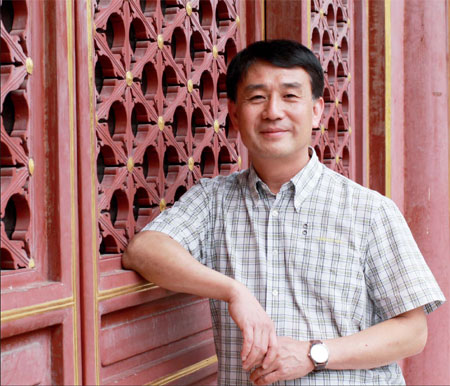
Chen Xiaoyong says he wants to find a unique music language, "one that is both Chinese and relatable to all human." Li Yanwen / for China Daily |
Drawing on his roots in China and experience of living in Germany, composer Chen Xiaoyong has forged his own cross-cultural style
As the concert drew to an end, Chen Xiaoyong sighed with relief. An acclaimed composer based in Germany, his expectations back home in Beijing are unreasonably low. "I'm really delighted to have seen the audience make it to the end," he says.
For two-and-a-half hours, the concert presented seven symphonies composed by Chen and young Chinese composers tutored by him. The Chinese influence in the music is tangible, yet not as flamboyant as the Chinese audience is used to. While some enjoyed it, many looked confused.
But that's exactly why Chen is here. Drawing on his experience in the West and the East, he is helping nurture a new generation of Chinese musicians, educators and audiences. And he is fully aware of the immensity of the task, given that the Western classical music scene in China is in its infancy.
"We are not intending to make classics through just one concert. This is a chance for us to meet the audience, for them to raise questions and build an environment that will allow the music to grow," Chen says.
Known for creating music that fuses together Western and Eastern sounds, the Bach Prize winner has been commissioned to create work by prestigious organizations including Southwest German Radio Symphony Orchestra, Asian Culture Link Vienna and the NDR Symphony Orchestra. In 2000, Chen was invited by cellist Yo-Yo Ma to create a piece called Fusion for Ma's Silk Road Project. In 2010, he was appointed as guest professor of composition at the Academy of Music and Theater in Hamburg.
Chen has always tried to stay connected with his home country. He has been serving as professor for composition at the Shanghai Conservatory of Music since 2006 and has returned to China five times in the last three months to help organize his recent concert, part of a project to train teachers for the Attached Middle School of China Conservatory. Chen serves as the leading tutor of the project.
He is also involved in designing the music curriculum for Chinese schools, in a bid to improve the teaching quality of elementary music education that has been eroded by the pressure put on students to pass exams.
"The key for the development of music in China is the basic education," he says. "We have to cope with the mounting pressure of getting into universities, but we also have to see what we are living for. If the kids are not educated properly, how can we hope for the future of China's music?"
Of the significance of education, few know better than Chen. Born in 1955, he was among the first generation after the "cultural revolution" (1966-76) to receive a proper university education.
He studied composition at the Central Conservatory of Music in Beijing before moving to Germany to study at the Music Academy of Hamburg in 1985. There he was taught by Gyorgy Ligeti, a prominent composer.
"One of the most important lessons Ligeti taught me was: You are from a different culture, but you should not be one of the masses of avant-garde artists in the West. You are unique, and you should find your own language."
However, it took many years for Chen to finally understand what Ligeti really meant.
Chen's first breakthrough came in 1987 when his String Quartet No 1, a chamber piece highlighting Chinese musical elements, was publicly performed in Europe. It's also the first piece Chen completed in Germany.
"They paid attention to me as a young composer because of the new musical culture I brought there," he says. "I didn't know Europe very well. All that I did was to express my own culture in the new musical language I had learnt there."
Soon afterwards, he was commissioned by Southwest German Radio Symphony Orchestra and as further invitations began to flood in, Chen began to think deeply about his musical direction.
"I began to wonder, is this really the music that I want to make?" he says. "Will regional music really be international or will it only be a novelty? People are interested in us, but if we continue doing it, is this the right attitude toward art, or is it just for fame and novelty?"
As Chen settled in Germany and tried to understand the country's culture, he also strived to find the roots of European music.
"I want to find a more unique music language, one that is both Chinese and relatable to all humans," he says. "Western audiences can understand it, but at the same time, they recognize it as music from outside Europe, from East Asia."
Chen's second major breakthrough came in 1996, when he held a portrait concert at the Hamburg State Opera. He had finally discovered a music language that he found "limitless".
"I found a music language that is rooted in China but can reach over to an international audience," he says. "The spirit of the era, after all, is not limited by national borders or times. When it comes to cultural matters, you can't tell if one is better than the other; you can only tell the difference. My concern is to find a new way to combine different cultures in my music."
Chen attributes the evolution of his art to the influence of both German and Chinese culture.
"When two cultures come together, there could be rejections; there could also be questions about why you think this way and trying to understand the history and reason behind it. And the Germans will do that. They are very good at thinking. I really respect them for that," he says.
"Maybe I'm no longer a typical Chinese person, but I'm still rooted in Chinese culture. Both cultures can be traced in my music."
Reflecting upon the possible directions of music education in China, Chen suggests more emphasis should be placed on the cultural background of the music.
"In terms of musical technique, China's music education is quite successful," he says. "We are good at systemizing to reach a certain goal. But music is part of culture. We have plenty of musicians who are flawless in skills but they can't play the music right.
"We should do it more from a cultural angle and teach more about what the music means. If you don't have a proper understanding of the culture and history behind the music, you will never understand the music."
sunyuanqing@chinadaily.com.cn
(China Daily 01/11/2013 page28)

 Filipinos suffer from shortage of typhoon aid
 Healthy baby born to brain-dead mom in Hungary
 Abe honors heroic Chinese student
 Twin panda cubs at Zoo Atlanta
 Hawaii legalizes gay marriage
 Graduation celebration for Santas
 One World Trade Center deemed tallest US skyscraper
 US honors its veterans with ceremonies, parades

Copyright 1995 - . All rights reserved. The content (including but not limited to text, photo, multimedia information, etc) published in this site belongs to China Daily Information Co (CDIC). Without written authorization from CDIC, such content shall not be republished or used in any form. Note: Browsers with 1024*768 or higher resolution are suggested for this site.
License for publishing multimedia online 0108263 Registration Number: 20100000002731