Comments()
  Print
Print  Mail
Mail  Large Medium Small
Winter cold is not only uncomfortable but also sometimes expensive, and increased power use this time of year adds an extra burden to the already taxed power grid, which is why both the Japanese government and ordinary people appear to be willingly adopting "warmth sharing," or the communal use of warm and toasty places to save electricity.
In addition to saving power and reducing carbon dioxide emissions, two benefits that the Japan's Environment Ministry hopes to gain from the movement, the concept can help provide companionship to elderly people living alone and help restaurants boost profits.
The idea was introduced this year as part of the ministry's "warm biz" campaign to reduce wintertime electricity use.
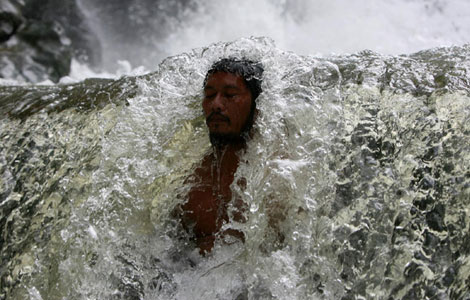
Warmth sharing at its simplest is having the whole family spend time in a single heated room, while public gatherings can be held in places such as stores or libraries. The most direct method might be plopping oneself in a communal tub of hot water by visiting a public bath or hot spring.
Limited power availability in Hokkaido has prompted the government to ask people to use at least 7 per cent less electricity this winter.
In late December in Sapporo, snow fell and temperatures plunged below zero. To weather the chill together, about 90 residents of a condominium in Atsubetsu Ward gathered to make mochi by pounding rice, and also to share warmth.
The condominium has turned off some of the lights in its parking lot and on the streets, but has kept a sidewalk-warming device running to protect the many elderly residents from slipping on icy paths.
"People turn off their home heaters before coming, so it helps save power. We can also make sure our elderly neighbours are OK, killing two birds with one stone," said Yasuko Motokawa, head of the condo's resident association.
The Atsubetsu Ward Office has encouraged neighbourhood associations and businesses to participate in the warmth sharing movement.
"[Warmth sharing] can save power without too much effort, strengthen neighbourhood ties and revitalise businesses. There's so many good things about it," said Hiroaki Shiga, chief of the ward office's general affairs and planning division.
The Sheraton Sapporo Hotel became a warmth-sharer at the request of the ward office.
"We hope it will encourage people to come to our hotel," said hotel official Kengo Ito.
Professor Masahiro Horiuchi of Tama Art University in Tokyo heads the Share Map website [sharemap.jp], which provides information about warmth share locations.
More than 5,500 warmth-sharing spots have registered with the website nationwide, including restaurants, bathhouses, and other public facilities.
The site also provides information on facilities with special offers.
For instance, the Tsumugi no Yu public bathhouse run by the town government of Ichikawa-Misato, Yamanashi Prefecture, allows people to stay all day if they tell the reception desk they turned off the heat at home before coming.
The usual charge for three hours is 300 yen (US$3.42) for town residents and 400 yen for out-of-towners.
Burning through energy
CO2 emissions in fiscal 2011 were 12.8 per cent lower than fiscal 1990 levels in the industrial sector, which includes factories, according to an interim report from the Environment Ministry. However, household emissions rose 48.1 per cent over the same period.
This is partly because of the increase in one-person households, but the growing number of electric appliances and automobiles has also had an effect.
Heating accounts for 14.6 per cent of a typical home's CO2 emissions, which is about six times more than the 2.6 per cent accounted for by cooling.
A study by a research team led by building engineering expert Professor Takashi Inoue of Tokyo University of Science showed that the higher a person's environmental awareness, the more she or he tended to believed that cooling consumes more energy than heating.
These people make an effort to save electricity in summer, Inoue said.
He added, however, "energy consumption would be reduced more if people turned down the heat and went to public baths instead of using their home bathtubs."
*US$1=87.60 yen
Copyright 1995 - 2010 . All rights reserved. The content (including but not limited to text, photo, multimedia information, etc) published in this site belongs to China Daily Information Co (CDIC). Without written authorization from CDIC, such content shall not be republished or used in any form. Note: Browsers with 1024*768 or higher resolution are suggested for this site.
License for publishing multimedia online 0108263 Registration Number: 20100000002731