Comments
  Print
Print  Mail
Mail  Large Medium Small
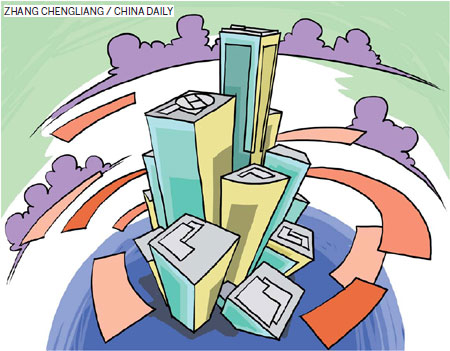
Hu Jintao has laid out plans that are highly challenging but attainable
The just concluded 18th National Congress of the Communist Party of China has given us a smooth transition from the "fourth-generation" leaders headed by Hu Jintao to "fifth-generation" ones led by Xi Jinping. Hu, in his keynote speech on Nov 8, outlined the overall approach to modernizing China further in five areas: the economy, politics, culture, society and ecology.
Of particular note, he set a new target for economic growth, announcing that China should double its 2010 GDP and per capita income for both urban and rural residents by 2020. He also emphasized the importance of accelerating market reforms and shifting the growth model. In addition, he called on the Communist Party of China to make unremitting efforts to combat corruption, address income inequality, and respect the rule of law.
Indeed, if these goals are achieved, the Chinese economy will match that of the US by 2020. Even on the basis of per-capita income, China will comfortably stand as one of the top middle-income nations.
Of course, it is one thing to have such goals, and entirely another thing to achieve them. So the question becomes how China can go about doing that.
China has achieved double-digit growth over the past 10 years, but such rapid growth also comes with significant side effects. The country's economic structure has become increasingly unsustainable, the investment-to-GDP ratio surpassing 50 percent last year, while the consumption-to-GDP ratio fell below 40 percent. Further relying on investment-led economic stimulus could lead to diminishing returns. The surge in investment after the global financial crisis to pump-prime the economy has also led to an increase in non-performing loans, heightening risks in the banking system.
Despite years of market reform, many important industries are still dominated by the state sector. They have become a deep-rooted vested interest group resistant to further reform.
Reform challenges on other fronts include severe environmental degradation as a result of the extreme exploitation of energy and other resources and rapid industrialization.
A rapidly aging population requires urgent reform in the pension system, and an adjustment to the family planning policy adopted more than 30 years ago. All these factors suggest that China's growth potential will also be further constrained by rising wages and other costs, as well as by more strictly enforced environmental standards.
If these structural challenges are not tackled they will certainly thwart Hu's ambitions, as well as the Party's, to double both GDP size and per capita income in 10 years. So the new leaders will have to tackle these problems head on by advancing a set of comprehensive economic reforms to boost consumption, rebalance the economy and ensure that targets are met.
To boost consumption, China will need to put a high priority on rebuilding its meager social safety net so as to reduce the caution-bound penchant of people to save. This then requires the government to use the wealth of fiscal resources at its disposal to undertake further pension reform, including making pension contributions portable when people work in different provinces.
The government will also need to replenish pension shortfalls by transferring the equity shares of state-owned companies and banks held by various levels of government, as well as the earnings of China's foreign exchange reserves. Although great strides have been made in healthcare reform, the government will need to refine the 2009 universal health insurance program further by making it cheaper and more accessible.
In addition, China's rural consumption could also be boosted if the land title reform, an experiment already taking place in Chengdu to strengthen property rights with farmers' land leases, could be applied to the rest of the country. Once these land-lease titles can be used as collateral for bank loans, they would not only help stimulate rural consumption but also speed up industrialization in the western and central regions. Land-lease titles would also prevent land grabs by corrupt local government officials.
To check the influence of the powerful state-owned enterprises, the new leaders will need to engage in further deregulation and encourage competition in some state-monopolized sectors. In particular, service sectors will benefit greatly from deregulation because that will help increase competition, enhance productivity and create jobs that require high skills. This is especially urgent in state-dominated financial services, which will need to open up more to foreign and private Chinese capital.
Meanwhile, deregulation will be needed in other state-dominated services such as medical care and other social services, education, rail and air transport and infrastructure. Allowing private investment in these areas will help China rebalance its industrial structure, reducing its over-reliance on manufacturing and placing greater emphasis on services.
Although the State Council has already lowered entry barriers for private participation in about 36 sectors previously restricted to the state sector, the government will also need to reduce other implicit entry barriers if it wants Chinese private capital in these traditionally state-dominated sectors to increase significantly.
While these reforms are challenging, China has the resources and the expertise to implement them and make them work. Unlike the difficult reforms in the late 1990s when millions of jobs had to be shed and thousands of small and medium state-owned factories were privatized, China's next stage of reform will create millions of skilled jobs in the service sector for university graduates. That means the collective desire for further reform should be strong. If these reforms are pushed forward, the goals that Hu has set should be achieved with relative ease by 2020.
The author is chief economist, Greater China, Australia and New Zealand Banking Group in Hong Kong. The views do not necessarily reflect those of China Daily.
(China Daily 11/16/2012 page8)

 US honors its veterans with ceremonies, parades
 Carnival season kicks off in Cologne
 Typhoon Haiyan hits Vietnam
 UK's Royal Air Force marks ties with Bahrain
 Red Cross Red Crescent holds meetings in Sydney
 Intl space crew returns Olympic torch to Earth
 Philippines storm kills estimated 10,000
 Games of Indigenous People kicks off in Brazil

Copyright 1995 - . All rights reserved. The content (including but not limited to text, photo, multimedia information, etc) published in this site belongs to China Daily Information Co (CDIC). Without written authorization from CDIC, such content shall not be republished or used in any form. Note: Browsers with 1024*768 or higher resolution are suggested for this site.
License for publishing multimedia online 0108263 Registration Number: 20100000002731