Comments
  Print
Print  Mail
Mail  Large Medium Small
Competition in China's economy is vital to spur innovation and raise productivity
A clear indication of China's global importance is that media all over the world have extensively covered the 18th National Congress of the Communist Party of China. As the congress ended, all eyes were on the first public appearance of the members of the Politburo's new standing committee. These people will be at China's helm when it surpasses the United States to become the world's largest economy, based on purchasing power.
A just-published OECD study, Looking to 2060 - Long-term Global Growth Prospects, projects that this will occur in about five years. The study also projects that China will continue to have the fastest annual GDP growth of any country until 2020, when it will be overtaken by India and Indonesia, reflecting from about 2015 a shrinking Chinese working population. China's share of global GDP is projected to rise from 17 percent in 2011 to about 28 percent by 2030, and will remain about this level thereafter as China's working population shrinks, and other large countries with younger populations, such as India and Indonesia, grow faster than China.
With about one-fifth of the world's population and a relatively low proportion of cultivable land, throughout its history China has faced a problem of how to provide its people with the basic means of supporting themselves.
Today it is easy to forget that China's astonishing development to become a middle-income country has required huge change, many sacrifices and much hardship. But the challenges are not over, and if China focuses on celebrating its accomplishments so far, instead of continuing its struggle to become a modern, high-income country, in the years ahead it will fall behind competitors such as India.
Given the fact that China will become the world's largest economy soon, the rest of the world also has a significant interest in whether it can continue its economic progress. In fact, it is the actions of Chinese leaders, and the determination of Chinese people over the next decade, that will determine whether China can achieve its economic potential and continue to spread that success throughout the world.
The OECD's recent study of long-term global growth bases its assumptions on each country's capacity for structural change. Its baseline case of global GDP growth of about 3 percent, once the world has fully recovered from the Western debt crisis, is based on an assumption of gradual economic reform. But the OECD study points out that "bolder structural reforms could raise global GDP by an average of 16 percent relative to its baseline assumption, and "ambitious policy market reforms could raise GDP by 10 percent". There is a clear, established link between, on the one hand, well-considered economic policies that encourage structural change, and, on the other, higher GDP growth and more wealth per person.
The economic growth paths the world and China will follow depend on the policies that are executed in the next few years. Policies that encourage productivity growth and innovation will provide a much better future. But if that is so, why doesn't every country introduce well-planned economic reforms today? The reason is that reforms always involve change in the existing structure. People and institutions who are doing well at the moment do not want change that threatens their positions. They resist change, arguing that it is unnecessary or dangerous. A government is likely to be influenced by powerful lobbies and special-interest groups from large industries who like to keep things as they are.
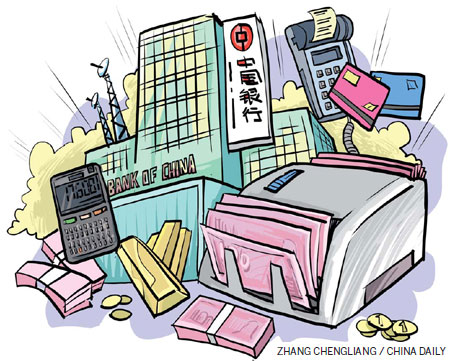
But China cannot stand still. The new leaders must seek and embrace well-planned changes that encourage more growth and prosperity in China. Their starting point is to introduce much greater competition into the economy. For example, in the financial sector the state-owned banks today enjoy very powerful competitive positions because they support, and in turn are supported by, the dominant state-owned sector.
Although foreign banks were allowed to enter the Chinese market a decade ago, they have not been allowed to fully penetrate the banking market. They are restricted in the commercial activities they can conduct, and the share they can own of Chinese financial institutions.
China needs to remove constraints on foreign banks, as well as on privately-owned and well-regulated Chinese banks from entering fully into the Chinese banking market. It is the regulator's job to ensure that banks operating in China have enough capital and operate in accordance with Chinese laws and customs. Restricting foreign access to China's financial sector is the wrong way of making sure that China's economy is not disturbed by improper or dangerous financial activities. Providing a fully competitive financial sector, operating within clearly defined and strongly policed guidelines, would provide a huge boost to the Chinese economy, in growth, product innovation and consumer choice.
Incumbents always fear they will suffer if more competition is introduced, so they try to stop it. In fact, when well-qualified and well-capitalized new competitors enter a market, they come with new products that are offered at attractive prices to build market share. Prices fall and new products appear. Consumers benefit from lower prices and greater choice, and are stimulated to spend more. The total market size expands. Existing players are forced to adjust their products and prices. Often, once they have begun to adjust to the new entrants and the inevitability of competition, they benefit enormously from the new competitive landscape because they can use their strong existing positions in the market to take advantage of shifts in demand by repositioning themselves.
The financial services industry is not the only Chinese industry that needs much greater competition, but it is the most important. Since 2008 we have seen how the collapse of the Western banking system has paralyzed the developed economies. Financial services lie at the heart of a modern economy. Bank credit provides the flow of blood to the economic body. Efficient securities and investment banking services ensure that many important market prices, such as oil, reflect their true economic values, so that the correct signals are sent allowing the economy to function efficiently, and growth and employment are both as strong as they could be.
More competition needs to be introduced into most of the rest of China's economy. The huge telecommunications industry, another example, is populated by entirely Chinese players. Here, too, well-regulated foreign companies need to be encouraged to enter the market. The result? Better products, lower prices, more choice, more growth and more innovation. Competition in China's economy is vital to spur the innovation that China depends on to raise productivity as its workforce starts to shrink.
Here, then is the first major challenge for China's new leadership. For an example they need only look at the benefits that China's joining the World Trade Organization in 2001 brought to the country's economy. Encouraged by the prospect of a China that operated within the WTO's system of rules, foreign companies poured into China's coastal provinces to find cheaper China-made products that they could profitably sell in their domestic markets. China's fast growth and increase in wealth since then owes much to that decision. Let us hope that China's new leaders are inspired by their predecessors to follow in their difficult but correct path. If they do, China can look forward to becoming a high-income country within the next generation.
The author is a visiting professor at Guanghua School of Management, Peking University. The views do not necessarily reflect those of China Daily. Contact the writer at gileschance@yahoo.com
(China Daily 11/16/2012 page9)

 US honors its veterans with ceremonies, parades
 Carnival season kicks off in Cologne
 Typhoon Haiyan hits Vietnam
 UK's Royal Air Force marks ties with Bahrain
 Red Cross Red Crescent holds meetings in Sydney
 Intl space crew returns Olympic torch to Earth
 Philippines storm kills estimated 10,000
 Games of Indigenous People kicks off in Brazil

Copyright 1995 - . All rights reserved. The content (including but not limited to text, photo, multimedia information, etc) published in this site belongs to China Daily Information Co (CDIC). Without written authorization from CDIC, such content shall not be republished or used in any form. Note: Browsers with 1024*768 or higher resolution are suggested for this site.
License for publishing multimedia online 0108263 Registration Number: 20100000002731