Comments
  Print
Print  Mail
Mail  Large Medium Small
|
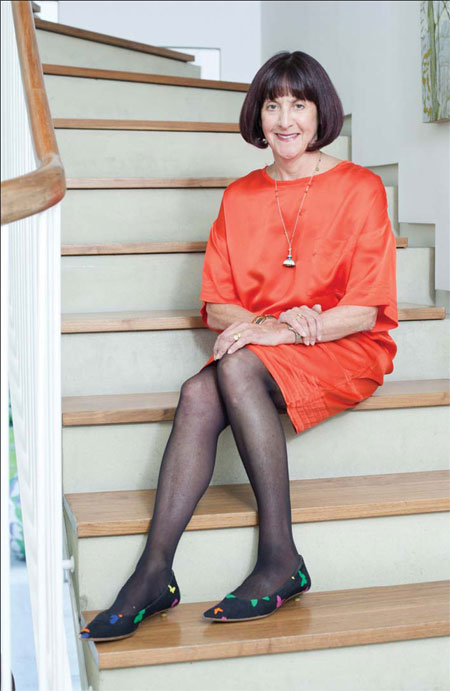
Curator Janice Blackburn unfolds the landscape of new Chinese design. Provided to China Daily |
British curator hopes to project Chinese design talent on the global stage
Janice Blackburn, one of Britain's most influential curators, has traveled the world to uncover the best work of emerging artistic talent and bring it to international attention through an annual exhibition of contemporary decorative design at Sotheby's in London. This year, for the first time, she has been focusing on the work of Chinese design students.
"I think Chinese products have a reputation for just being cheap copies, but there is actually a huge amount of creativity in China which people don't really know. This is just a graduate show, so people see it as emerging," she says.
Titled Unfolding Landscapes, the exhibition features furniture, ceramics, jewelry, fashion and photography produced by around 20 graduates from the School of Design of the China Central Academy of Fine Arts in Beijing.
Blackburn says the students' work exhibits great creativity, craftsmanship and use of technology. For example, one student, Huo Yijin, has designed a heat-reactive tea tray that changes color when water is poured over it, which she found "very original".
Another student, Zhang Kai, shot a set of photographs, Ageing Series, which documents a group of men and women aged over 90, who are friends of Zhang's grandfather and all come from the same village.
Some have lost their teeth, others use walking sticks, and one elderly man wears a stained T-shirt. Individually and together they exhibit a quiet courage in the face of a harsh rural life.
"It is very beautiful and very moving," Blackburn says.
The idea of showing an exhibition on Chinese design came to Blackburn last year, when she was having lunch with the rector of the Royal College of Art. "I said I was interested in China and I was thinking about doing something, but that I thought it would be very hard," she recalls.
By chance, the rector knew Wang Min, a professor of graphic design at CAFA, and introduced them. A meeting between Blackburn and Wang followed, and the two realized that they had a similar vision to bring Chinese design to the global stage.
"I want people to think about what they are seeing, why it's different, and why it comes from Chinese designers, and I think that was something that professor Wang thought was important," she explains.
As well as introducing Blackburn to the students' work, Wang also gave the exhibition the title Unfolding Landscapes, based on the idea that Chinese design is just emerging on the international scene.
In March, Blackburn visited the students in Beijing to handpick work for her exhibition. She did not want stereotypical Chinese work, but did want every piece to have some link to China.
"You could say that everything has a certain something about it that you would know is Chinese without it hitting you in the face with a sign that says 'I'm Chinese'. I want it to be very subtle, very creative. If I'd wanted to do something obvious, I'd have shown something you get from the gift shops at the airport," Blackburn says.
She goes a step further and resists labeling the work Chinese. "I don't like using the word Chinese. I'd rather say it's not what you would find anywhere else," she explains.
Among the Chinese characteristics Blackburn noticed in the students' work was the use of particular materials that reflect China's heritage, such as rattan. Unlike other palms, rattan has slender stems and is typically used for weaving by hand into large pieces of furniture in the East, although it is rarely used in the West.
Student Liu Xiaoxuan designed a collection of seating in rattan, and Li Bowen produced two rattan chairs as part of a collection called Memories of Childhood.
Blackburn was particularly impressed by the work of Liu Yingchuan, who embroidered a story about animal conversations onto 27 individual pieces of silk to form a book. Despite it being incomplete when Blackburn first saw the work, she knew immediately that she wanted it in the exhibition.
"She was about to start a course in textiles at the Royal College of Art and she brought her book to show me. She thought I wouldn't be interested in it, but I said 'you must finish it, even if you can't finish it for the exhibition'," says Blackburn, explaining that she sometimes shows incomplete work to give the audience an insight into the design process.
As Liu had left her embroidery equipment in China, Blackburn offered to bring it to the UK for her when she visited Beijing again for the Beijing Design Festival in September. "Her father brought me all her material and I brought it to her; all her threads, pins and needles. So yes, I do have a working relationship with the artists," she says.
Looking through the students' work, Blackburn noticed that memory was a recurring theme.
"I don't know if it's a cultural thing. It's very strong, whether it's in the furniture, graphics, or photography," she says.
Another common theme among the work was sensitivity. Blackburn was struck by how personal much of the work was.
"They put a lot of their own person into their work," she says.
Blackburn was born in Washington in 1949 and moved to Leeds, in north England, at the age of 7. At 18 she moved to London, where she worked in the press office of Bernie Cornfeld, a Turkish businessman, and in the promotions and merchandising department of Penthouse, a men's magazine.
In 1984, she joined a contemporary art gallery run by Charles Saatchi that became a center for showcasing a group known as the Young British Artists. She left her job as the assistant curator in 1994, and in 1997 put on the first of her Sotheby's London shows that have become major events on the city's art calendar and have brought a younger and grittier crowd to Mayfair's pinstriped showrooms.
"I talent-spot young people. Because I'm free to do what I want, I often show the work of people who haven't been seen enough," she says.
"I choose work that has its own voice, that I can see is developing, as art is all about developing yourself and improving. That occasionally means failure, but that's a part of the journey."
Much of the work from her exhibitions is ultimately sold, including that from the Unfolding Landscapes show. Blackburn takes a commission to cover expenses but stresses that she does not make a profit.
Blackburn first visited China about 20 years ago on holiday, but not again until March this year. The changes she noticed were immense, and some unpleasant.
"When I first went, Shanghai still had those beautiful buildings, but sadly they are hardly there now. I feel very sad that these skyscrapers and highways have made Shanghai like any other big city in the world."
Another change she noticed was the influx of Western luxury brands into China to woo high-spending urban shoppers.
"To me it's disappointing that I'm walking around and seeing all the French fashion houses. The global brands have moved in so aggressively and I have to walk around so much to find Chinese brands. It's a shame because China has much to offer itself," she says.
Convinced that good Chinese design can still be found, Blackburn embarked on a search for an embroidery shop that she had read about on a loose piece of paper tucked into the back of a guide book.
"When I saw it, it was amongst a hundred other things. I just saw the words 'hand embroidered', and I had to ask the hotel to track it down," she says.
Her efforts were rewarded when she eventually found the shop, run by an elderly man, where she bought hand-embroidered towels and shoe soles.
"The workers at the shop were in their 70s, and they're not going to be around much longer. It's a shame that this wonderful heritage is dying," she says.
The experience confirmed her belief that Chinese design is in desperate need of asserting its presence on the world stage like an unfolding scroll, as well as being reborn in China. And it made her feel good to be a part of that movement.
cecily.liu@chinadaily.com.cn
(China Daily 11/09/2012 page29)

 Filipinos suffer from shortage of typhoon aid
 Healthy baby born to brain-dead mom in Hungary
 Abe honors heroic Chinese student
 Twin panda cubs at Zoo Atlanta
 Hawaii legalizes gay marriage
 Graduation celebration for Santas
 One World Trade Center deemed tallest US skyscraper
 US honors its veterans with ceremonies, parades

Copyright 1995 - . All rights reserved. The content (including but not limited to text, photo, multimedia information, etc) published in this site belongs to China Daily Information Co (CDIC). Without written authorization from CDIC, such content shall not be republished or used in any form. Note: Browsers with 1024*768 or higher resolution are suggested for this site.
License for publishing multimedia online 0108263 Registration Number: 20100000002731