A newly re-elected President Barack Obama will need to spend some of his political capital on stabilizing the United States' relationship with China even as those ties continue to get more competitive.
That's the view of leading American experts on China. They say Obama's challenges over the next four years are likely to include fleshing out the US policy, including militarily, of "rebalancing" toward an expanded Asia-Pacific presence; building a second-term foreign-policy team; and formulating durable trade policies with China.
Many China specialistsin the US have approved of Obama's China policy so far. Highlights include regular exchanges with the Asian country in the key areas of trade, defense, culture, education and tourism.
China and the United States are each other's second-biggest trading partner. In 2011, Chinese imports of US goods and services exceeded $100 billion for the first time, making China the fastest-growing US export market for 11 straight years, according to the Ministry of Commerce.
In addition to the thousands of American investments in China, the US has become a popular investment destination for Chinese companies in recent years.
The world's two biggest economic powers have worked to address pressing global and regional issues such as the financial crisis, climate change and nuclear security.
Despite pressure from Congress, the Obama administration hasn't labeled China a "currency manipulator" but has engaged Beijing to allow the yuan to steadily rise toward its market value.
Obama is widely expected to continue his policies on China, particularly in building comprehensive, cooperative bilateral ties.
Michele Flournoy, senior foreign-policy adviser to the Obamare-election campaign and a former undersecretary of defense for policy, told China Daily at the Democratic National Convention in September that she didn't foresee any second-term changes by Obama toward China.
"President Obama will continue to invest in this relationship, which is so critical to both of us economically and the stability across the region," she said.
But Obama will confront a more complicated agenda with China, marked by intensified mutual suspicions over geopolitical positioning, said Jonathan Pollack, an expert on Asia-Pacific security at the Brookings Institution and acting director of its John L Thornton China Center.
If this suspicion isn't addressed, "it could lock both countries into an antagonist relationship neither country wants," he said.
Since the administration launched its rebalancing, or "Asia pivot", strategy this summer, many in China have seen the move as aimed at containing China's development in the region. However, Beijing has expressed hope that Washington would play a positive role by contributing to Asia-Pacific stability and prosperity.
The Chinese government strongly opposes US involvement in territorial disputes such as those in the South China and East China seas involving China and US allies Japan and the Philippines.
Pollack urged the new leadership in each country to make "major and early efforts" to ensure a stable foundation for the relationship in all crucial areas. Without this, "we will face some real turbulence in the relationship," he warned.
Another challenge for Obama, he said, is to find suitable replacements for his departing foreign-policy team, led by Secretary of State Hillary Clinton and Kurt Campbell, assistant secretary for East Asian and Pacific affairs.The two have been the driving force behind America's Asia-rebalancing strategy.
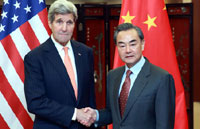
There has been much speculation that Senator John Kerry will succeed Clinton as secretary of state once Obama's second term begins early next year.
The Massachusetts Democrat, who lost his bid for president against George W Bush in 2004, has ample experience in foreign policy. The former US navy officer in Vietnam and current chairman of the Senate Foreign Relations Committee is known for his moderate stance on China and close working relationship with Chinese officials.
Kerry formerly served as the ranking Democrat on the Foreign Relations subcommittee on East Asian and Pacific affairs and is regarded as an expert on the region.
Also considered to be on the short list of secretary of state candidates are US Ambassador to the United Nations Susan Rice and Obama’s national security adviser, Tom Donilon.
Douglas Paal, director of the Asia program at the Carnegie Endowment for International Peace, said Obama should change hisAsia policy.
"My hope is the administration can return to promoting trade, seeking more targeted results on trade and investment issues, and not play up the military aspects of the rebalancing, which will continue," he said.
In November 2011, Obama announced that 2,500 Marines would be stationed in Australia. His visit to Darwin, capital of that country’s Northern Territory, which faces the South China and East China seas, was seen as a signal of US strategic intentions.
David Rothkopf, editor-at-large of Foreign Policy magazine, wrote in an article headlined "12 Catastrophes the Next President Must Avoid" that the incoming US leader must avoid a trade war with China. Confrontation could lead to just that, he warned.
"Not only is this economically unhealthy for the world's two largest (and very interdependent) economies, but it would be diplomatically devastating since many of the biggest problems require a kind of cooperation between the two sides we have seldom seen before," Rothkopf wrote.
The president of the US-China Business Council, John Frisbie, said earlier that the United States should focus on better interaction with China over confrontation.
He said evidence has shown that the best way to make progress is through comprehensive engagement. Such an approach has led to the yuan exchange rate appreciating by more than 30 percent since 2005, Frisbie added.
A recent survey by the business council showed that over 90 percent of US companies that are invested in China have done so primarily to serve the Chinese market, not to outsource production and export back to the US.

Copyright 1995 - . All rights reserved. The content (including but not limited to text, photo, multimedia information, etc) published in this site belongs to China Daily Information Co (CDIC). Without written authorization from CDIC, such content shall not be republished or used in any form. Note: Browsers with 1024*768 or higher resolution are suggested for this site.
License for publishing multimedia online 0108263 Registration Number: 130349