Comments
  Print
Print  Mail
Mail  Large Medium Small
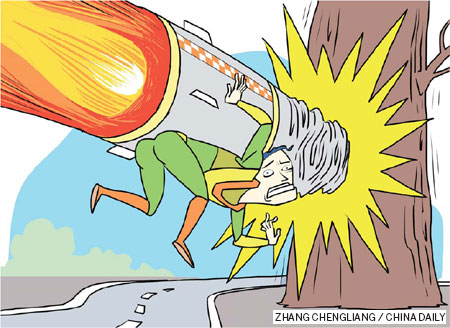
Calls for a change in China's direction are wrong headed
In the next 15 years one of the greatest turning points in world history can occur. In five to seven years China will become the world's largest economy. In about 15 years China will achieve the annual $12,000 GDP per capita qualifying it as a developed economy by World Bank criteria. China is so large that these events will change the world. For example, China's 1.3 billion population is larger than the combined 1.1 billion of all existing developed economies.
But these successes are not inevitable. China has enjoyed tremendous economic achievements since 1978, experiencing in the last decade the fastest per capita GDP growth in any major economy in history, and the fastest growth of consumption in a large country. It achieved this because it followed economic policies laid out by Deng Xiaoping from 1978. But now an attempt is being made by some to divert China onto an economic path, neo-liberalism, which has failed wherever it has been carried out. Examining the factual record of neo-liberal policy shows the scale of what is at stake both for China and internationally.
Neo-Liberal policies were applied in Latin America in the 1980s. The result was that Latin America's per capita GDP fell by an average 0.5 percent a year for 10 years.
In the former Soviet Union neo-liberal shock therapy, based on full privatization, was carried out after 1991. Russia's GDP fell 36 percent, the greatest decline of a major economy in peacetime in modern world history. Russia's male life expectancy fell by four years, to only 58, by 1998 and Russia's population today is 7 million less than it was in 1991.
Neo-liberal policies in the US instigated under Ronald Reagan led to the colossal accumulation of debt that culminated in the international financial crisis of 2008. During the earlier Keynesian period of US economic policy, lasting from the end of the Korean War (1950-53) until 1980, US state debt fell from 70 percent to 37 percent of GDP. During the succeeding neo-liberal period US state debt rose to 88 percent of GDP by last year. Over the same period the 10-year moving average of annual US GDP growth fell from 3.3 percent to 1.6 percent. Under neo-liberal policies US state debt more than doubled, and US economic growth halved.
Given neo-liberalism's disastrous record, which is even starker when compared with China's growth, how can anyone advocate that China adopt such a failed policy? The answer is that intellectually this can be done only by making no reference to economic facts or by falsifying them. An example of the latter is the assertion that China's investment is less efficient than that of economies such as the US when the facts show the opposite. Even before the international financial crisis China had to invest only 4.1 percent of GDP to produce each percentage point of economic growth, compared with the 8.8 percent in the US. Since the financial crisis the US position has worsened.
Neo-liberalism fails as economic policy because it refuses to follow science's first rule of starting with the facts, or, in the famous Chinese phrase, it refuses to "seek truth from facts". Rather in the style of pre-Copernican astronomers who insisted that the sun orbited the Earth, because they failed to make measurements showing the Earth circles the sun, neo-liberals construct models of an economy that does not exist. They imagine an economy made up of millions of competitive firms (technically "perfect competition"), in which prices are flexible downward as well as upward, and in which investment is a low percentage of the economy. The real economy is nothing like this.
The scale of investment has been rising for 300 years to levels of 20 percent, or even more than 40 percent, of GDP. Huge financial structures were necessarily created to centralize the resources for this. Banks now agreed to be "too big to fail", and which therefore cannot be allowed to operate in a free market without incentivizing uncontrollable risk taking. Due to this high investment the world's most important industries - automobiles, aviation, computers, finance, pharmaceuticals - do not operate according to "perfect competition" but are monopolies or oligopolies. As neo-liberalism does not correspond to economic reality its policies are necessarily damaging.
For this reason, even when not fully adopted, neo-liberalism's influence damages China's economy. For example, early this year severe negative pressure on China's economy occurred due to a downturn in the global economy driven by a fall in private investment. However, due to the influence of neo-liberal views, that the State should "get out" of the economy, the necessary stimulus to counter this was not launched early enough. Fortunately, in the second half of the year, China's government launched a required medium-scale State-led investment stimulus that stabilized the economy during the third quarter and should now lead to accelerated growth.
The consequences for the popularity of those implementing neo-liberal policies, and for social stability, are also clear. For example in Britain David Cameron launched the Big Society, the concept that the state should be small and be replaced in social protection by the market and voluntary organizations. But factual evidence shows that pure operation of the market increases, not decreases, social inequality and fails to provide social protection. The result under Cameron was sharply rising social inequality, ridiculing of his policies even by those not associated with the political opposition, and a collapse in the government's popularity.
In China, where there is a widespread consensus that in the recent period social inequality has gone too far, and which due to size is more difficult to govern than any European state, to embark on neo-liberal policies, which would inevitably increase inequality, would not only be economically damaging but socially and politically destabilizing.
However, neo-liberalism is not just an intellectual theory. Many people profit from it. In the US most of those in the finance sector who led its economy to disaster in 2008 retain the private wealth gained from neo-liberal policies.
Two groups of people would gain from neo-liberalism in China, and therefore support it. The first are some financial layers in the country. The second are US neo-con circles that aim to maintain the US as the world's largest economy despite remorseless arithmetic showing this is impossible.
The population of the US is only 23 percent of China's. The only way the US could remain the world's largest economy is if China's per capita GDP, and by implication its living standards, never reaches 23 percent of US levels. Quite rightly China's population will never accept they can only have less than one quarter of the US living standard; nor in the future will India. As China's GDP per capita moves toward that of the US China's economy will become first the largest and later the strongest in the world. The only way to stop this is to sharply slow China's economic growth, neo-liberalism's disastrous consequences being the way to achieve that.
China's economic rise immensely benefits not only itself but humanity. When, in about 15 years, China achieves advanced economy status, 35 percent of the world's population, for the first time in modern history, will enjoy the benefits of this. When China has come so close not only to full national revival but to decent living standards for its people it would be one of the greatest tragedies in world history for neo-liberalism to block this.
The author is a visiting professor at Shanghai Jiao Tong University. From 2000 to 2008 he was the economic adviser to the mayor of London. The views do not necessarily reflect those of China Daily. Contact the writer at johnross43@gmail.com
(China Daily 11/02/2012 page9)

 US honors its veterans with ceremonies, parades
 Carnival season kicks off in Cologne
 Typhoon Haiyan hits Vietnam
 UK's Royal Air Force marks ties with Bahrain
 Red Cross Red Crescent holds meetings in Sydney
 Intl space crew returns Olympic torch to Earth
 Philippines storm kills estimated 10,000
 Games of Indigenous People kicks off in Brazil

Copyright 1995 - . All rights reserved. The content (including but not limited to text, photo, multimedia information, etc) published in this site belongs to China Daily Information Co (CDIC). Without written authorization from CDIC, such content shall not be republished or used in any form. Note: Browsers with 1024*768 or higher resolution are suggested for this site.
License for publishing multimedia online 0108263 Registration Number: 20100000002731