Comments
  Print
Print  Mail
Mail  Large Medium Small
|
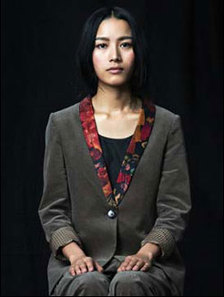
Above and right: Neemic's designs, three of which are shown here, are created with the aim of doing as little harm to the environment as possible. Left: Hans Martin Galliker. |
A one-time Swiss farmer is making a mark on the fashion scene, and doing his bit to look after the planet
A little less than half a lifetime ago Hans Martin Galliker was starting a farming apprenticeship in Switzerland. Now, 17 years later, he is in the fashion business, and the backdrop of his working life is not soaring mountains and glistening Lake Lucerne but an ancient courtyard in Beijing. But even in the Chinese capital, traces of Galliker's bucolic young years are still apparent in the life he leads: one of the driving forces behind his fashion brand Neemic is the utmost respect for the environment.
|
|
Neemic, which Galliker founded with a friend, Amihan Zemp, in 2010, and which promotes sustainable fashion, will soon launch the first of its collections after a gestation of more than a year.
Sitting on the veranda of a courtyard house in Dongsiqitiao hutong (alley) in Beijing, Galliker is having breakfast: corn flakes, yoghurt, milk, honey, fruit, and roasted barley tea served in a china teapot.
The house, for which he pays 6,000 yuan ($960; 740 euros) a month, from savings in Switzerland, includes working and living space for Galliker and a team member.
Galliker says he generally leads a simple life, the aim being to avoid waste and reduce pollution. That means, for example, that in summer he and his colleagues rely on a sprawling tree outside, rather than air conditioning, to offer respite from Beijing's sometimes torpor-inducing heat.
"This shirt was bought in Berlin in 2001, and these shorts were bought in Switzerland in 2004, and my latest investment is the Giant bicycle five months ago," he says. "Maybe I will need a new computer next year because the current one is really slow."
|
|
It all started two years ago when Galliker worked in the small fashion company of a friend in Shenzhen, South China. His experience working on organic farms put him onto the idea of fashion-design sustainability, which advocates the use of organic fabrics and implementing the principles of fair trade in the fashion and textile industries.
Galliker talked with friends about the idea, one of them Zemp, who was working in the fashion industry at the time.
"Actually, she studied sociology and religion, but she is very interested in fashion, and at the time was working in the industry in Berlin, learning all things about fashion weeks and fashion fairs. When I told her my idea she said she wanted to do it, so she moved to China from Switzerland."
Neemic's website, www.neemic.cn, notes that "the world has enough fabric already" and says the people at Neemic pick "the finest natural materials from leftovers of the industry, recycle used clothes, and strive to order new fabrics only from certified organic producers".
Galliker says: "There are many fashion brands and many of them are meaningless because they do fashion which looks more or less the same, which has no creativity and does a lot of harm to the environment.
 |
"Growing cotton is highly chemicals and labor-intensive, which degrades the soil and pays people very low salaries. And the dying and coloring processes pollute rivers and people receive low salaries but have to work long hours. The whole textile industry is really bad for the environment."
So Neemic does not want to add to the problem, he says.
Zemp's latest fall/winter collection has been well received in the industry and creative circles.
"Three months ago we started selling some of our designs at a boutique in Beijing that focuses on upcycling fashion. People like it and want to buy more," Galliker says.
But Neemic cannot use organic fabrics in all of its collections, he says, because it is hard to find suitable certified organic fabric in China, and the company is too small to buy large amounts of organic material from the few Chinese suppliers.
"But we have to be pioneers, and we have to make a starting point. We have to show people it's possible to do stylish organic clothes, and we are proving we can do it."
Neemic is not Galliker's only project aimed at promoting environmental sustainability in fashion. He plans to set up a Beijing chapter of the Organic Textile Association, which he cofounded in Hong Kong, and which encourages fashion designers to jointly buy organic material. He also has a website that publishes material on sustainable agriculture innovation in China, domestic policies for organic farming, and sustainable businesses for entrepreneurs, investors, researchers and decision-makers in this field.
Galliker says he has been to more than 30 countries, and while his early years were rooted in farming, he has been a jack of several trades since then, including being a salesman, a gardener and an account manager with IBM.
He studied at Beijing Union University for four and half months until the beginning of 2009, and in that time decided that if he was to bring his environmental project to fruition he would need to stay in China for 10 years.
He has spent a lot of time traveling around China in a car with two other foreign students and visited 17 provinces, including Guangdong, Fujian, Jiangsu, Zhejiang, Jiangxi and Yunnan, studying Chinese agriculture, he says. After returning to Beijing he made a point of visiting farms and vegetable-trading fairs to learn more.
"It's very normal for Chinese farmers to use many fertilizers, but the environment is going bad and consumers do not like this kind of farming. For farmers it's not meaningful to produce only to make money to live a decent life. It should be more than that. So I am interested in concepts such as organic farming, the slow-food movement, local production and local consumption, and started to learn more."
"From designing to farming, everything is sustainable People who are interested in our fashion project may not be interested in our fertilizers database project. With the fashion project, maybe we cannot make the environment better, but it can help to promote projects like the fertilizer database."
In the courtyard house's business operations Galliker and his friends are doing almost everything bar the sewing, including programming for their multilingual websites and taking online payments.
Galliker hopes they can soon attract investment so they can buy machines and material and employ their own sewing staff to start production.
Although production is yet to start, he says, he wants Neemic's fashion wear not only to be made with organic fabrics but also to comply with fair-trade standards, under which employers need to pay for employees' further education and provide good working conditions, including holidays and special leave.
"In two years we want to do fair-trade production," he says. But Galliker's dreams are not limited to China, and he has already sown the seeds for what he will be doing once his 10 years in China are up.
"In the long term we will have many successful projects here or non-profit companies, a lot of creative force and investment so that we can help rural regions in Africa to do sustainable agriculture projects. If I have the contacts and capital, I can use them to do good, useful sustainable projects there."
yangyangs@chinadaily.com.cn
(China Daily 10/19/2012 page29)

 Filipinos suffer from shortage of typhoon aid
 Healthy baby born to brain-dead mom in Hungary
 Abe honors heroic Chinese student
 Twin panda cubs at Zoo Atlanta
 Hawaii legalizes gay marriage
 Graduation celebration for Santas
 One World Trade Center deemed tallest US skyscraper
 US honors its veterans with ceremonies, parades

Copyright 1995 - . All rights reserved. The content (including but not limited to text, photo, multimedia information, etc) published in this site belongs to China Daily Information Co (CDIC). Without written authorization from CDIC, such content shall not be republished or used in any form. Note: Browsers with 1024*768 or higher resolution are suggested for this site.
License for publishing multimedia online 0108263 Registration Number: 20100000002731