Comments
  Print
Print  Mail
Mail  Large Medium Small
|
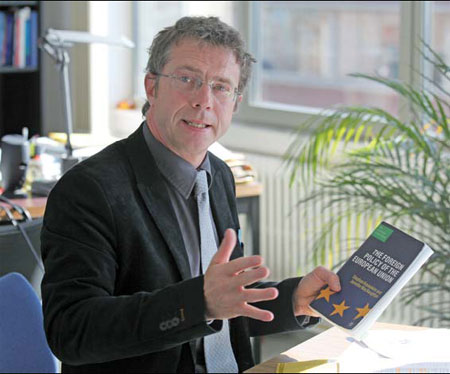
European foreign policy expert Stephan Keukeleire says it does not make sense to say China is not a market economy. Fu Jing / China Daily |

European policymakers should end arms embargo and grant market economy status to China
European foreign policy professor Stephan Keukeleire has shared the same sentiments with Premier Wen Jiabao, who takes Brussels' long reluctance of lifting arms embargo and granting market economy status as "two regretful things".
Furthermore, Keukeleire believes that Brussels did not answer Beijing's repeated requests, partially because of a lack of self-confidence and the influence of America's global leadership.
Keukeleire is the Jean Monnet Professor at the Institute for International and European Policy of the Catholic University of Leuven and chair-holder of the Total Chair at the College of Europe in Bruges, Belgium.
As a close observer of the decision-making process in Europe, Keukeleire says the European Council made a "major mistake" in 2005 by going back on an earlier decision to end the arms embargo against China. He says that the European Council backtracked on the earlier decision of the ministers of foreign affairs due to dissent among some member states and also at the behest of the United States.
"I followed that quite closely at that time. The EU missed an incredible opportunity to launch a real strategic partnership with China. I think it has been a major mistake that the arms embargo was not lifted then," says Keukeleire, sitting in his chambers at the Catholic University of Leuven, one of the oldest universities in the world, which started operations in 1425.
For several years Beijing has been putting pressure on Brussels to end the arms embargo imposed in 1989 and also grant China market economy status. Though Premier Wen Jiabao expressed satisfaction at the overall progress in bilateral ties during the China-EU summit in Brussels last month, the impasse on these issues continued to be his "two major regrets".
Keukeleire says that Europe is still reliant on the US, especially some Eastern European nations, and often turns to Washington for that extra bit of security and insurance in diplomatic matters. Europe's arms embargo has been motivated by the US ban on arms and high-tech exports to China due to national security concerns.
Though the US influence is a major factor, there are also divergent views among various European nations on the issue.
"This is a major obstacle for overall consensus. In many European nations, if something major were to happen they would first call Washington and not Paris, London or Brussels. It is important for these nations to have an open-track policy and keep their external channels of communication with the US open always," he says.
Keukeleire says that things have now become more difficult for Brussels due to the impending US presidential polls and the continuing tensions between China and Japan over the Diaoyu Islands.
With incumbent Barack Obama facing a tough challenge from Mitt Romney, Keukeleire says it will be difficult to conclude how the US factor matters for Brussels' foreign policy. "Romney or Obama, it may make a huge difference."
He points out that the political distance between Europe and the United States will be larger if Romney becomes the president, as the Republican candidate may not be at ease with the European political ideology.
"In such a scenario, it might be easier for European countries to expand their partnership with the other parts of the world," says Keukeleire, implying that relations between Beijing and Brussels look poised for an easier future.
However, Keukeleire says Romney may adopt a tougher policy stance on Asia, with special focus on Japan and other regions, to stir up more trouble for China.
"Tensions in Asia may make it difficult for Brussels to address the arms embargo issue with China," he says.
"The tension between China and Japan over the Diaoyu Islands and with other Asian nations on territorial issues should not be stirred up unnecessarily."
Justifying his statement, he says that if more disputes were played up, then there would be concerns over an arms race in Asia. "It would become even more difficult for European lawmakers to end the arms embargo," he says.
"We have to hope that the tensions are manageable. Otherwise, it will be very difficult for European politicians to justify the need to end the arms embargo."
Keukeleire says Beijing should consider what his peers term as "security dilemma" before making decisions.
"With China and Japan strengthening their security mechanism, there are now more fears about the military build-up," Keukeleire says.
"That is a point that I hope will be contained."
He says China has in general taken a peaceful route to solve its territorial disputes with third states. "I think China and some other Asian countries can point to several examples where they resolved vexed issues in a smooth and permanent manner."
As far as market economy status is concerned, Keukeleire says there are several aspects to the issue. Corporate ownership, finance and bankruptcy matters are gray areas that need to be addressed before any decision is made on the market economy status.
"I'd like to say that several of the changes expected by the EU from China are reminiscent of the actions taken by EU countries some 20 or 30 years ago," Keukeleire says.
"If you look at the European, French and Belgian economy in the 1980s, you will see a lot of State-owned enterprises. There were also strong linkages between the states and the economic leaders. Moreover, the EU now suffers from major financial weaknesses in its economic system, forcing the political authorities in Europe to intervene."
According to Keukeleire, it really does not make any sense in saying that China is not a market economy. "Obviously, China is a market economy. How can the EU's second-biggest trade partner, China, whose most important trade partner is the EU, not be a market economy?" he asks.
The European affairs expert says that although the EU is right on some points, as it is defending its own interests, if some of its concerns are dealt with, it will not be able to stop recognizing China as a market economy because of the huge State role in industries.
Keukeleire says he looks at EU-China ties and other relations from the perspective of an external observer, with added focus on European foreign policy.
Keukeleire says that what has really been interesting is that despite the squabbles, ties between the two sides are on a solid footing.
Though there are conflicts between China and European Union, they have never been over-emphasized or blown out of proportion.
"This is a positive trait in itself," he says.
However, it is also quite possible that at some particular meeting there have been heated discussions and much debate over some issue that is a major concern, such as the solar panel dispute or on other trade-related matters. But this did not undermine the overall relationship.
"Many of these issues are being tackled within the different specialized frameworks," Keukeleire says.
The different dialogues between the two sides, even on matters such as cyber space security, have been making new ground.
"Again, it has not been that spectacular, but from a long-term perspective, it provides the basis for gradual transformation across various sectors," he says.
Looking at the comprehensive strategic partnership that Beijing and Brussels announced a decade ago, the professor says, "The EU and China have never created a strategic partnership, but it has been established as a goal, or even more, as a process, a long-term process."
Liu Jia contributed to this story.
fujing@chinadaily.com.cn
(China Daily 10/12/2012 page32)
 US honors its veterans with ceremonies, parades
 Carnival season kicks off in Cologne
 Typhoon Haiyan hits Vietnam
 UK's Royal Air Force marks ties with Bahrain
 Red Cross Red Crescent holds meetings in Sydney
 Intl space crew returns Olympic torch to Earth
 Philippines storm kills estimated 10,000
 Games of Indigenous People kicks off in Brazil

Copyright 1995 - . All rights reserved. The content (including but not limited to text, photo, multimedia information, etc) published in this site belongs to China Daily Information Co (CDIC). Without written authorization from CDIC, such content shall not be republished or used in any form. Note: Browsers with 1024*768 or higher resolution are suggested for this site.
License for publishing multimedia online 0108263 Registration Number: 20100000002731