Comments
  Print
Print  Mail
Mail  Large Medium Small
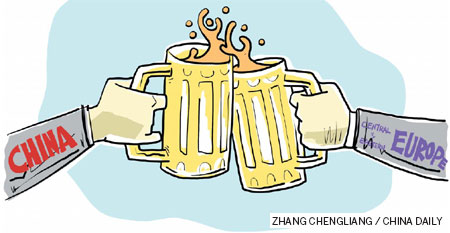
China's ties with a clutch of Central and Eastern European countries pave the way for a better relationship with the EU
Relations between China and Central and Eastern Europe have blossomed in recent years, in the manner of two old friends getting to know one another again after being apart for a very long time. The two are now building a relationship that should bring cheer to all and offense to none.
In the eyes of Chinese academics the relationship between the two has gone through four stages: warm (1949 to the early 1960s), frozen (1960s to 1978), thawing (1978 to 1989) and warming up (1989 till now). So it is only natural that when Chinese leaders talk about the countries of Central and Eastern Europe, they most often refer to it as "traditional friendship". Indeed, when China has gone through difficult times, the political and economic support these countries provided was of great help. This is the solid foundation on which relations between China and the Central and Eastern European countries are now being built.
Since the 1990s, dealing with prevailing conditions particular to each, China and these countries have embarked on different paths of political and economic development, even if both have geared themselves to reforming old systems, grappling with economies in transition and exploring political and social reform.
As Central and East European countries have joined the European Union, the world's largest group of developed countries, over the past 10 years or so, their relationships with China have taken on a new dimension: instead of having a limited significance, bilateral and regional, they have also become globally significant.
The current euro debt crisis has only served to strengthen the ties. As a bridge between Europe and Asia geographically and culturally, Central and Eastern Europe is playing an indispensable role in the China-EU exchange.
Undoubtedly, enlightened economic self-interest has had no small role in all this goodwill, but beyond the financial dividends for everyone, economic exchanges have promoted personnel exchanges, social exchanges and civil dialogue.
In the 10 years to last year, bilateral trade rose from $4 billion (3.1 billion euros) to $52.9 billion, growing at an average of 27.6 percent a year. China's exports to Central and Eastern European countries rose from $3.4 billion to $32.2 billion, growing at an average of 31 percent a year.
Among these countries, China is now the second-largest trading partner after the EU. However, in building any stable, long-term country-to-country relationship, much more is needed than sound economics and sound trade. The two sides also need to develop structural economic integration and to build consensus on politics, security and governance regionally and worldwide. This is the direction China has been working toward to strengthen its strategic partnership with Central and Eastern Europe over the past few years.
Making the most of their historical ties and geographical advantages, Central and Eastern European countries are well positioned to play a key role as the EU's long-term strategic partnership with China develops. Economic diplomacy is an important aspect of China's policies in Central and Eastern Europe, but it should not be the only policy priority.
The current global economic crisis is changing the world as countries and institutions re-evaluate the way they work, including how they handle foreign policy, and China is no exception. "Closer integration" has been advanced as a solution to the European debt crisis, even as the rich diversity and complexity of Europe has become ever clearer.
Those working on developing a stable long-term relationship between China and the EU need to take into account the possibility of a more integrated Europe as well as the reality of diversity. China, bearing in mind its traditional relationship with Central and Eastern Europe, and in the context of its relationship with the EU, needs to plan and implement a more explicit policy toward Central and Eastern Europe.
Historically, Central and Eastern Europe has been known as "the land between", and the countries of the region have long striven to rid themselves of the albatross of power politics. China understands that predicament only too well, which gives it a headstart in building a constructive relationship with these countries.
One of the biggest challenges to the relationship is the crossover between matters economic and political. For example, some Central and Eastern European countries, while keen to draw on the advantages of doing business with China, feel compelled to criticize it over "human rights" or other issues, egged on by third parties. These Central and East European countries can proclaim that their trade ties with China are based on nothing more than the desire to have a stable political relationship, but their fickleness as a partner and their readiness to criticize will do no favors for anyone.
Even where the traditional friendly relationship is going well, there is always a need for both sides to look for improvements, for areas of possible growth and for areas where each side can help the other. For example, despite China's economic strength and international influence, it still needs the backing of Central and Eastern European countries on issues such us Tibet, Taiwan, human rights, lifting the EU's arms embargo on China, and cracking down on separatist forces.
Central and Eastern European countries appear to have no serious issues requiring China's strategic support, so it is important to keep strategic trust, political cooperation, economic exchanges and cultural dialogue in balance.
Another issue to bear in mind is economic and trade imbalances, which will obviously weigh on the political relationship, particularly given the fact that the trade imbalance between China and Central and Eastern Europe far exceeds that between China and some developed countries.
Finally, some Western academics see fierce competition between the "established powers" and "emerging countries", and if there is any truth in that, Central and Eastern European countries can play a role in promoting cooperation above confrontation.
If China and the EU are serious about having a modern, dynamic and durable relationship, they could do no worse than taking the relationship between China and Central and Eastern Europe as their role model.
The author is director of European Studies at the China Institute of International Studies. The views do not necessarily reflect those of China Daily.
(China Daily 09/14/2012 page10)

 US honors its veterans with ceremonies, parades
 Carnival season kicks off in Cologne
 Typhoon Haiyan hits Vietnam
 UK's Royal Air Force marks ties with Bahrain
 Red Cross Red Crescent holds meetings in Sydney
 Intl space crew returns Olympic torch to Earth
 Philippines storm kills estimated 10,000
 Games of Indigenous People kicks off in Brazil

Copyright 1995 - . All rights reserved. The content (including but not limited to text, photo, multimedia information, etc) published in this site belongs to China Daily Information Co (CDIC). Without written authorization from CDIC, such content shall not be republished or used in any form. Note: Browsers with 1024*768 or higher resolution are suggested for this site.
License for publishing multimedia online 0108263 Registration Number: 20100000002731