International partnerships build connections
Updated: 2012-09-12 07:52
(China Daily)
|
|||||||||||


|
The majestic Victoria Falls, site of a new telecommunications project Provided to China Daily |


From eLearning to rural telephony, ICT is the backbone of growth for Zimbabwe's economy
As well as modernizing the country's financial system, the government is also laying the foundations for Zimbabwe to become a digital society by 2015.
While this may sound ambitious for a developing country, the information technology and communications landscape has changed exponentially since 2008; the cellphone telephony penetration rate skyrocketed from 13 percent to 72 percent in 2011, while Internet penetration jumped from 1.3 percent in 2008 to 24 percent last year, amounting to some 1.42 million users.
As the International Telecommunications Union recently reported, 8,000 primary and secondary schools in Zimbabwe will shortly be connected to the Internet as part of a new national eLearning program, which aims to take in the rural areas in due course.
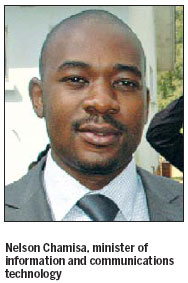
Nelson Chamisa, the country's minister of information and communications technology said: "All political parties in the government have agreed that eLearning should be a priority in order to improve our education system."
He added that the State would be furnishing educational institutions with computers so that all schools go digital by 2014.
Although Zimbabwe enjoyed a relatively sophisticated communication links before the so-called "lost decade", some of the connections have been poorly maintained, and minister Chamisa is committed to changing this and bringing the nation's ICT infrastructure up to the standards of developed countries.
"ICT has to be the backbone of Zimbabwe, and the first key element to achieving that is to build the necessary infrastructures," he said. "We have focused on putting fiber optic cables in place and over the past couple of years, have done very well. After connecting with Mozambique and South Africa through submarine fiber optics, we have managed to catch up.
"The Zimbabwean people are digital immigrants, and our enthusiasm and appetite for technology is incredible!"
Echoing the statements of the other government officials interviewed, Chamisa also praises the learning capacity of the Zimbabwean people.
"Our greatest resources and assets are our people and we are not afraid of difficulties," he said. "Zimbabweans have the abilities, talents and education to move forward right now. We have to improve the business environment, but communication is the locomotive of human transactions, and we are confident we will reach our goals."
Although there is currently a strong link with Zimbabwe and China in the technological sector - Chinese high-tech giant Huawei has partnered many companies in the southern African country - Minister Chamisa expects many more opportunities to open up, particularly in infrastructure, software and private-public partnerships. Econet Wireless is the largest provider of telecommunications services (see page 5 for full story), and expects to have invested a total of $1 billion by the end of this year.
For Reward Kangai, managing director of Net One, the first cellular network operator in Zimbabwe to provide GSM services, the telecoms landscape has never looked better.
"We have passed through our lost decade," he said. "While other African countries invested more than $10 billion in telecommunications, Zimbabwe invested less that $500 million.
"The changes that came about in 2009 created the right environment to facilitate growth. As a Zimbabwean citizen, I welcome this development because it was effective in so many ways.
"Telecommunications, mining and tourism are fundamental sectors for Zimbabwe to achieve the kind of high growth we expect in the hope we can focus on building the infrastructure needed for our country. In terms of ICT, we are behind the rest of the world, so there are many opportunities for investment."
Universal access
As the ambitious Minister continued: "We want everyone, whether they live in the cities or rural areas, to be able to access ICT services, but people in the rural areas - around 7.8 million according to a World Bank report published last year - are underserved because most of the rural areas need roads, electricity and so forth.
"Building ICT infrastructures requires a lot of investment, but I have no doubt the government's 2015 plan will happen. We have already made a significant step forward and there are a lot of projects already coming from China.
"Because of our literacy rate, ICT will be more readily accepted by the general population who can exploit its potential.
"The government has invested in education since independence, and most people can speak English so we can communicate with the rest of the world, which is a big advantage.
"With new infrastructure, we will provide a base for expanding the economy: it will be possible in the future to do financial transactions using your mobile phone. By 2015, Zimbabwe will be there."
In 2010, Zimbabwe signed a loan agreement with China's Exim Bank for $45 million, and Net One, which is wholly owned by the government, has benefited hugely from this money to implement large telecommunications projects.
"We started cooperation with Huawei in 2005, and they established the second mobile switching center in Bulawayo, Zimbabwe's second-largest city," Kangai explained.
"Now the city of more than 700,000 people can communicate quickly and easily. Our next project in telecommunications infrastructure will involve Victoria Falls. There is a Chinese team of engineers and technicians working closely with Net One to deliver a faster Internet service in that area.
"It is our intention to conjoin Huawei in building a very fast mobile telecommunications network infrastructure using the latest technology called Long Term Evolution."
"We will open up a very fast information super highway that will allow people to be part of modern day life, covering many aspects such as e-education, e-government, mobile commerce and so forth."
InFocus provided the story.
(China Daily 09/12/2012 page7)






Hot Topics
Editor's Picks

|

|

|
|

|

|