Comments
  Print
Print  Mail
Mail  Large Medium Small
|
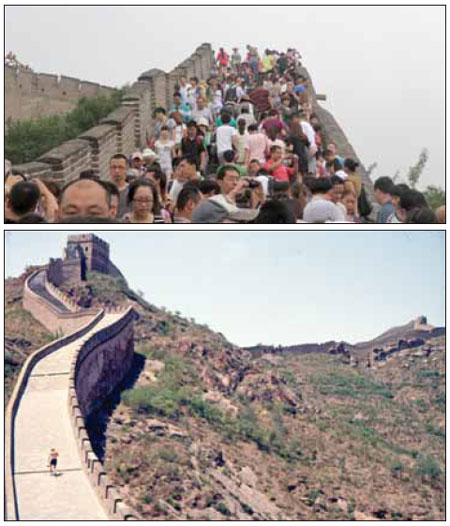
The Great Wall had few visitors in 1972 (above) but 40 years later it is crowded with tourists from around the world (top). Photos by Stefan A. Pedersen and Stig N. Pedersen / for China Daily |
An artist retraces a trip that his father made decades earlier
In July 1972 a young Dane studying psychology in Copenhagen traveled with his class to China on a one-month visit. At the time, such visits were rare - US president Richard Nixon had made his door-opening visit to China just five months earlier - and of course the student, Stig Pedersen, kept a full record of his trip, including a journal and 16 mm film. Exactly 40 years on, his son, Stefan Pedersen, 32, an artist, has just been to China for the first time, using his father's records as a kind of compass.
"I thought as an experiment it would be interesting to see what I could get out of retracing my father's steps," Pedersen says. "And as an artist I have been interested in how, historically, China has been seen in the West as something unified - as if we all agree on what it is, what it means."
For centuries, people in the West have constructed notions of China, he says.
Pedersen says his specific interest in China stems from the material he inherited from his late father.
"The trip was not so much to make a direct comparison between 'his' China then and 'my' China today, but perhaps more in order to confront myself with similar challenges of dealing with the representation of a trip like this: traveling for one month through a relatively limited part of China, and seeing what that means."
Before he started the trip, Pedersen says, he had been reluctant to linger on his own impressions of China. "I have been more interested in how China is being represented and how it represents itself in various ways and situations."
As an artist, Pedersen's trip was also designed to be an art project, dealing with the historical representation of China, starting with the study of his father's trip materials. He used his father's unfinished film and diary notes to shape the trip.
This experience will manifest itself in an exhibition at the Overgaden Institute of Contemporary Art in Copenhagen this autumn.
"The theme of the exhibition is not going to be a direct comparison of my father's trip and mine, but more a journey into what it means to be out of sync with your subject - historically, geographically and personally."
The first stop on Pedersen's journey was Beijing, in the first week of July. He then took trains to Zhengzhou, in Henan province; Changsha and Shaoshan, Hunan province; Hangzhou, Zhejiang province; Shanghai; Guangzhou and Shenzhen, Guangdong province; and finally he flew home from Hong Kong on Aug 5. Shenzhen, which in 1972 was a mere flicker of the city it has become, was the only one of those stops not on his father's itinerary.
One big difference between the trips of father and son, of course, was Stefan Pedersen's ability to connect with people almost anywhere on the planet to let them know what he was doing.
"Most contacts are Chinese, whom I met through either people in the ever more internationalized art world, or academic researchers. I found that expat communities can be a limited way through which to get to know a new place. Often what they share is that they are foreign, and for me, it's not an interesting way of creating a community in this context.
"It may sound naive, but I really learned something about scale. Coming from Denmark, it was quite impressive to visit several provincial capitals whose metropolitan area has roughly the same population as Denmark."
Beijing has a population of more than 20 million, and provincial capitals like Zhengzhou, Changsha and Hangzhou have populations of more than 7 million; Denmark's population is about 5.5 million.
Of course, another thing that has developed immensely since Pedersen senior was in China is air travel, but Pedersen junior decided to stick to old-fashioned trains - one or two bullet trains notwithstanding - to get the most out of his trip, even if that meant a 12-hour ride from Shanghai to Guangzhou.
Not only did trains offer a better chance to lap up the scenery, but more opportunities to chat with people, Pedersen says.
"I took the soft-berth class on the train from Shanghai to Guangzhou, which was a pity, because I (could) get to see more and meet more people on hard-berth ones." (In the soft-berth class of China's long-distance trains there are discrete compartments, each with four bunks, while the hard-berth class has a more open design, reducing physical barriers and making it easier for people to communicate with their fellow passengers.)
In a small county near Shenzhen, on one of the last stops of his trip, Pedersen looked like an expatriate who had been in China for years, familiar with China in many aspects.
Even though he was on his first trip to China and unable to speak Chinese, he managed to get from Shenzhen to a nearby county and hire an electric tricycle to get about.
Pedersen says the most memorable experience of his trip was Zhengzhou Tractor Factory, which still exists, but which had its heyday in the 1970s.
He met some of the old workers and a former engineer, and showed them a film his father had shot 40 years ago of the production in the factory.
"They are now demolishing parts of the old factory buildings in order to make space for housing. So in one way the situation also somehow represented a change: a seemingly outdated mode of communal production giving way for the booming real estate market."
Pedersen says it was difficult to sum up his impressions of China after such a trip. While it was an extraordinary experience, he says, in many ways he found that as he followed his father's path it all seemed strangely familiar.
"Trying to see things through his eyes, but failing because of the historical gap between our two journeys. To sit in the park of the Temple of Heaven and reading my father's words of how he ponders if he will ever return to Beijing - he didn't - was a moment I will never forget."
yanyiqi@chinadaily.com.cn
(China Daily 08/31/2012 page29)

 Filipinos suffer from shortage of typhoon aid
 Healthy baby born to brain-dead mom in Hungary
 Abe honors heroic Chinese student
 Twin panda cubs at Zoo Atlanta
 Hawaii legalizes gay marriage
 Graduation celebration for Santas
 One World Trade Center deemed tallest US skyscraper
 US honors its veterans with ceremonies, parades

Copyright 1995 - . All rights reserved. The content (including but not limited to text, photo, multimedia information, etc) published in this site belongs to China Daily Information Co (CDIC). Without written authorization from CDIC, such content shall not be republished or used in any form. Note: Browsers with 1024*768 or higher resolution are suggested for this site.
License for publishing multimedia online 0108263 Registration Number: 20100000002731