Comments()
  Print
Print  Mail
Mail  Large Medium Small
分享按鈕
0
Large Medium Small
分享按鈕
0TOKYO — As the US and its allies decry Pyongyang's planned rocket launch, they're also rushing to capitalize on the rare opportunity it presents to assess the nation's ability to strike beyond its shores.
|
 |
If Pyongyang goes ahead with the launch, expected between April 12-16, the United States, Japan and South Korea will have more military assets on hand than ever to track the rocket and — if necessary — shoot it out of the sky.
Behind the scenes, they will be analyzing everything from where the rocket's booster stages fall to the shape of its nose cone. The information they gather could deeply impact regional defense planning and future arms talks.
Military planners want to know how much progress Pyongyang has made since its last attempt to launch a satellite three years ago. Arms negotiators will be looking for signs of how much the rocket, a modified ballistic missile launcher, uses foreign technology.
"There are a number of things they will be watching for," said Narushige Michishita, an expert with Japan's National Graduate Institute for Policy Studies. "If Pyongyang does get a satellite into orbit, that means it could deliver an object anywhere on the globe, and that has intercontinental implications."
One thing analysts could quickly test is Pyongyang's insistence that the satellite launch is a peaceful mission. Experts can easily estimate from photographs the rocket stages' mass ratio — a measure of their efficiency — and that will give a quick indication of whether the rocket is designed primarily to be a space vehicle launcher or long-range missile.
They also will be watching where the rocket goes.
Pyongyang?says it will fire the satellite into a polar orbit. The "splash zones" for the booster stages suggest it will travel south over the East China Sea and the Pacific, rather than the easterly path it chose for a launch in 2009 that sent the rocket directly over Japan's main island.
That could indicate?Pyongyang is being more cautious about its neighbors' reactions — though it has alarmed others such as the Philippines which could be in the rocket's path. But the launch could also have military implications.
If?Pyongyang were to attack the United States, Michishita said, it would likely launch to the north. It can't feasibly conduct such a test, because that would anger Russia and China, which would be under the flight path. Launching to the south can provide similar data.
Actually reaching the splash zones is another hurdle. In its 2009 launch, the stages barely made their zones, suggesting they had lower thrust than expected.
Analysts stress that success by no means suggests Pyongyang could pull off an attack on the US.
Pyongyang?has a long way to go in testing the technologies required for re-entry — a key to missile delivery that is not tested in satellites. And while it is believed to be capable of producing nuclear weapons — and almost certainly wants to put them on a military-use missile — it is not yet able to make them small enough to load into a warhead. Doing so will likely require another nuclear test, which North Korea hasn't done since 2009.
The launcher itself is another issue — and it has a history of failure.
The Unha-3 rocket that will be used is believed to be a modified version of the long-range Taepodong-2 ballistic missile, which mixes domestic, Soviet-era and possibly Iranian designs.
Pyongyang?launched its first Taepodong-2 in 2006 and it exploded just 40 seconds after liftoff. A follow-up attempt in 2009 got off the launch pad and successfully completed a tricky pitching maneuver, but analysts believe its third stage failed to separate, sending it and the satellite it carried into the Pacific.
Even so, physicists David Wright and Theodore Postol of the Union of Concerned Scientists say the 2009 launch displayed major strides over the Taepodong-1. If modified as a ballistic missile, they say, it would potentially give?Pyongyang the capability to reach the continental United States with a payload of one ton.
In an analysis of the 2009 launch, Wright and Postol suggested Pyongyang relies heavily on a stockpile of foreign components, likely from Russia. If data from the upcoming launch confirm that, it may mean Pyongyang's missile program is severely limited by the isolated country's ability to procure new parts from abroad.
That could figure into future arms talks. If Pyongyang?is running out of the parts it needs, it isn't likely to conduct frequent missile tests and may be more willing to agree to moratoriums. More emphasis on blocking its imports would also make sense if the North cannot manufacture what it needs.
What analysts find out will figure into regional security planning for years to come — as?Pyongyang's first attempted satellite launch did in 1998.
Japan and the United States responded to that launch by pouring billions of dollars into the world's most advanced ballistic missile shield. That shield includes a network of sea-based SM-3 interceptor missiles and land-based PAC-3 Patriot missiles.
| ?
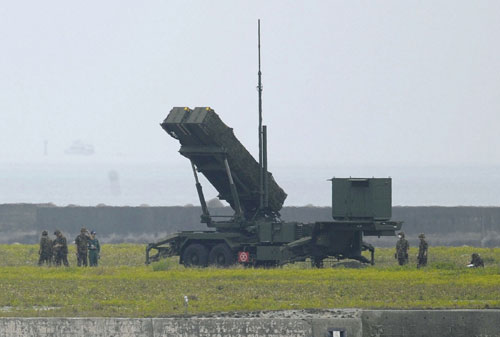 A Patriot Advanced Capability-3 (PAC-3) missiles unit is seen in Ishigaki on Japan's southern island of Ishigaki Island, Okinawa prefecture April 5, 2012. [Photo/Agencies] |
Japan is now mobilizing PAC-3 units in Okinawa, which is near the path of the upcoming launch and where more than half of the 50,000 US troops in Japan are deployed. It's also mobilizing PAC-3 units in Tokyo, which is much farther from the rocket's expected path. South Korea is taking similar steps — which it didn't do in 2009.
The US will be watching with equipment that was unavailable in 2009: a Sea-Based X-Band radar system, aboard a Navy ship that left Pearl Harbor late last month.
US officials claim the SBX system is so powerful it can track a baseball-sized object flying through space 2,500 miles (4,000 kilometers) away. Further, if US military satellites detect a flash of heat from a missile launch, within a minute computers can plot a rough trajectory and share that information with Japan.
Tokyo and Seoul warn they will use their interceptors on anything that threatens their territory, though that is highly unlikely. No country has ever shot at another country's satellite launch, and, barring any major surprises, the rocket will be traveling mostly over water, not populated areas.
"Whether it comes close to our southwestern islands or not, this will have significant implications for our missile defenses, and how they should be adjusted in the future," said Hiroyasu Akutsu, a senior fellow and Korea expert with the National Institute for Defense Studies, a think tank run by Japan's Defense Ministry.
In Washington, Pentagon press secretary George Little also said the launch was being tracked closely out of concern for debris.
"Debris is a concern with any launch anywhere ...," he said Thursday. "Obviously, anything you put up in the air, if it comes down, you want to be able to assess where it goes and what the potential impact will be."
Copyright 1995 - 2010 . All rights reserved. The content (including but not limited to text, photo, multimedia information, etc) published in this site belongs to China Daily Information Co (CDIC). Without written authorization from CDIC, such content shall not be republished or used in any form. Note: Browsers with 1024*768 or higher resolution are suggested for this site.
License for publishing multimedia online 0108263 Registration Number: 20100000002731