Science and Health
Whale migrant signs climate threat to Atlantic
(Agencies)
Updated: 2011-06-26 17:11
 |
Large Medium Small |
|
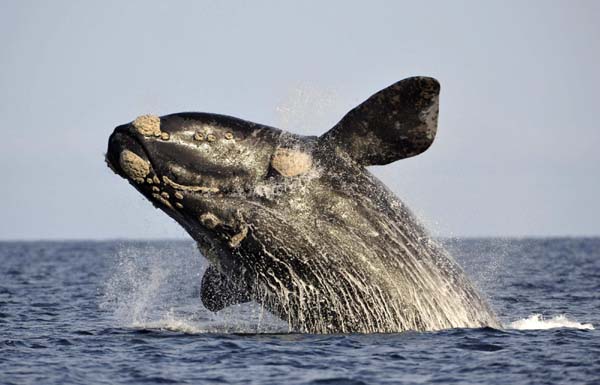 A southern right whale, known in Spanish as ballena franca austral, jumps off the water in the Atlantic Sea, offshore Golfo Nuevo, near Argentina's Patagonian village of Puerto Piramides, June 17, 2011. |
AMSTERDAM?- When a 43-foot (13-meter) gray whale was spotted off the Israeli town of Herzliya last year, scientists came to a startling conclusion: it must have wandered across the normally icebound route above Canada, where warm weather had briefly opened a clear channel three years earlier.
On a microscopic level, scientists also have found plankton in the North Atlantic where it had not existed for at least 800,000 years.
The whale's odyssey and the surprising appearance of the plankton indicates a migration of species through the Northwest Passage, a worrying sign of how global warming is affecting animals and plants in the oceans as well as on land.
"The implications are enormous. It's a threshold that has been crossed," said Philip C. Reid, of the Alister Hardy Foundation for Ocean Science in Plymouth, England.
"It's an indication of the speed of change that is taking place in our world in the present day because of climate change," he said in a telephone interview Friday.
Reid said the last time the world witnessed such a major incursion from the Pacific was 2 million years ago, which had "a huge impact on the North Atlantic," driving some species to extinction as the newcomers dominated the competition for food.
Reid's study of plankton and the research on the whale, co-authored by Aviad Scheinin of the Israel Marine Mammal Research and Assistance Center, are among nearly 300 scientific papers written over the last 13 years that are being synthesized and published this year by Project Clamer, a collaboration of 17 institutes on climate change and the oceans.
Changes in the oceans' chemistry and temperature could have implications for fisheries, as species migrate northward to cooler waters, said Katja Philippart, of the Royal Netherlands Institute of Sea Research who is coordinating the project funded by the European Union.
"We try to put the information on the table for people who have to make decisions. We don't say whether it's bad or good. We say there is a high potential for change," she said.
The Northwest Passage, the route through the frigid archipelago from Alaska across northern Canada, has been ice-free from one end to the other only twice in recorded history, in 1998 and 2007. But the ice pack is retreating farther and more frequently during the summers.
Plankton that had previously been found only in Atlantic sea bed cores from 800,000 years ago appeared in the Labrador Sea in 1999 _ and then in massive numbers in the Gulf of St. Lawrence two years later. Now it has established itself as far south as the New York coast, Reid said.
The highly endangered gray whale sighted off the Israeli coast in May 2010 belonged to a species that was hunted to extinction in the Atlantic by the mid-1700s. The same animal?- identified by unique markings on its fluke, or tail fin - appeared off the Spanish coast 22 days later, and has not been reported seen since.
Though it was difficult to draw conclusions from one whale, the researchers said its presence in the Mediterranean "coincides with a shrinking of Arctic Sea ice due to climate change and suggests that climate change may allow gray whales to re-colonize the North Atlantic."
That may be good for the whales, but other aspects of the ice melt could be harmful to the oceans' biosystems, the scientists warn.
Plankton is normally the bottom of the marine food chain, but some are more nutritious than others. Plankton changes have been blamed for the collapse of some fish stocks and threats to fish-eating birds in the North Sea, the studies show.
The migration of a solitary whale and two species of plankton is not of much concern so far, Reid said. "It's the potential for further ones to come through if the Arctic opens. That's the key message."
| 分享按鈕 |