Global General
Stark reality in a Somali community
By Hu Yinan (China Daily)
Updated: 2010-12-06 07:26
 |
Large Medium Small |
 |
|
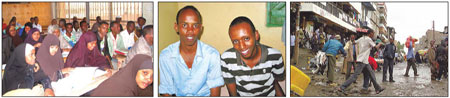
From left: Students listen to a lesson at the COMPIT training center in Eastleigh, an area known as "Little Mogadishu"; Feisal Farah Mohamed (left) and Mohamed Amin pose for a picture in Mandera; A street corner in the primarily Somali-inhabited district of Eastleigh. The residents complain about the district's lack of infrastructure, while Kenyan officials worry about the rapid infiltration of Somali insurgency. [Photos by Hu Yinan / China Daily] |
Although many in East Africa join Al-Shabaab for the money, in August, Fatuma Noor, an investigative reporter with the Nairobi Star newspaper, revealed a series of shocking accounts of Western-educated, faith-driven Somalis who had willingly returned home to fight for the group.
The stories were of young men who all claimed to have suffered discrimination in the West. One of them, US citizen Abikar Mohamed, reportedly recalled that despite being among the top five students in his high school in Minnesota, he was denied a scholarship without "any real reason".
Aside from a backlash against racial prejudice and a collective search for identity in a crisis-torn country, Muhyadin, who was born and raised in Mogadishu's Wardhigley neighborhood where two US Army Black Hawks crashed in 1993, also attributes Al-Shabaab's growing influence to global stakeholders, who he said are too often turning a blind eye.
"The world is not serious about Al-Shabaab," he said.
Most media coverage on Somalia focuses on sea piracy and its effect on regional stability and trade routes.
Somalia's 3,300-kilometer coastline is Africa's longest and forms much of the Horn of Africa. It sits at the entrance to the Gulf of Aden, which leads to the Red Sea and Suez Canal, one of the world's most important shipping channels, used by roughly 22,000 ships annually.
An international naval presence off the Somali coast to protect vessels since 2008 appears to have resulted in a strong backlash from local communities and, consequently, a rising number of ships being hijacked in seas further from Somali waters - and way beyond the reach of patrolling foreign navies.
Pirates have already commandeered 40 ships and kidnapped 790 crewmen and women so far this year, although the number may soon surpass the 47 ships and 867 people taken in 2009. (According to ECOTERRA International, an NGO monitoring high seas piracy, at least 34 vessels and 627 people are still being held.)
The Navy of the People's Liberation Army of China sent its seventh escort fleet in two years to the Gulf of Aden on Nov 2, including 780 crew members on two missile frigates, one supply ship and two ship-borne helicopters. So far, Chinese fleets have "successfully escorted more than 2,800 ships from China and other countries since the end of 2008", according to a report by Xinhua News Agency.
On Nov 12, just 10 days after the deployment, Somali pirates hijacked a Panama-flagged cargo ship with 29 Chinese crew members onboard in the Arabian Sea near India.
Andrew Mwangura, coordinator of the Seafarers' Assistance Program, said the global "obsession" in combating piracy through naval intervention fails to address the root causes of the crisis, and will therefore only help sustain and perpetuate it over time.
"People are focusing on the smaller issues because they either don't want it (resolved), don't know, know but keep quiet or gain from the conflict," Mwangura told China Daily in an exclusive interview in the Kenyan port city of Mombasa.
A lifelong seaman, Mwangura, 48, maintains unparalleled contact with both pirates and mariners held hostage. In most instances, he is the first person the global media come to in attempts to confirm the hijacking or release of a vessel in Somali waters and beyond.
Somali communities, reporters, scholars and activists have long tried to raise public awareness over the impact of decades of foreign exploitation of local fishing resources - often referred to as "pirate fishing" by the region's inhabitants - and massive nuclear and toxic waste dumping from western countries.
They believe it was these illegal activities - coming at a time when Somalia was falling into chaos and the government had no means to protect its waters and people - that gave rise to piracy in the first place.
The World Commission on Protected Areas' High Seas Taskforce, which was set up by various countries' fisheries ministers and global NGOs, estimates that illegal foreign fleets take more than $450 million worth of fish out of Somalia every year.
Research led by Abdi Ismail Samater, a geography professor at the University of Minnesota, suggests illegal fishing ships that "directly steal Somali seafood" come from European and Asian countries.