Science and Health
WHO says 600,000 die from passive smoking
(China Daily)
Updated: 2010-11-27 10:02
 |
Large Medium Small |
 |
|
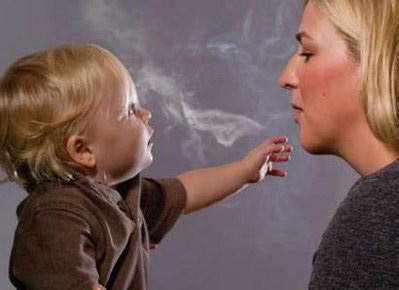
This handout image, released on Nov 10, 2010, depicts a mother blowing cigarette smoke in a child's face in one of the Federal Drug Administration's proposed new "graphic health warnings." |
Annual death toll revealed in major study of second-hand smoke
LONDON - Around one in a hundred deaths worldwide is due to passive smoking, which kills an estimated 600,000 people a year, World Health Organization (WHO) researchers said on Friday.
In the first study to assess the global impact of second-hand smoke, WHO experts found that children are more heavily exposed to second-hand smoke than any other age-group, and around 165,000 of them a year die because of it.
| ||||


Children's exposure to second-hand smoke is most likely to happen at home, and the double blow of infectious diseases and tobacco "seems to be a deadly combination for children in these regions", they said.
Commenting on the findings in the Lancet journal, Heather Wipfli and Jonathan Samet from the University of Southern California said policymakers try to motivate families to stop smoking in the home.
"In some countries, smoke-free homes are becoming the norm, but far from universally," they wrote.
The WHO researchers looked at data from 192 countries for their study. To get comprehensive data from all 192, they had to go back to 2004. They used mathematical modeling to estimate deaths.
Worldwide, 40 percent of children, 33 percent of non-smoking men and 35 percent non-smoking women were exposed to second-hand smoke in 2004, they found.
This exposure was estimated to have caused 379,000 deaths from heart disease, 165,000 from lower respiratory infections, 36,900 from asthma and 21,400 from lung cancer.
For the full impact of smoking, these deaths should be added to the estimated 5.1 million deaths a year attributable to active tobacco use, the researchers said.
While deaths due to passive smoking in children were skewed toward poor and middle-income countries, deaths in adults were spread across countries at all income levels.
In Europe's high-income countries, only 71 child deaths occurred, while 35,388 deaths were in adults. Yet in the countries assessed in Africa, an estimated 43,375 deaths due to passive smoking were in children compared with 9,514 in adults.
Pruss-Ustun urged countries to enforce the WHO's Framework Convention on Tobacco Control, which includes higher tobacco taxes, plain packaging and advertising bans, among other steps.
"Policymakers should bear in mind that enforcing complete smoke-free laws will probably substantially reduce the number of deaths attributable to exposure to second-hand smoke within the first year of its implementation, with accompanying reduction in costs of illness in social and health systems," she wrote.
Only 7.4 percent of the world population currently lives in jurisdictions with comprehensive smoke-free laws, and those laws are not always robustly enforced.
In places where smoke-free rules are adhered to, research shows that exposure to second-hand smoke in high-risk places like bars and restaurants can be cut by 90 percent, and in general by 60 percent, the researchers said.
Studies also show such laws help to reduce the number of cigarettes smoked by smokers and lead to higher success rates in those trying to quit.
Reuters