Asia-Pacific
Obama pushes Senate to support arms treaty with Russia
(Xinhua)
Updated: 2010-11-20 22:34
 |
Large Medium Small |
|
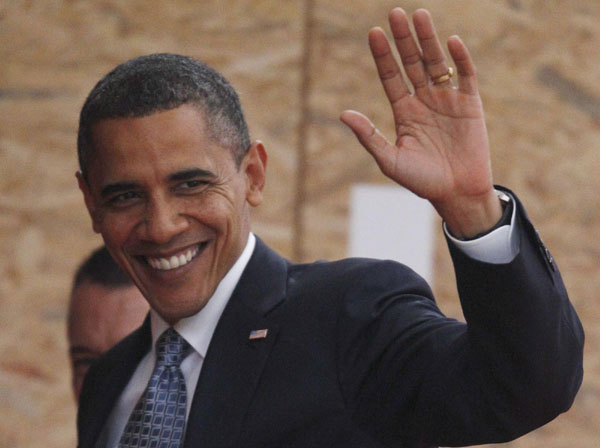 US President Barack Obama waves as he arrives for the opening session of the NATO summit in Lisbon Nov 19, 2010. [Photo/Agencies] |
WASHINGTON - In his latest efforts to push for passage of the arms reduction treaty with Russia this year in the Senate, US President Barack Obama has appealed to the US public and foreign leaders for support in the last two days.


"Today, I'd like to speak with you about an issue that is fundamental to America's national security: the need for the Senate to approve the new START treaty this year," Obama said, repeating a refrain echoed oftentimes these days by himself and other high-ranking officials.
"This treaty is rooted in a practice that dates back to (former president) Ronald Reagan. The idea is simple: as the two nations with over 90 percent of the world's nuclear weapons, the United States and Russia have a responsibility to work together to reduce our arsenals," he said.
The treaty stipulates that the number of nuclear warheads be reduced to 1,550 on each side over seven years, while the number of delivery vehicles, both deployed and non-deployed, must not exceed 800. It also sets out rules for verification and monitoring of the nuclear arsenals on both sides.
"And to ensure that our national security is protected, the United States has an interest in tracking Russia's nuclear arsenal through a verification effort that puts US inspectors on the ground, as President Reagan said when he signed a nuclear arms treaty with the Soviet Union in 1987, 'Trust, but verify,'" Obama said in his weekly address.
The new START treaty is seen as a major achievement of the Obama administration in foreign relations and part of its efforts to reset relations with Russia.
The pact sets the stage for further arms reductions, as its preamble states that the US and Russia see the new START as providing new impetus to the step-by-step process of reducing and limiting nuclear arms, with a view to expanding this process in the future to a multilateral approach.
Obama reiterated to Medevedev last Sunday that it is a "top priority" of his administration to get the US Senate to ratify the new START pact.
"The treaty also helped us reset our relations with Russia, which led to concrete benefits," Obama told his American audience. "For instance, Russia has been indispensable to our efforts to enforce strong sanctions on Iran, to secure loose nuclear material from terrorists, and to equip our troops in Afghanistan."
Some Republican senators have not only asked to review the new pact, but also have sought access to the negotiating record to get clarity on whether the treaty would limit US missile defense programs and more money for maintaining the nuclear weapons stockpile and modernizing the production complex.
Obama has promised an extra $4.1 billion in addition to an existing $80 billion over 10 years for the modernization of the country's nuclear weapons complex. In his weekly address, he said 18 hearings have been held in the Senate to answer nearly 1,000 questions relating to the pact in the past six months.
However, Republican Senator Jon Kyl, who is seen as key to winning enough support to ratify the treaty, said Tuesday that a deal did not seem possible in the lame-duck session of Congress, dealing a severe blow to the Obama administration.
At a White House meeting on Thursday, Obama stressed that "It is a national security imperative that the United States ratify the new START treaty this year. This is not about politics, it's about national security. This is not a matter that can be delayed." The meeting joined many current and former high-ranking officials who support the pact, including former secretaries of state Madeleine Albright, James Baker and Henry Kissinger and former defense secretaries William Cohen and William Perry.
The US Senate Foreign Relations Committee approved in September the new START treaty, clearing the way for a vote on the Senate floor. The US and Russian presidents had agreed that the ratification process should be simultaneous at US Senate and Russia's Duma.
Obama's Democrats lost control of the House of Representatives to the opposition Republicans in the Nov 2 mid-term elections but retained control of the Senate. On Monday, a lame-duck session of Congress begins until the start of the new Congress in January next year.
For the passage of the treaty in the Senate now, the Democrats need nine Republican votes for support. If delayed until next year when the new Congress opens, 14 Republican votes are needed.
In his weekly address, Obama said: "Bipartisan support for new START could not be stronger, it has been endorsed by Republicans from the Reagan administration and both Bush administrations."
"Some make no argument against the treaty - they just ask for more time. But remember this: it has already been 11 months since we've had inspectors in Russia, and every day that goes by without ratification is a day that we lose confidence in our understanding of Russia's nuclear weapons."
While in Lisbon, Portugal on Friday for a NATO summit, Obama spared no efforts to win support among his foreign colleagues.
He told reporters there: "The message that I've received since I've arrived from my fellow leaders here at NATO could not be clearer: a new START will strengthen our alliance and it will strengthen European security."
The White House quoted German Chancellor Angela Merkel as saying: "We have to thank President Obama that he negotiated a new START treaty. I would wish that the new START treaty would also be ratified."
NATO Secretary General Anders Fogh Rasmussen told reporters: "I would strongly regret if the ratification of the START treaty is delayed. A delay of the ratification of the START treaty would be damaging to security in Europe. I strongly encourage all parties involved to do their utmost to ensure an early ratification of the START treaty."
Obama and other NATO leaders are scheduled to meet Russian President Dmitry Medvedev on Saturday at a NATO-Russia Council summit in Lisbon.