Asia-Pacific
Desperate parents abandon children in Haiti
(Agencies)
Updated: 2010-05-10 14:00
 |
Large Medium Small |
PORT-AU-PRINCE, Haiti - Weeks after the 1-year-old was found in a dumpster, his father showed up.
The baby wriggled in his cot, smiled and held up his arms. When the father didn't touch him, the baby started to cry and kick his legs.
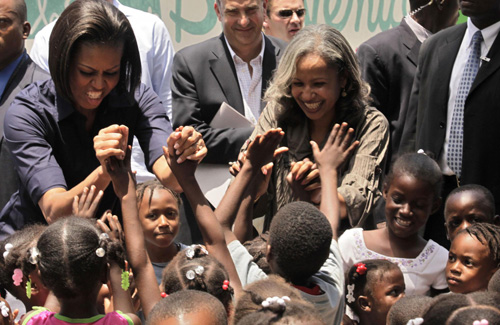 US first lady Michelle Obama (L) and Elisabeth Debrosse, wife of Haitian President Rene Preval, greet children during her visit to a local child welfare project in Port-au-Prince April 13, 2010. [Agencies] |
The man left moments after he arrived, never to be seen again, according to a report written by a social worker at the Saint Catherine Hospital in the Cite Soleil slum, where the child was taken.
The catastrophic earthquake that left at least 1.3 million of Haiti's 9 million people homeless was the final push over the edge for families that could barely afford to feed their children before. Now stuck in leaky tents with dwindling aid handouts, Haitian families are abandoning their children in the hope that rescue organizations will offer them a better life, aid workers say.
|
||||


Even before the magnitude-7 quake, poor parents left children at orphanages where they would at least receive one meal a day. Now the number of abandoned children has skyrocketed, said 37-year-old Tamara Palinka, who helped coordinate logistics at the University of Miami-run field hospital on the grounds of the airport.
"I personally talked a lot of mothers out of giving up their children," said Palinka, who cordoned off a space inside the field hospital's pediatric tent for abandoned children, including another toddler found crawling on a garbage heap.
Orphanage workers say their facilities are swelling with children who are not orphans.
At Mother Teresa's orphanage behind a tall wall covered in concertina wire, nuns in white saris hover over the cribs of children whose arms are attached to drips. They don't take in orphans, only malnourished children who will be returned to their families after they put on weight. They require the mothers to stay on the grounds because otherwise they might not come back.
"We don't let them leave," said Sister Genova, a diminutive woman who weaves between the cribs, reaching out to stroke the head of a twig-like child with bright orange hair, a sign of malnutrition.
Nadine Jean-Baptiste, 35 years old and HIV-positive, recently left her 2-year-old daughter Christine at an orphanage down the street from the storage shed where she now lives.
Before the January 12 quake, she was barely able to pay for her medication and look after her daughter. Then her husband, a cook, was buried inside the restaurant where he worked. She heard his cries from beneath the concrete but could do nothing.
With him gone and her house destroyed, she is weighing a terrible decision: An American couple has expressed interest in adopting Christine. The sick mother lies awake at night trying to decide whether she should sign over her child, a chubby little girl with hair bunched into pigtails.
"I love my child. Giving her away is not my wish," she said, her voice choked with sadness, her body thin as an ironing board from the disease. "But I have nothing to feed her. I have no choice but to give her away."
The United Nation's Children's Fund set up a toll-free hotline in February for abandoned or lost children who had been separated from their families during the quake. The call center has registered 960 children so far. "We don't call them orphans because they could have family," explained Edward Carwardine, UNICEF's spokesman in Haiti.
UNICEF gave the hotline number only to agencies and aid workers, not the public for fear of an avalanche of calls from desperate families trying to unload their children.
The SOS orphanage saw what happens when such an offer is made known to the public at large.
Their tidy campus is an oasis in the rubble-strewn capital, located on a leafy lot crisscrossed with walkways. Children live in "families" inside cottages overseen by a doting house "mother." Their days are a carnival of activities, from soccer and painting to one-to-one sessions with psychologists who use art to get at the trauma of the quake.
In the week after the quake, SOS announced on the radio that the orphanage had room for more orphans. The next day, the orphanage nearly doubled in size after staff found around 120 children lined up outside the gate. In the three months since, the orphanage has tripled in size.
But SOS quickly realized that most of the new arrivals were not in fact orphans, said spokeswoman Line Wolf-Nielsen. One mother posed as a stranger dropping off three of her own children, whom she claimed were 'orphans' found after the quake. Others sent in their children with neighbors or friends, making it more difficult to find the family. One family instructed three boys to memorize a fictitious last name to complicate efforts to find their real parents.
Haitian law requires that orphanage authorities do everything they can to reunite children with their birth families. Post-quake, that has often involved reuniting kids with families that do not want them back. SOS is sifting through the roughly 300 children they took in since the disaster, sending workers into the camps to look for parents.
"It's very tough, but we need to concentrate our efforts on the neediest cases. Obviously if you have family, your situation is less needy than that of a child that has no one," says Wolf-Nielsen.