WORLD> America

|
WORLD> America
|
|
Related
NASA launches 1st unmanned moon shot in decade
(Agencies)
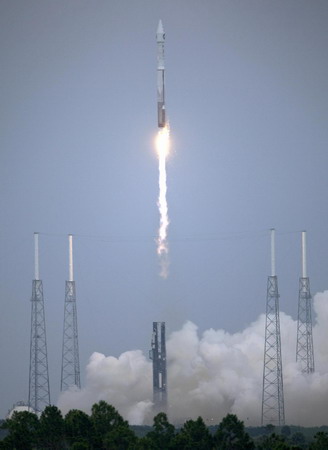
Updated: 2009-06-19 11:53 CAPE CANAVERAL, Fla.: NASA launched its first moon shot in a decade Thursday, sending up a pair of unmanned science probes that will help determine where astronauts could land and set up camp in years to come.
The liftoff occurred just one month and two days shy of the 40th anniversary of the first lunar footprints. The mission is a first step in NASA's effort to return humans to the moon by 2020. Scientists cheered as the Atlas V rocket carrying the two spacecraft blasted off in late afternoon, ducking through clouds and providing an exhilarating start to the $583 million mission. "It was amazing," said John Keller, a deputy project scientist. The two spacecraft should reach the moon in four to five days - or by early next week. One will enter into an orbit around the moon for a mapping mission. The other will swing past the moon and go into an elongated orbit around Earth that will put it on course to crash into a crater at the moon's south pole in October. NASA expects the dramatic moon-impacting part of the mission to be "a smashing success." It's a quest to determine whether frozen water is buried in one of the permanently shadowed craters. Water would be a tremendous resource for pioneering astronauts. "We're going to be doing some lunar prospecting, if you will, excavation style," said project manager Dan Andrews.
The Lunar Reconnaissance Orbiter will provide a high-precision, three-dimensional map of the lunar surface. It will circle the lunar poles and, via its seven science instruments, provide a new atlas of the moon as well as a guidebook for future explorers. When it comes time to launch astronauts to the moon, NASA wants to avoid putting them down on an uneven surface, near boulders or in a crater. "The Apollo program accepted risk and was able to have safe landings," said Richard Vondrak, project scientist for the orbiter. "But we want to return to the moon, make repeated landings in some areas, and be able to go there with a higher degree of safety." The second probe, called the Lunar Crater Observation and Sensing Satellite, will be aiming for a spectacular smashup that should be visible from the United States. "How do you get something that's been in the dark for maybe a billion or 2 billion years out to study it?" said Anthony Colaprete, the principal investigator. Answer: Impact the bottom of the shadowed crater with the satellite's spent upper-stage Centaur rocket, more than 5,000 pounds of dead weight careening in at 5,600 mph. LCROSS, pronounced L-Cross, will drop the Centaur into the targeted crater. The impact will send a plume of ejected material up into the sunlight, vaporizing any ice and exposing any traces of water. Previous spacecraft have detected hydrogen in these craters, which could be evidence of frozen water. The plume of ejected material - more than 350 tons of soil and rock - should rise as high as six miles.
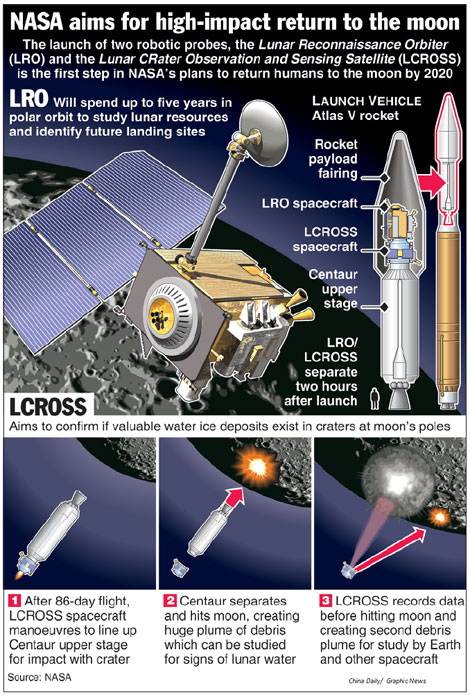 The trailing LCROSS will fly through the plume, take measurements, send the data to Earth, then crash into the surface four minutes after the Centaur, creating a second plume of debris. The impacts and plumes should be visible to observers in the United States, west of the Mississippi River, using 10- to 12-inch telescopes. The Hubble Space Telescope will monitor the event, as well as the Lunar Reconnaissance Orbiter, still circling the moon. In a novel touch, NASA has a song to go with the impact mission, "Water on the Moon," written and performed by deputy project manager John Marmie, a song-writing engineer who once considered a music career in Nashville, Tenn. The rock 'n' roll tune begins with a short countdown and the sound of a launching rocket. The moon shot - NASA's first since the 1998 launch of Lunar Prospector - should have gotten under way Wednesday. But the space agency wanted to give shuttle Endeavour one last crack at taking off on a space station mission; a recurring hydrogen gas leak halted the countdown. |