WORLD> America

|
WORLD> America
|
|
Related
Obama presidency is pinnacle of a long struggle
(Agencies)
Updated: 2009-01-19 22:33 NEW YORK _ When Barack Obama was born in 1961, the marriage of his black father and white mother would have been illegal in half the United States, and blacks across the South were virtually barred from voting.
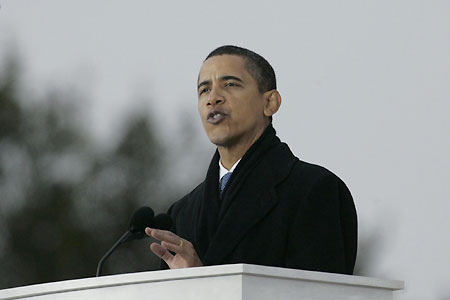
As Obama stands on the verge of becoming the first black US president Tuesday, he represents the pinnacle of a five-decade long struggle that stretches back to segregation. Obama's predecessors range from what he has called the Moses generation of civil rights leaders, to big city mayors to national figures like Colin Powell and Condoleezza Rice, the two secretaries of state over the last eight years. As the number of black politicians grew rapidly around the country, a new generation emerged that, like Obama, had gone to Ivy League schools instead of historically black colleges, had no roots in the civil rights movement and offered inclusive messages with mainstream appeal.
Jackson, a protege of civil rights leader Martin Luther King, was wildly popular among African-Americans and became the first black presidential candidate to win a state primary race in 1984. He later tried to broaden his appeal to white voters and finished a strong second to Democratic nominee Michael Dukakis four years later. "Jackson's influence was important because of the symbolism," said David Bositis, a political analyst at the Joint Center for Political and Economic Studies and an expert on black politics. "He raised the status of the idea of a black president. He ran and he got a lot of votes." Jackson, a political activist based in Chicago, had been inspired to run for president by the 1983 election of Chicago's first black mayor, Harold Washington, who swept to victory in a racially divided city in his second mayoral campaign. Washington's victory also inspired a young Obama, who had just graduated from Columbia University in New York and moved to Chicago. In his first book, "Dreams from My Father," Obama wrote of the excitement that Washington stirred among Chicago's minorities. "His picture was everywhere: on the walls of shoe repair shops and beauty parlors; still glued to lampposts from the last campaign; even in the windows of the Korean dry cleaners and Arab grocery stores, displayed prominently, like some protective totem," he wrote. Black mayors eventually won in big cities around the US: Andrew Young in Atlanta, David Dinkins in New York City, Willie Brown in San Francisco and Wilson Goode in Philadelphia. They proved that African-American politicians could aspire to represent more than black congressional districts and paved the way for a black president, said John H. McWhorter, a senior fellow at the conservative Manhattan Institute. "Black mayors held real power," he said. "That got us all used to a black man wearing a suit, giving speeches, pulling the strings. That's what got America used to the idea of a black man or woman running things." Winning statewide offices proved tougher. When Obama won election to the US Senate in 2004, he became just the third African-American to do so by a popular vote, following Democrat Carol Moseley Braun's 1992 win in Illinois and Republican Edward Brooke's win in Massachusetts, way back in 1966. "When Barack Obama came on the scene, I was asked frequently if I thought he could be elected," Brooke said. "And I'd say I'm the last person to say it couldn't happen. I've already shown that white voters are open to voting for black candidates, so it made sense to me. "Though I was pleased, I'm not that surprised that he was able to pull it off. But I am thankful to God to live to see this happen." In 1989, Douglas Wilder, the grandson of a slave, became the first African-American to win an election for governor. The Democrat did it in Virginia, a former slave-owning state that had been home to the capital of the Confederacy during the Civil War. Wilder ran for president in 1992, but quickly bowed out. The next election cycle nearly produced the strongest black presidential candidate yet. Powell had become a celebrity general during the first Gulf War, when he led daily televised press briefings on the destruction of Iraq's army as chairman of the Joint Chiefs of Staff, the highest US military position. After retiring from the Army, Powell wrote a best-selling memoir about his rise from humble roots _ born in New York City's rough South Bronx neighborhood to Jamaican immigrants _ and he considered challenging President Bill Clinton for the White House in 1996. Polls showed that Powell had high approval ratings, but in 1995 the career soldier demurred, declaring it was "a calling that I do not yet hear." Republicans had also hoped that Rice, Powell's successor as secretary of state, would run for president or vice president, but she has repeatedly stated that she wasn't interested. Powell and Rice "never had to run for anything, but they became highly visible officials and representatives of our government to people around the world," said Rep. John Lewis of Georgia, a civil rights leader who was nearly beaten to death during a 1965 march. "And in America people saw them, read about them, heard their voices and considered their views, and I really think that created a helpful climate for other African-Americans, even Obama." When Powell crossed party lines to endorse Obama late in the campaign, he held considerable sway over independent voters, said Cook, the politics professor. "The Powell endorsement was absolutely essential," he said. "That was the singular, most powerful moment of the campaign." Jackson, however, was sidelined by Obama throughout his campaign. He was publicly chastised and later apologized last summer after being caught saying on an open microphone that he wanted to castrate Obama for speaking down to blacks. But in November, many Americans were moved by the sight of Jackson, tears streaming down his face, as he listened to Obama's victory speech on election night. |
|||||||