WORLD> Opinion

|
WORLD> Opinion
|
|
How to get money moving is the question
By Bruce Bartlett (China Daily)
Updated: 2008-12-26 07:51 There is an old joke about economists: They are people who see something working in practice and try to figure out if it would work in theory. Just recently we have seen an example of this when interest rates on US Treasury bills turned negative, meaning the US federal government got paid for borrowing money rather than paying to do so. In theory, this isn't supposed to happen. If market interest rates are negative then people normally just hold on to their cash. But these aren't normal times. The fear of risk is so pervasive that individuals and businesses don't trust even cash and are willing to pay a premium to park their money in Treasury bills. This explains a great deal about what is at the root of the economy's problem today. People are so risk-averse that they are hoarding money, refusing to spend; banks are refusing to lend even to their best customers; and businesses are so desperate for safety that they would rather get a negative return on a safe asset than invest in something remotely risky, no matter how high the potential return. When everyone in the economy suddenly stops spending, the number of times that money turns over falls. Since the gross domestic product equals the money supply times its rate of turnover - something economists call velocity - this means that if the money supply is unchanged then the GDP must fall.
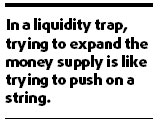
Theoretically, the Federal Reserve (Fed) can compensate for a decline in velocity by increasing the money supply. But in times like these it is very hard for it to do so because of something economists call a liquidity trap. When this occurs, the Fed cannot inject liquidity into the economy because its normal means of doing so no longer works. In a liquidity trap, trying to expand the money supply is like trying to push on a string. Normally the Fed expands the money supply by buying Treasury bills and paying for them by creating money out of thin air. When it wants to contract the money supply it does the reverse, putting Treasury bills from its portfolio on the market and drawing money out of the economy when financial institutions pay for them. But when interest rates on Treasury bills fall to zero this process doesn't work because money is essentially nothing but a perpetual government bond that pays no interest. If the Fed creates money to buy a Treasury bill that pays zero interest, it accomplishes nothing, economically. All it does is trade one government security for another that is virtually identical. There is no net increase in liquidity. Under these circumstances, when the normal rules don't apply, the government must find more creative ways to ease credit conditions and get the economy moving again. First, it needs to increase the budget deficit. This expands the amount of Treasury bills in circulation and is the same as expanding the money supply, which is necessary to keep the GDP from shrinking due to a fall in velocity. Second, the Fed needs to revise its operating procedures. Instead of buying only T-bills it needs to buy securities with positive interest rates. These include longer-term Treasury bonds and securities issued by government-sponsored enterprises like Fannie Mae. If necessary, the Fed could also buy corporate bonds, state and local government bonds, or even bonds issued by foreign governments. Third, the government must try to raise velocity by stimulating aggregate spending in the economy. This is harder than it sounds. Buying bonds and securities may expand liquidity, but it doesn't increase spending. And we know from experience that tax rebates don't work because people save them. The trick is to find a way to get people and businesses to spend money over and above what they would have spent anyway. A stimulus is not a stimulus unless it causes an incremental increase in aggregate spending. Simply replacing private spending with public spending doesn't do any good unless total spending increases in the process. Since it is just as stimulating to invest money as to buy things with it, it may be possible to bring forward the plans for future investments that businesses and governments already have. But, again, it is essential that these investments be marginal - over and above what would otherwise be spent - or else there will be no increase in aggregate spending, and we will be no better off. Above all, policymakers need to understand that the economy's fundamental problem is the decline in aggregate spending, which is pulling down both prices and output and rendering the Fed's usual tools for increasing liquidity useless. To restore the economy to health will require new policies that increase aggregate spending. The author was an economist in the Treasury Department during the George H.W. Bush administration The New York Times Syndicate |