WORLD> Opinion

|
WORLD> Opinion
|
|
Twin crises of finance and food
By He Changchui (China Daily)
Updated: 2008-11-20 07:49 As world leaders struggle to halt the crisis spreading across the global financial markets, analysts and economists are attempting to gauge the magnitude of this meltdown. Will it rival or surpass the Great Depression of the 1930s, the Black October of 1987 or the Asian Economic Crisis of 1997? In fact, it has the potential to be far worse, and the reasons are high food prices and food shortages, and the steady erosion of agriculture and rural economies. Food availability and affordability are the bedrocks of any society. During the Great Depression, Black October and the Asian Economic Crisis, food prices were at historic lows. No matter how dire the situation, food was still plentiful and cheap. Today, the story is different. Food is in shorter supply; prices have been steadily climbing since 2001, and have escalated dramatically since 2006. According to the tracking of our Food and Agriculture Organization, food prices rose by 9 percent in 2006, 24 percent in 2007, and surged 51 percent in the past 12 months. Although we saw some price drops for certain food commodities in the past months, average prices are still much higher than normal, and the international markets remain volatile. During normal times, that level of "sticker shock" would spell hardship for most working people and the poor. Coupled with an economic crisis of the enormity taking place today, the impact could be catastrophic. The role of food security in wider events should not be underestimated. Food shortages and runaway food price inflation have a history of leading to social unrest and political upheaval. The current crisis has already sparked riots and social turbulence in over 30 countries and regions, and contributed to the fall of at least one elected government. In 2007 alone, the food crisis threw an additional 75 million people into the ranks of the malnourished. Hard-won gains by many nations in their battles against hunger and poverty may be reversed. The ability of countries to meet the Millennium Development Goals will be ever more doubtful. Over 60 countries are receiving support and assistance from the international community to boost food production. World leaders have been aware of the growing threats to food security for several years. Recently, they began taking steps to address these looming perils. In June 2008, more than $11 billion was pledged at the Rome Food Security Summit, attended by representatives from 181 nations including more than 40 heads of state. 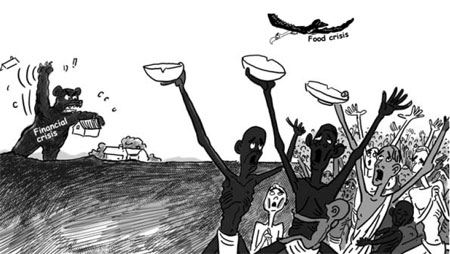 The money is to be used for immediate food aid for those who need it, and for investing in and revitalizing the agricultural sector to boost crop production. Considering the array of needs to be addressed, it was not an enormous sum, but it was a good start. The danger today is that those commitments will not be kept. Governments have few choices except to set aside hundreds of billions of dollars to rescue ailing financial institutions. But that may leave them with hard choices. Some may have to cut funding from other programs to pay for this bailout. One of the least politically popular areas of government expenditure is foreign aid. Citizens naturally ask: when times are tough at home, why should we be giving money to poor farmers in developing countries? It is a legitimate question. Let us be clear about the answer: This is not just a problem of poor farmers in developing countries. This is everybody's problem. In the modern world few if any nations are self- sufficient when it comes to food security. Even the wealthiest countries import massive amounts of food. Countries that ship rice overseas may still need to source wheat from outside their borders. In this respect, the world truly is interconnected and interdependent. For that reason, this is a problem that can only be addressed at a global level, and so the pledges made in Rome must be fulfilled - and fulfilled on time. For food prices to come down, food supplies will have to increase. And for food supplies to meet the growing demands of the world's population, an infusion of investment in agriculture is essential. Climate change may already be a factor behind increasing droughts and flooding in fertile, food-producing regions. The lure of quick cash from growing crops suitable for bio-fuels has reduced the amount of land devoted to growing food. Subsidies and trade barriers distort markets and reduce efficiency in production and distribution. A critical factor in the shortfalls in food supplies is that in much of the developing world farmers are not anywhere near as productive as they could be. They have the potential to grow a greater variety of crops and increase the number of harvests each year. Unfortunately, many lack the technical knowledge, tools and infrastructure to achieve this. With investment and support they can remedy these problems and begin producing enough food for us all at prices we can stomach. A thriving agricultural sector provides another benefit for many societies; it serves as a social safety net. As factories closed and jobs disappeared in the wake of Asia's meltdown during the late 1990s, substantial numbers of rural people who had migrated to cities to work returned to their farms and villages. Resources were still plentiful and food was there to be shared. But with governments focusing investment on industry, the lives of those engaged in agriculture have become ever more hard. There are 583 million hungry people on farms and in villages across Asia and the Pacific; 75 percent of the region's poor live in rural areas. These days, there may not be much in the village for the jobless to return to. The social safety net has been frayed. Governments of developing countries, therefore, must also do their part. The bulk of investment to improve infrastructure and boost productivity must come from the developing countries themselves. Policies that support agriculture, making it sustainable, rewarding and sufficiently productive to support us all must be adopted with urgency. As a result of the convergence of financial, food and fuel crises, a global tragedy is rapidly unfolding. In our efforts to prevent this, we must not be placed in a position of having to choose between bankers and farmers when it comes to resources. As costly and painful as the mistakes of those engaged in finance have been and will be, we must not short-change those engaged in agriculture. For our own sake, we must provide them with the tools for achievement and the seeds for success. The author is assistant director-general and the FAO Regional Representative for Asia and the Pacific, based in Bangkok (China Daily 11/20/2008 page9) |
