WORLD> America

|
WORLD> America
|
|
US confronts possibility of long, deep recession
(Agencies)
Updated: 2008-10-16 09:05 NEW YORK -- The US has not endured a deep and prolonged recession in more than a quarter century -- enough time for many Americans to forget what one feels like. But unlike the last two relatively short recessions, this one could be much longer and more severe, potentially bringing with it anxiety and job losses not seen in many years. "In thinking about recessions, people will naturally think back to the last couple" in the early 1990s and in 2001, said Paul Ashworth, senior US economist at Capital Economics in Toronto. "What they should be looking back at is further."
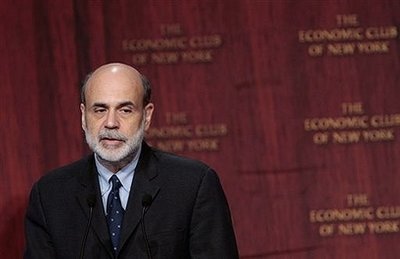
That requires dredging up memories of the economic slides in the 1970s, when an Arab oil embargo starved the nation of energy, and the early 1980s, when unemployment and inflation soared. The last recession -- coinciding with the collapse of the tech stock bubble and the terrorist attacks of 2001 -- lasted just eight months. It was known more for the slow "jobless" recovery that followed than for the depth of the downturn. Many economists agree that the nation won't be so fortunate this time. "I don't think we can escape damage to the real economy," former Federal Reserve Chairman Paul Volcker said this week in Singapore. "I think we almost inevitably face a considerable recession." The Fed's current chairman, Ben Bernanke, delivered a more measured, but similarly grave assessment to economists, saying the recent financial turmoil "may well lengthen the period of weak economic performance and further increase the risks to growth." The signs of stress are starting to show: The US has lost 760,000 jobs since late last year, and retail sales in September plunged 1.2 percent, the largest drop in three years. Every recession is driven by its own dynamic and psychology. The current slump started with the collapse in the housing market and got worse with sharp restrictions on credit that pressured consumer spending and businesses. That is a different environment from 1973, when an oil crisis was the culprit, squeezing US businesses and consumers. In the early 1980s, raging inflation and high interest rates took their toll. Both periods saw millions of Americans out of work. In 1975, the unemployment rate peaked at 9 percent. In 1982, it jumped to 10.8 percent. Most economists forecast a sharp increase in the number of people who lose their jobs. But they do not see it leading to unemployment on the scale of either the 1970s or 1980s. The jobless rate is currently at 6.1 percent, and many economists expect it to rise to about 7 percent early next year -- a level the country has not seen since 1993. Some analysts believe the unemployment rate could eventually climb close to 8 percent, which hasn't happened since 1984. But this recession could begin to feel like those of the past not just because of lost jobs, but because of fear about the future. In the 1980s, as the nation struggled with inflation and a transition from a manufacturing economy to one based on services, Americans had "a huge amount of uncertainty and anxiety that lingered on for a long period of time," said Bart van Ark, chief economist for The Conference Board. "That element I find comparable to what we're seeing today, but some of the underlying dynamics are very, very different." In 1973, the US economy had been growing for three years and unemployment had dropped to well below 5 percent. Then, on Oct. 6, Egyptian and Syrian forces launched surprise attacks on Israeli-held territory while Jews were observing Yom Kippur. Arab members of OPEC soon cut off shipments of oil to the US and other countries that supported Israel. Oil prices rose sharply and forced rationing of tight supplies. Drivers lined up at filling stations on odd or even days depending on the number on their license plates. Some stations ran out of gas. A recession is typically defined as a period in which the economy shrinks for two quarters in a row. In the 2001 recession, the quarters weren't even consecutive. |