US moves to avert economic meltdown
Updated: 2008-01-23 10:05
WASHINGTON -- Jolted by global recession fears, the Federal Reserve slashed interest rates Tuesday, and President Bush and leaders of Congress joined in a rare show of cooperation in promising urgent action to pump up the economy with upwards of $150 billion in tax cuts and government spending.
|
|
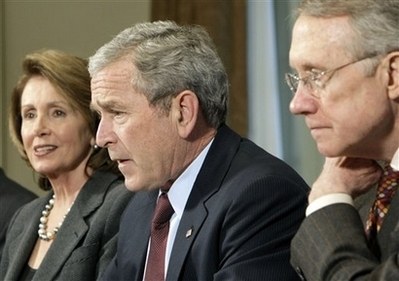
Market meltdowns overnight around the globe and growing anxiety at home stirred lawmakers and the administration toward swift action, possibly within a few weeks. Wall Street plummeted as the day began, following Asian stocks, then warily eased its sell-off after the Fed ordered the biggest cut on record in a key interest rate. The Dow Jones industrials, down 465 points at one point, closed the day off 128.
The Fed, announcing its action after an emergency video conference Monday night, indicated further rate reductions were likely, aimed at encouraging people and companies to start spending again.
"The urgency that we feel at home is now even more urgent as we see the impact of our markets on others," House Speaker Nancy Pelosi said after both Democratic and Republican lawmakers met with Bush at the White House.
Senate Majority Leader Harry Reid said the goal was to get a deal through Congress and on Bush's desk within roughly three weeks -- lightning speed compared with the usual snail's pace on Capitol Hill. His Republican counterpart, Mitch McConnell of Kentucky, agreed the aim was action in the next few weeks and said, "That, by the standards in Congress, is pretty fast."
Bush expressed confidence that he and the Democratic-led Congress could put aside bitter differences that have marked his presidency.
"I believe we can find common ground to get something done that's big enough, effective enough so that an economy that is inherently strong gets a boost -- to make sure that this uncertainty doesn't translate into more economic woes for our workers and small business people," Bush said in the Cabinet Room.
Later, announcing the creation of a panel to educate people about their finances, Bush said he thought there would be an agreement "in relatively short order."
The White House meeting was intended to show the world that Bush and his Democratic adversaries recognize the gravity of the economic slowdown and are serious about protecting consumers and investors who have watched their holdings shrink. Wall Street and global markets fear the stimulus package outlined by Bush is not enough to avert a recession. The Dow Jones industrial average is down nearly 10 percent since the beginning of the year -- its worst first 14 trading days ever.
Official Washington was accentuating the positive.
"I really feel good that we have an opportunity to do something together," Reid said, standing in the White House driveway with Pelosi after talking with Bush. Reid said the size of a deal suggested by Bush was "a good number."
Administration officials are focusing on rebates of $800 to $1,600 for individuals and couples and so-called bonus depreciation to allow companies to deduct 50 percent of business investments made this year. Democrats say the package also should include boosts in unemployment benefits, food stamp payments and the Medicaid health care program for the poor and disabled. Talks between Pelosi and Minority Leader John Boehner, R-Ohio, have focused on smaller tax rebates of perhaps $500 for individuals.
Like Bush, lawmakers would not discuss what a compromise plan would look like, stressing cooperation rather than potential differences over details.
"This is about one thing in this package: Is it a stimulus?" Pelosi said "So whatever it is that we are considering, it must meet that one criterion: Does it stimulate the economy? Does it put money into the hands of those who will spend it?"
When the Democratic leaders were asked if they agreed with Bush's statement that the economy is inherently strong, Pelosi said, "I certainly hope so."
Reid said the House would pass a package first and send it to the Senate.
Treasury Secretary Henry Paulson went to Capitol Hill for talks on the ingredients of the economic package. "Time is of the essence and the president stands ready to work on a bipartisan basis to enact economic growth legislation as soon as possible," he said earlier in a speech at the U.S. Chamber of Commerce.
Many analysts say the United States already has tumbled into a recession -- a notion rejected by the White House. "We are not forecasting a recession," spokeswoman Dana Perino said. "Clearly there is a slowdown."
Leaving open the possibility of a bigger stimulus package, she said, "I'm not going to close the door but I'm not suggesting that anyone believes it has to be bigger" than the roughly $150 billion figure already discussed. Later, she said the White House has not "seen higher numbers floated by members of Congress" and that Bush believes the package he has outlined is "the right amount."
The Fed's rate cut caught Washington by surprise. Federal Reserve Chairman Ben Bernanke and his colleagues approved the cut Monday night after global markets were slammed by rising concerns that weakness in the world's largest economy was spreading worldwide.
"The world's stock markets are in meltdown, so the Fed came in with an inter-meeting move to try to stop the panic," said Christopher Rupkey, senior economist at Bank of Tokyo-Mitsubishi.
The reduction in the federal funds rate from 4.25 percent to 3.5 percent marked the biggest reduction in this target rate for overnight loans on records going back to 1990. It marked the first time the Fed has changed rates between meetings since 2001, when the central bank was battling the combined impacts of a recession and the terrorist attacks.
Commercial banks responded by announcing similar cuts of three-quarter of a percent in their prime lending rate, the benchmark for millions of business and consumer loans. The action will mean the prime lending rate will drop from 7.25 percent down to 6.50 percent.
Analysts said the fact that the Fed did not wait until its meeting next week to cut rates underscored the seriousness of the situation. The Fed was expected to cut rates further, possibly as soon as their next meeting on Jan. 29-30, if there are continued signs that the economy is weakening.
"This move by the Fed was essential," said Lyle Gramley, a former Fed governor who is now a senior analyst with the Stanford Financial Group in Washington. "Bernanke promised in a speech earlier this month to take substantive action in a timely and decisive manner."
|
|
|
||
|
||
|
|
|
|