Source of mysterious antimatter found
Updated: 2008-01-17 09:22
Antimatter, which annihilates matter upon contact, seems to be rare in the universe. Still, for decades, scientists had clues that a vast cloud of antimatter lurked in space, but they did not know where it came from.
|
|
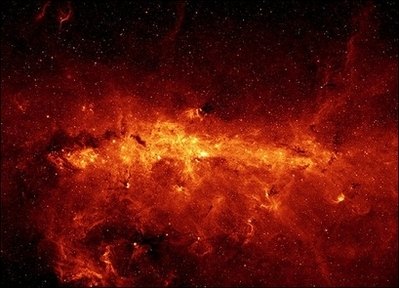
The mysterious source of this antimatter has now been discovered -- stars getting ripped apart by neutron stars and black holes.
While antimatter propulsion systems are so far the stuff of science fiction, antimatter is very real.
What it is
All elementary particles, such as protons and electrons, have antimatter counterparts with the same mass but the opposite charge. For instance, the antimatter opposite of an electron, known as a positron, is positively charged.
When a particle meets its antiparticle, they destroy each other, releasing a burst of energy such as gamma rays. In 1978, gamma ray detectors flown on balloons detected a type of gamma ray emerging from space that is known to be emitted when electrons collide with positrons -- meaning there was antimatter in space.
"It was quite a surprise back then to discover part of the universe was made of antimatter," researcher Gerry Skinner, an astrophysicist at Goddard Space Flight Center in Greenbelt, Md., said.
These gamma rays apparently came from a cloud of antimatter roughly 10,000 light-years across surrounding our galaxy's core. This giant cloud shines brightly with gamma rays, with about the energy of 10,000 suns.
What exactly generated the antimatter was a mystery for the following decades. Suspects have included everything from exploding stars to dark matter.
Now, an international research team looking over four years of data from the European Space Agency's International Gamma Ray Astrophysics Laboratory (INTEGRAL) satellite has pinpointed the apparent culprits. Their new findings suggest these positrons originate mainly from stars getting devoured by black holes and neutron stars.
As a black hole or neutron star destroys a star, tremendous amounts of radiation are released. Just as electrons and positrons emit the tell-tale gamma rays upon annihilation, so too can gamma rays combine to form electrons and positrons, providing the mechanism for the creation of the antimatter cloud, scientists think.
Billions and billions
The researchers calculate that a relatively ordinary star getting torn apart by a black hole or neutron star orbiting around it -- a so-called "low mass X-ray binary" -- could spew on the order of one hundred thousand billion billion billion billion positrons (a 1 followed by 41 zeroes) per second. These could account for a great deal of the antimatter that scientists have inferred, reducing or potentially eliminating the need for exotic explanations such as ones involving dark matter.
"Simple estimates suggest that about half and possibly all the antimatter is coming from X-ray binaries," said researcher Georg Weidenspointner of the Max Planck Institute for Extraterrestrial Physics in Germany.
Now that they have witnessed the death of antimatter, the scientists hope to see its birth.
"It would be interesting if black holes produced more matter than neutron stars, or vice versa, although it's too early to say one way or the other right now," Skinner explained. "It can be surprisingly hard to tell the difference between an X-ray binaries that hold black holes and neutron stars."
Weidenspointner, Skinner and their colleagues, detailed their findings in the Jan. 10 issue of the journal Nature.
|
|
|
||
|
||
|
|
|
|