US Congress passes kids health bill again
Updated: 2007-11-02 14:49
WASHINGTON -- A defiant Democratic-controlled Congress voted Thursday to provide health insurance to an additional 4 million lower-income children, and President Bush vowed swiftly to cast his second straight veto on the issue.
|
|
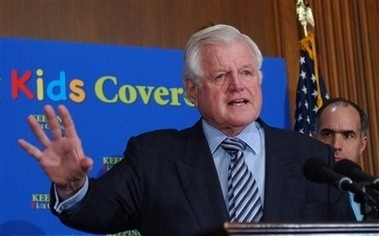
The legislation cleared the Senate on a vote of 64-30. It passed the House last week, but supporters were shy of the two-thirds majority needed to override Bush's threatened veto.
"We're convinced that the president has undermined an effort to protect children," Senate Majority Leader Harry Reid, D-Nev., said shortly before the vote.
"Congress has known for weeks that the President would veto this bill," White House press secretary Dana Perino countered in a statement shortly after the vote. "Now Congress should get back to work on legislation that covers poor children and stop using valuable floor time to make partisan statements."
In a situation of unusual political complexity, Republicans dictated the decision to pass the legislation speedily. It appeared their goal was to short-circuit attempts by supporters of the bill to reach a compromise that could attract enough votes in the House to override Bush's veto.
Attempts by Reid to delay final passage of the bill until next week or longer drew objections from the GOP.
"I believe a deal is within reach," said Sen. Max Baucus, D-Mont., the chairman of the Senate Finance Committee, a participant in meetings with two senior Senate Republicans, Sens. Charles Grassley of Iowa and Orrin Hatch of Utah, and several members of the House GOP.
Rep. Judy Biggert, R-Ill., who supported Bush's first veto and is involved in the discussions, said "we are pretty close" to an agreement but that several issues remain. For example, she said, the two sides had narrowed their differences on the issue of insuring maximum coverage of poor children before those in slightly higher-income families can be brought into the program.
Baucus said the negotiations would resume next week.
The veto-threatened measure would add an estimated 4 million beneficiaries to an existing program that provides coverage for children from families who earn too much to qualify for Medicaid but cannot afford private insurance. The program currently provides benefits to roughly 6 million children.
At a cost of $35 billion, the bill would be paid for through an increase in tobacco taxes, including a 61-cent rise on a package of cigarettes.
Bush vetoed an earlier children's health bill this fall, and Republican critics said it failed to give a high enough priority to covering poor children, marked a Democratic attempt to expand government-run health care, and did not take sufficient steps to prevent the children of illegal immigrants from receiving benefits.
Democrats failed to override his veto on a vote of 273-156, 13 short of the two-thirds majority they needed.
In response, Democrats launched a replacement measure, incorporating changes they said were designed to meet Republican objections to their first offering.
But Bush dismissed those efforts this week, telling a business audience, "If Congress sends this bill back to me, I'm going to veto it again." He predicted his second veto would be upheld.
A day earlier, the president told House Republicans in a private meeting that he would veto any measure that raised tobacco or any other taxes, a significant hardening of the administration's public position on the issue.
Political polls show the children's health issue enjoys widespread support, and Democrats and their allies have moved quickly to exploit it for their advantage with television and radio commercials attacking Republicans who opposed the legislation.
The result has been a growing nervousness among House Republicans looking ahead to the 2008 elections. The party's top leaders, Reps. John Boehner of Ohio and Roy Blunt of Missouri, joined the compromise negotiations in recent days.
It is unlikely either of them would support a bill that raises taxes. Rather, officials said their intention was to coax as many concessions as possible from the Democrats so that the next measure would be one that other Republicans among the rank-and-file could comfortably support.
As an example of the unusual political maneuvering on the legislation, House Majority Leader Steny Hoyer announced shortly after the vote that Democrats would not immediately send the measure to the White House.
And Reid said that out of deference to rank-and-file House Republicans who are involved in the talks, he would ask Speaker Nancy Pelosi not to call for an immediate attempt to override a veto.
Whether it succeeded or not, such a vote would only add to the political discomfort of GOP lawmakers who have supported the president so far on the issue, but may eventually part company with him.
As part of the negotiations, House Republicans presented a proposal several days ago that requires a 90-percent signup rate for the poorest eligible children before a state can expand coverage.
According to a description of the proposal made available to The Associated Press, no adults could be covered beginning Oct. 1, 2008, except for pregnant women, although any adults currently receiving benefits could be transferred to Medicaid.
All applicants would be required to stipulate that family assets did not exceed $1 million. Anyone seeking coverage would have to provide a birth certificate as proof of citizenship, a provision designed to bar illegal immigrants from receiving benefits.
The proposal from House Republicans made no mention of the tobacco tax increase.
The legislation that passed the Senate drew the support of 45 Democrats, 17 Republicans and two independents. All 30 votes in opposition were cast by Republicans.
|
|
|
||
|
||
|
|
|
|