Japan nuke plant leak worse than thought
(AP)Updated: 2007-07-19 08:53
KASHIWAZAKI, Japan - An earthquake-wracked nuclear power plant was ordered closed indefinitely Wednesday amid growing anger over revelations that damage was much worse than initially announced and mounting international concern about Japan's nuclear stewardship.
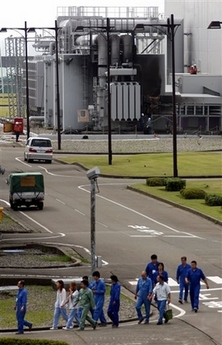 Workers stroll past a burnt generator attached to the number three nuclear power plant at Kashiwazaki Kariwa nuclear power plant in Kashiwazaki, northeastern Japan, Wednesday, July 18, 2007. [AP]  |
Tokyo Electric Power Co. warned that the nuclear plant shutdown could lead to power shortages in Japan. It has asked six other power companies to consider providing emergency electricity to prepare for rising demand from summer air conditioning, spokesman Hiroshi Itagaki said.
The mayor of Kashiwazaki, a city of 93,500 on the northern coast, called in the head of the nation's biggest power company and ordered the damaged nuclear station closed until its safety could be confirmed, escalating a showdown over a long list of problems at the world's most powerful generating plant.
"I am worried," Mayor Hiroshi Aida said in ordering the closure. "The safety of the plant must be assured before it is reopened."
Officials at Tokyo Electric, operator of the plant, said damage caused by the quake posed no danger to people or the environment.
But damage was widely visible on the site, from cracked roads and buckled sidewalks to the charred outside wall of an electrical transformer building that caught fire.
"To be honest, it's a mess," said company President Tsunehisa Katsumata, but he insisted fears of radioactive contamination were unfounded.
That did little to calm anger over the company's slow revelations of damage at the Kashiwazaki-Kariwa plant, which generates 8.2 million kilowatts of electricity. The plant, like much of the nuclear industry in Japan, has been plagued with mishaps, such as a radioactive leak in a turbine room in 2001.
On Tuesday, the utility shocked the nation by releasing a list of dozens of problems triggered by the quake, after earlier reporting only the transformer fire and a small leak of radioactive water.
The new list of problems included the transformer fire, broken pipes, water leaks and spills of radioactive waste. It also said the leak of radioactive water into the Sea of Japan was 50 percent bigger than announced Monday night.
"We made a mistake in calculating the amount that leaked into the ocean," the company said in a statement. Spokesman Jun Oshima said the amount was still "one-billionth of Japan's legal limit."
Even that list had to be revised. Tokyo Electric said later Wednesday that about 400 barrels containing low-level nuclear waste had tipped over at a storage facility at the plant during the quake, revising an earlier figure of 100.
The lids were knocked off about 40 barrels, spilling their contents onto the floor, spokesman Tsutomu Uehara told reporters in Tokyo. Uehara said no radiation had been detected outside the facility.
Concerns about nuclear safety echoed across Japan, which depends on 55 reactors for about 30 percent of its electricity needs.
"Japan has a dense population so the human damage would be major here. There would be many deaths," Hideyuki Ban, a director of the civil group Citizen's Nuclear Information Center, told reporters. "I think that a quake-prone country should phase out its use of nuclear power."
The International Atomic Energy Agency pressed Japan's government to undertake a thorough investigation of the damage to see if lessons could be applied to nuclear plants elsewhere.
Speaking in Malaysia, IAEA chief Mohamed ElBaradei offered help from his UN watchdog agency.
"I would hope, and I trust, that Japan would be fully transparent in its investigation of that accident," he said. "The agency would be ready to join Japan through an international team in reviewing that accident and drawing the necessary lessons."
Katsumata, Tokyo Electric's president, said the company would thoroughly study the impact of the earthquake.
"We will conduct an investigation from the ground up. But I think fundamentally we have confirmed that our safety measures worked," he said. "It is hard to make everything go perfectly."
Yet, while Japan is one of the world's most earthquake-prone countries, executives at the plant admitted they had not foreseen such a powerful temblor hitting the facility.
The plant's deputy superintendent, Masakazu Minamidate, said the strongest known quake in the region previously was a magnitude 6.5. "This was stronger than we expected," he said.
New data from aftershocks following Monday's offshore quake suggested a fault line may run underneath the power plant itself, which was only 12 miles from the epicenter.
Minamidate said an onshore survey of fault lines had been completed, but not one offshore. While it was unclear how close the fault line involved in the quake is to the plant, Meteorological Agency official Osamu Kamigaichi said it might stretch under the site.
Japan's Coast Guard said it would launch a study of the ocean floor off Kashiwazaki starting Friday to better map fault lines in the area.
Repercussions from the quake also were felt in the business world.
Shares of Tokyo Electric Power Co. fell in trading on Tuesday and Wednesday, and were at 5 percent below their closing price last week. They ended at $29.5 Wednesday - their lowest level since early December - on heavy trading of more than 13 million shares.
The temporary closure of auto parts maker Riken Corp.'s plant at Kashiwazaki forced Toyota Motor Corp., Nissan Motor Co., Mitsubishi Motors Corp. and Fuji Heavy Industries Ltd. to scale back production.
Toyota, Japan's No. 1 automaker and challenging General Motors Corp. for world leadership, will stop production lines at a dozen factories centered in central Aichi prefecture Thursday afternoon and all day Friday, Toyota spokesman Paul Nolasco said.
Several thousand Kashiwazaki residents remained in gymnasiums and civic centers Wednesday night because their homes had either been destroyed or damaged or because water service remained off.
Search teams pulled a 10th body from the rubble Wednesday night, and one man was listed as missing.
|
|
|
||
|
||
|
|