CIA details spy scandal in old documents
(AP)Updated: 2007-06-27 09:12
The CIA released hundreds of heavily censored documents Tuesday about its spying on Americans, foreign assassination plots and other misdeeds that triggered a scandal in the mid-1970s.
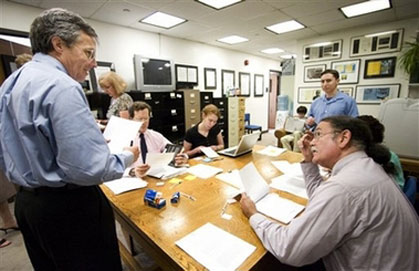 National Security Archive Executive Director Thomas Blanton, left, and Senior Fellow and CIA expert of the National Security Archive John Prados, right, confer as they examine documents, released by the Central Intelligence Agency, June 26, 2007, in Washington. [AP]  |
Known inside the CIA as the "family jewels," the documents were released with vast sections blocked out by agency censors. As a result, they were far less revealing than the reports issued in the mid-1970s by the three investigations which obtained unedited versions of these internal CIA documents a generation ago.
The ensuing scandal sullied the reputation of the intelligence community and led to new rules for the CIA, FBI and other spy agencies and new permanent committees in Congress to oversee them.
The 693 pages, mostly drawn from the memories of active CIA officers in 1973, were turned over at that time to three different investigative panels -- President Ford's Rockefeller Commission, the Senate's Church committee and the House's Pike committee.
The panels spent years investigating and amplifying on these documents. And their public reports in the mid-1970s filled tens of thousands of pages.
In early 1975, CIA Director William Colby told the Justice Department that these documents detailed assassination plots against foreign leaders such as Fidel Castro, the testing of behavior-altering drugs on unwitting citizens, wiretapping of US journalists, spying on civil rights and anti-Vietnam war protesters, opening of mail between the United States and the Soviet Union and China and break-ins at the homes of ex-CIA employees and others.
But as censored by the CIA, many of the most sensational events were mentioned in little more than one, sketchy paragraph apiece.
The new documents devoted two paragraphs to the programs that opened mail between US citizens and the Soviet Union and China.
One paragraph said "Project WESTPOINTER," from the fall of 1969 through October 1971, was based in the San Francisco area and the target was mail to the United States from Chinese mainland.
The other paragraph said a program, begun in 1953 but dormant by 1973, intercepted incoming and outgoing Russian mail, and occasionally other types of mail, at New York's Kennedy Airport.
By contrast, the Senate committee headed by Frank Church, D-Idaho, which spent two years investigating these documents, produced a book-length study of 12 CIA and FBI mail opening programs from 1940 to 1973. It found that the CIA alone had opened and photographed almost 250,000 first class letters in the United States and produced a computerized CIA index of nearly 1.5 million names.
The agency's new documents contained an unsigned three-page memo that described CIA's program code named Operation CHAOS as a worldwide effort to collect information "on foreign efforts to manipulate US extremism." It said some American extremists had been recruited by the CIA and sent abroad as contract agents, but asserts that CHAOS "has not and is not conducting efforts domestically for internal domestic collection purposes."
Another 1973 memo to Colby from the CIA inspector general expressed concern over CHAOS "because of the high degree of resentment we found among many agency employees at their being expected to participate in it."
But the Church committee reported in 1976 that CHAOS compiled a computerized index of 300,000 individuals, including 7,200 Americans and more than 100 domestic groups between 1967-1973 as it examined civil rights and anti-Vietnam war protesters.
One of the most detailed descriptions in the newly released documents concerned one of the plots to kill the Cuban dictator Castro.
A memo by CIA security chief Howard Osborn said in August 1960 the CIA recruited ex-FBI agent Robert Maheu, who was a top aide to Howard Hughes in Las Vegas, to approach mobster Johnny Roselli and pass himself off as the representative of international corporations who wanted Castro killed.
Roselli introduced Maheu to "Sam Gold" and "Joe," who were actually 10-most wanted mobsters Sam "Momo" Giancana, Al Capone's successor in Chicago, and Santos Trafficante. The mobsters worked for free, turning down a US$150,000 offer. The CIA gave them six poison pills, and they tried unsuccessfully for several months to have several people put them in the Cuban leader's food.
This particular plot was dropped after the failed CIA-sponsored Bay of Pigs invasion of Cuba. Other plots continued against Castro though they are not detailed in the newly released documents. Details of this plot first appeared in Jack Anderson's newspaper column in 1971.
The new releases devote one bare-bones paragraph to CIA involvement in a plot that resulted in Congolese Premier Patrice Lumumba's assassination in 1961.
The Church committee produced a 364-page report on assassination plots that described at least eight plots involving the CIA to assassinate Castro between 1960 and 1965 and detailed how the CIA encouraged Congolese dissidents to kill Lumumba.
In a message to CIA employees Tuesday, Director Michael Hayden said: "It's important to remember that the CIA itself launched this process of recollection and self-examination. And it was the Agency itself that shared the resulting documents in full with Congress.
"The collection as a whole was exhaustively reviewed in the 1970s by three outside investigative panels," Hayden said. The documents provide "reminders of some things the CIA should not have done" and "a glimpse of a very different era and a very different agency," he said.
The documents were one of the products of the Watergate scandal. Then-CIA Director James Schlesinger was angered to read in the newspapers that the CIA had provided support to ex-CIA agents E. Howard Hunt and James McCord, who were convicted in the Watergate break-in. Hunt had worked for a secret "plumbers unit" in Richard Nixon's White House. The unit originally was tasked to investigate and end leaks of classified information but ultimately engaged in a wide range of misconduct.
In May 1973, Schlesinger ordered "all senior operating officials of this agency to report to me immediately on any activities now going on, or that have gone on the past, which might be construed to be outside the legislative charter of this agency." The law establishing the CIA barred it from conducting spying inside the United States.
The result was 693 pages of memos whose contents Schlesinger's successor, Colby, reported to the Justice Department.
"These are the top CIA officers all going into the confessional and saying, 'Forgive me father, for I have sinned,'" said Thomas Blanton, director of the private National Security Archive, which had requested release of the documents under the Freedom of Information Act.
Some contents of these documents first spilled into public view Dec. 22, 1974, with a story by Seymour Hersh in The New York Times on the CIA's spying against anti-war and other dissidents inside this country.
|
||
|
||
|
|