Americas
Teams mimic stem cells using skin cells
(AP)
Updated: 2007-06-07 08:45
 |
Large Medium Small |
NEW YORK - In a leap forward for stem cell research, three independent teams of scientists reported Wednesday that they have produced the equivalent of embryonic stem cells in mice using skin cells without the controversial destruction of embryos.
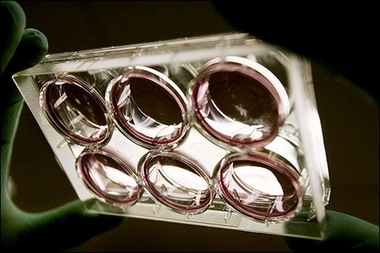 Stem cell cultures are held up in a US lab. Doctors on Thursday report a lab technique that, they hope, will ease an ethical row clouding the eagerly-sought goal of cloned embryonic stemcells. [Agencies]  |
Experts were impressed by the achievement.
"I think it's one of the most exciting things that has come out about embryonic stem cells, period," said researcher Dr. Asa Abeliovich of Columbia University in New York, who didn't participate in the work. "It's very convincing that it's real."
But he and others cautioned that it will take further study to see whether this scientific advance can be harnessed for creating new human therapies. For one thing, the procedure used to get the mouse skin cells to mimic embryonic stem cells wouldn't be suitable. And it's simply not known whether the mouse results can be reproduced with human cells.
"We have a long way to go," said John Gearhart of Johns Hopkins University, a stem cell researcher who also wasn't involved in the new work.
In any case, scientists said, the advance does not mean that research that involves getting stem cells from human embryos should now be abandoned. "We simply don't know which approach ... will work the best," said researcher Konrad Hochedlinger of the Harvard Stem Cell Institute, who led one of the three teams.
Embryonic stem cells are prized because they can develop into all types of tissue. So experts believe they might be used for transplant therapies in people who are paralyzed or have illnesses ranging from diabetes to Parkinson's disease.
To harvest human embryonic stem cells, embryos must be destroyed, an action many people oppose.
Scientists have long hoped to find a way to reprogram ordinary body cells to act like stem cells, avoiding the use of embryos altogether. The new mouse studies seem to have accomplished that. Past experiments seeking alternative routes to getting stem cells have generally involved tampering with an embryo or egg.
At a press conference Wednesday, Hochedlinger and a member of a second team said their work was not an attempt to evade the ethical objections to embryo destruction. Instead, they said, the goal was to learn how cell reprogramming works.
But in a telephone interview, a prominent critic of embryonic stem cell research welcomed the new work on ethical terms.
"This is what we were looking for people to explore because it may provide all the advantages of embryonic stem cells without the moral problem," said Richard Doerflinger, deputy director of pro-life activities for the U.S. Conference of Catholic Bishops. "So I'm very encouraged."
Hochedlinger and colleagues present their work in the inaugural issue of the journal Cell Stem Cell. (The first word in the journal's name refers to its publisher, Cell Press).
The other two teams reported their results Wednesday on the Web site of the journal Nature. Rudolf Jaenisch of the Whitehead Institute in Cambridge, Mass., is the senior author of one paper, and the work behind the other paper was led by Shinya Yamanaka of Kyoto University in Japan.
The new work builds on a landmark paper Yamanaka published last August. He found that by slipping four genes into mouse skin cells called fibroblasts, he could make the altered cells behave much like embryonic stem cells in lab tests.
But these so-called "iPS" cells still showed significant differences from embryonic stem cells. The three new papers report on creating iPS cells that proved virtually identical to stem cells in a variety of lab tests.
The technique used in the mouse studies could promote cancer in any patients getting therapy based on iPS cells, so researchers emphasized that a new approach that avoids that hazard would have to be developed.
Gearhart called that a major issue to be resolved. In addition, he said, scientists still must show that these cells can give rise to many cell types in the lab, as embryonic stem cells can.
And all this must be accomplished in human cells - a difficult task, he said, because introducing genes into human cells is a major challenge.
If the technique can be harnessed for people, the iPS cells and the tissue they develop into would provide a genetic match to the person who donated the skin cells. That would make them suitable for transplant to that person, theoretically without fear of rejection.
| 分享按鈕 |