Climate change battle could spell new disasters
(Reuters)Updated: 2007-06-06 09:22
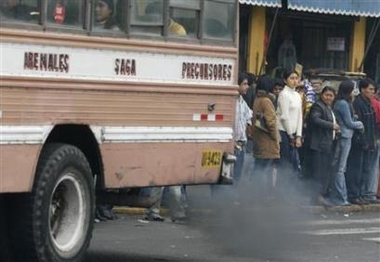 Pedestrians wait on a sidewalk to cross a street in Lima, June 5, 2007. [Reuters] |
Rich countries meeting in Germany this week will agree that they need to confront climate change, but unpleasant tradeoffs are already emerging.
Unless properly managed, a rush to reshape the world's economy to arrest climate change could end up trampling the lifestyles of the rich, the livelihoods of the rural poor, and the earth's most vulnerable habitats.
A tequila shortage is perhaps one of the least-expected results of planting lucrative, "climate-friendly" biofuels -- as Mexican farmers set ablaze their fields of cactus-like agave to make way for corn, a feedstock for ethanol. Biofuels are also blamed for raising food prices and destroying forests.
The result of misguided climate policies could be to undermine public support for action and discourage businesses from buying in.
"Definitely there'll be tradeoffs between climate change and the local environment, and with energy security," said Fatih Birol, chief economist at the International Energy Agency (IEA), which advises rich countries.
"We are not in the luxury of being able to choose from hundreds of energy types."
Just how mankind plans to battle climate change is still sketchy, but one buzz word is "scaling up" -- for example by boosting research into and deployment of clean energy technologies like wind and nuclear power and biofuels.
Urgency has been spurred by a series of U.N. climate reports this year confirming threats like desertification, droughts and rising seas and calling for action now to cut the long-term cost.
But evidence is emerging of the repercussions. British charity Christian Aid says Colombian rebel groups are forcing poor people off their land to grow lucrative palm oil for biodiesel, likening it to diamonds financing African wars.
"You could have blood biofuels in the same way as blood diamonds. It's a classic case of exploiting natural resources behind the veil of conflict," said Christian Aid climate policy analyst Andrew Pendleton.
"Unscrupulous private sector operators, rebel groups, are keen to make a fast buck."
POOR
Biofuels already occupy an area equal to all of the arable land in France, says the IEA, and they are blamed for raising the cost of corn, sugar and other foods they compete with for land.
But negative repercussions are hard to prove.
A hike in the price of tortillas, a Mexican staple, was blamed on biofuels and sparked riots, but may have more to do with the monopoly power of dominant tortilla producers, says Annie Dufey, research associate at Britain's International Institute for Environment and Development (IIED).
Such fears risk fatalism and favor the status quo, said Bert Metz, chair of a major U.N. report published last month on policy options.
"Problems of land ownership and poor people are there, let's do something about it, but not blame it on climate change," he said.
"There's no basis for supposing climate policies will create more problems than they solve, provided they're put in place wisely. I'd view that as another excuse for doing nothing."
The report did not weigh the cost and benefit of the recent consumer fad of boycotting air freight and travel to reduce carbon emissions, which could inadvertently hurt African exports and tourism.
"It's inequitable, tokenism," said the IIED's Bill Vorley of such consumer concerns.
Fresh fruit and vegetable exports from sub-Saharan Africa accounted for less than 0.1 percent of total British greenhouse gas emissions, but supported more than one million people, the IIED estimates.
SMALL IS BEAUTIFUL
On energy supply, a focus on small-scale distribution is the answer to fighting climate change and poverty both at once, say non-governmental and U.N. organizations.
In an interview with Reuters, Clemens Betzel, the president of Cardiff-based solar power company G24 Innovations, put on a table a bendy, solar power generator the size of a sheet of paper.
It produces enough power to run a mobile phone or light bulb, but there's plenty of demand for that, he said.
"People sit on a street corner selling power from a car battery. They're paying $60 to a $100 a year for kerosene to light their home," said Betzel, who said he could market his product for $20.
"We're going into Africa, India, China."
Small-scale biomass and solar power projects could also work in rich countries, reducing the need to switch to big, low-carbon alternatives like nuclear, hydroelectric and wind power, all of which face some opposition.
Environmental group Greenpeace says that a renewed focus on nuclear energy could divert political and financial capital from longer-term, renewable energy alternatives, although operators such as France's EDF point to affordability..
Meanwhile, hydropower could itself become a victim of global warming as rainfall patterns change, while it brings old problems of obliterating homes and wildlife. On June 1, a Brazilian court allowed the Estreito hydroelectric power project to move forward, over the opposition of indigenous and other groups.
Similarly, projects like burying greenhouse gases underground -- so-called carbon capture and storage (CCS) -- could simply delay the phase-out of coal and its associated effects on human health and the landscape.
"The biggest negative spin-off is that people continue to mine coal, so if you happen to live in Kentucky they'll strip-mine your backyard," said Stuart Haszeldine, professor of geology at Edinburgh University.
The worry that CO2 could leak from underground and asphyxiate people above was almost unfounded, however, he added.
Another proposal, installing mirrors or other reflective objects in the earth's atmosphere to reflect the sun's light and heat back into space draws short shrift from critics for its excessive complexity.
That would be like calming a rocking boat by rocking the sea, said clean energy entrepreneur Bill Joy.
|
||
|
||
|
|