Suicide bomber kills 39 at Iraqi mosque
(AP)Updated: 2007-02-25 08:16
|
People pass by a scene of a car bomb attack in Baghdad, Iraq, Saturday, Feb. 24, 2007. [AP] |
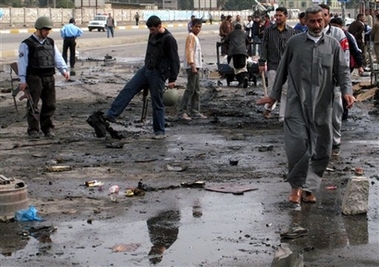
BAGHDAD- A suicide truck bomber sent a deadly storm of metal, stone and jagged plaster through worshippers leaving a Sunni mosque Saturday, killing at least 39 in a possible sign of escalating internal Sunni battles between insurgents and those who oppose them.
The motive for the attack was not immediately clear. But it carried the hallmarks of an increasingly bloody struggle for control of Anbar province ¡ª a hotbed of anti-U.S. guerrillas since the uprising in Fallujah in 2004 that galvanized the insurgency.
U.S. military envoys and pro-government leaders have worked hard to sway clan chiefs and other influential Anbar figures to turn against the militants, who include foreign jihadists fighting under the banner of al-Qaida in Iraq. The extremists have fought back with targeted killings and bombings against fellow Sunnis.
The blast in Habbaniyah ¡ª in the heart of insurgent territory about 50 miles west of Baghdad ¡ª was among the deadliest against civilians in Anbar.
The imam of the mosque had spoken out against extremists ¡ª most recently in this Friday's sermon, residents said. Many people in the neighborhood work for the Iraqi military and police forces, who frequently come under militant attack.
The truck, filled with building materials such as stone and plaster board, was blown apart as worshippers left following mid-afternoon prayers.
Rescuers, including U.S. soldiers, pulled survivors from the debris. The U.S. military sealed off the area and said it opened its medical facilities to "the most life-threatening injuries" among the more than 60 hurt.
Police official Lt. Abdul-Aziz Mohammed placed the death toll at 39, but authorities warned it could rise. The U.S. military said it was a suicide attack.
The attack came a day after U.S. troops raided a factory complex in Fallujah full of propane tanks and industrial chemicals that the military said could be used to make bombs. Back-to-back bombings in the past week released chlorine gas and raised worries that insurgents were experimenting with chemicals to boost the terror level of their attacks.
At least 14 people were killed in bombings around Baghdad ¡ª most targeting Shiite areas ¡ª even as U.S.-Iraqi forces press ahead with neighborhood-by-neighborhood sweeps seeking to reclaim control of the city. After nightfall, nearly 20 strong blasts reverberated through Baghdad in a reported exchange of fire between U.S. troops and insurgents south of the capital.
"There is no safe shelter for all outlaws," said Prime Minister Nouri al-Maliki, who reported that 426 militants have been captured since the campaign began Feb. 14.
But the crackdown also has sent Sunni insurgents fleeing the city to the nearby province of Diyala, which has emerged as a new and busy front for U.S. troops.
It's become so volatile that the Pentagon may delay plans to turn over control of Diyala to the Iraqi military by the end of the year, Maj. Gen. Benjamin Mixon told The Associated Press.
"The potential is there" to hand over Iraq's other 17 provinces "except in Diyala, where the future remains in question," said Mixon, commander of U.S. forces in northern Iraq, which includes Diyala.
Diyala, northwest of Baghdad, is known as "Little Iraq" because of its near-equal mix of Sunni and Shiite Arabs as well as Kurds ¡ª the country's three major groups. Al-Qaida in Iraq leader Abu Musab al-Zarqawi, a Jordanian, was killed in a U.S. airstrike in Diyala last year. Sunni extremists claim Diyala's capital, Baqouba, as the seat of an Islamic state in Iraq.
Direct fire attacks on U.S. soldiers are up 70 percent in Diyala since last summer, and fierce battles have raged since the Baghdad security plan was launched.
"We're working our way into the Baghdad security plan, and we won't be into the thick of it until late spring or summer. I expect more violence in Diyala through then," Mixon said.
Shiite compliance is essential for the Baghdad plan to work. Shiite leaders have apparently ordered their militia, including the powerful Mahdi Army, not to confront the security operation.
But the cooperation has been suddenly strained after U.S. military border guards stopped and searched the heir-apparent of the largest Shiite political group.
"Is this the way to deal with a national figure? This does not conform with Iraq's sovereignty," said Amar al-Hakim, 35, who was taken into custody for nearly 12 hours Friday after crossing from Iran with body guards.
Al-Hakim's father, Abdul-Aziz al-Hakim, heads the Supreme Council for the Islamic Revolution in Iraq, or SCIRI, which has close ties with Iran and is the strongest voice in Iraq's 275-seat parliament. In December, he met President Bush at the White House.
The younger al-Hakim ¡ª whom many believe is being groomed to take over the group ¡ª said U.S. soldiers handcuffed and blindfolded him before his release and "strongly abused" his bodyguards. He said cellular phones, licensed weapons and two-way radios were among items confiscated.
U.S. Ambassador Zalmay Khalilzad quickly apologized. A U.S. military statement called the detention "unfortunate" but insisted al-Hakim was not mistreated.
"It is not a question of offering apologies," al-Hakim told a news conference in the Shiite holy city of Najaf, about 100 miles south of Baghdad. "We need clear and honest measures to prevent such incidents from happening again."
The convoy was using the same route Washington believes is used to keep powerful Shiite militias flush with weapons and aid. There was widespread speculation that U.S. officials were seeking to send a message to Iran that the borders are under much tighter scrutiny.
About 8,000 people demonstrated near the Imam Ali mosque in Najaf against the detention. Similar rallies were held in Baghdad and across Shiite-dominated southern Iraq.
The protests, however, were relatively small considering the influence of the al-Hakim family, indicating they were mainly aimed at sending a warning to the Americans.
Vice President Adil Abdul-Mahdi, a Shiite and a top leader in the parliamentary bloc controlled by al-Hakim's father, described the behavior of the U.S. troops involved in the detention as "inappropriate, foolish and haphazard."
President Jalal Talabani, a Kurd, called the detention "uncivilized and inappropriate."
|
||
|
||
|
|