Iran gets army gear in Pentagon sale
(AP)Updated: 2007-01-17 15:16
Washington - Fighter jet parts and other sensitive US military gear seized from front companies for Iran have been traced in criminal cases to a surprising source: the Pentagon.
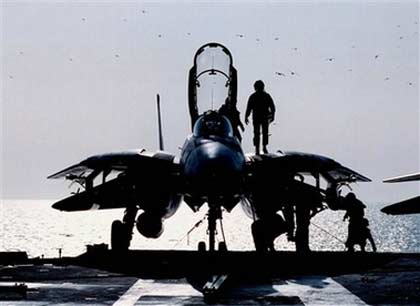 This photo released by the US Navy shows a pilot and his F-14B Tomcat silhouetted during a pre-flight inspection on the deck of the USS George Washington during maneuvers in the Persian Gulf Feb. 2, 1998. The Pentagon retired the F-14 in Sept. 2006. Federal investigators found that the US military has sold forbidden equipment at least a half-dozen times to middlemen for countries, including Iran and China, that exploited security flaws in the Defense Department's surplus auctions. The sales included F-14 fighter jet parts and missile components. [AP]  |
In one case, federal investigators said, contraband purchased in Defense Department surplus auctions was delivered to Iran, a country President Bush has branded part of an "axis of evil."
In that instance, a Pakistani arms broker convicted of exporting US missile parts to Iran resumed business after his release from prison. He purchased Chinook helicopter engine parts for Iran from a US company that had bought them in a Pentagon surplus sale. Immigration and Customs Enforcement agents say those parts did make it to Iran.
Sensitive military surplus items are supposed to be demilitarized or "de-milled" -- rendered useless for military purposes -- or, if auctioned, sold only to buyers who promise to obey US arms embargoes, export controls and other laws.
Yet the surplus sales can operate like a supermarket for arms dealers.
"Right Item, Right Time, Right Place, Right Price, Every Time. Best Value Solutions for America's Warfighters," the Defense Reutilization and Marketing Service says on its Web site, calling itself "the place to obtain original US Government surplus property."
Federal investigators are increasingly anxious that Iran is within easy reach of a top priority on its shopping list: parts for the precious fleet of F-14 "Tomcat" fighter jets the United States let Iran buy in the 1970s when it was an ally.
In one case, convicted middlemen for Iran bought Tomcat parts from the Defense Department's surplus division. Customs agents confiscated them and returned them to the Pentagon, which sold them again -- customs evidence tags still attached -- to another buyer, a suspected broker for Iran.
"That would be evidence of a significant breakdown, in my view, in controls and processes," said Greg Kutz, the Government Accountability Office's head of special investigations. "It shouldn't happen the first time, let alone the second time."
A Defense Department official, Fred Baillie, said his agency followed procedures.
"The fact that those individuals chose to violate the law and the fact that the customs people caught them really indicates that the process is working," said Baillie, the Defense Logistics Agency's executive director of distribution. "Customs is supposed to check all exports to make sure that all the appropriate certifications and licenses had been granted."
The Pentagon recently retired its Tomcats and is shipping tens of thousands of spare parts to its surplus office -- the Defense Reutilization and Marketing Service -- where they could be sold in public auctions. Iran is the only other country flying F-14s.
"It stands to reason Iran will be even more aggressive in seeking F-14 parts," said Stephen Bogni, head of Immigration and Customs Enforcement's arms export investigations. Iran can produce only about 15 percent of the parts itself, he said.
The GAO, the investigative arm of Congress, found it alarmingly easy to acquire sensitive surplus. Last year, its agents bought $1.1 million worth -- including rocket launchers, body armor and surveillance antennas -- by driving onto a base and posing as defense contractors.
"They helped us load our van," Kutz said. Investigators used a fake identity to access a surplus Web site operated by a Pentagon contractor and bought still more, including a dozen microcircuits used on F-14 fighters.
The undercover buyers received phone calls from the Defense Department asking why they had no Social Security number or credit history, but they deflected the questions by presenting a phony utility bill and claiming to be an identity theft victim.
It's no secret to defense experts that valuable technology can be found amid surplus scrap.
On a visit to a Defense Department surplus site about five years ago, defense consultant Randall Sweeney literally stumbled upon some that shouldn't have been up for sale.
"I was walking through a pile of supposedly de-milled electrical items and found a heat-seeking missile warhead intact," Sweeney said, declining to identify the surplus location for security reasons. "I carried it over and showed them. I said, 'This shouldn't be in here.'"
Sweeney, president of Defense and Aerospace International in West Palm Beach, Fla., sees human error as a big problem. Surplus items are numbered, and an error of a single digit can make sensitive technology available, he said. Knowledgeable buyers could easily spot a valuable item, he added: "I'm not the only sophisticated eye in the world."
Baillie said the Pentagon is working to tighten security. Steps include setting up property centers to better identify surplus parts and employing people skilled at spotting sensitive items. If there is uncertainty about an item, he said, it is destroyed.
Of the 76,000 parts for the F-14, 60 percent are "general hardware" such as nuts and bolts and can be sold to the public without restriction, Baillie said. About 10,000 are unique to Tomcats and will be destroyed.
An additional 23,000 parts are valuable for military and commercial use and are being studied to see whether they can be sold, Baillie said.
Asked why the Pentagon would sell any F-14 parts, given their value to Iran, Baillie said: "Our first priority truly is national security, and we take that very seriously. However, we have to balance that with our other requirement to be good stewards of the taxpayers' money."
Kutz, the government investigator, said surplus F-14 parts shouldn't be sold. He believes Iran already has Tomcat parts from Pentagon surplus sales: "The key now is, going forward, to shut that down and not let it happen again."
The Pentagon's public surplus sales took in $57 million in fiscal 2005. The agency
also moves extra supplies around within the government and gives surplus military gear
such as weapons, armored personnel carriers and aircraft to state and local law enforcement.
|
||
|
||
|
|