Saddam Trial
Saddam Hussein, rise and fall of a strongman
(Reuters)
Updated: 2006-12-30 11:44
 |
Large Medium Small |
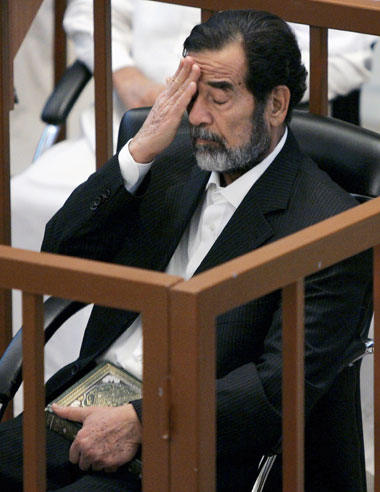 Saddam Hussein attends the third day of his trial for genocide against Kurds in the 1980s, in Baghdad in this August 23, 2006 file photo. Saddam was?hanged at about 6:00am Baghdad time, senior Iraqi officials said on Satuday. [Reuters]  |
But overarching ambition, which saw him invade neighbouring Iran and Kuwait and defy former US allies who accused him of developing nuclear and chemical weapons, destroyed Iraq's oil-rich economy and finally brought him down.
Saddam, 69, rose from fatherless poverty in Tikrit to seize power in a 1968 coup with his pan-Arab Baath party.
He went from being the Baath's power-behind-the-throne to Iraq's presidency in 1979 and invaded Iran the following year, launching a war that lasted eight years and killed hundreds of thousands of people, scarring an entire generation.
His rule crumbled when US tanks swept into Baghdad in April of 2003.
Saddam, meaning "one who confronts" in Arabic, was captured in December of that year when American soldiers found him in a hole near his home town of Tikrit.
He had vowed to go down fighting, as his sons did months before, but gave up without firing a shot. US forces said Saddam was disoriented when they found him in a pit covered with polystyrene and a rug, near a simple shack in an orange grove.
"I am the president of Iraq, and I want to negotiate," he told the soldiers who found him.
The hut where he had been staying consisted of one room with two beds and a fridge containing a can of lemonade, a packet of hot dogs and an opened box of Belgian chocolates. Several new pairs of shoes lay in their boxes scattered around the floor.
A US general said he was caught "like a rat" and many Arabs who had admired his defiance of the United States were shocked by his failure to fight back.
Iraqis who lived for years under the gaze of proud Saddam statues and posters saw humiliating images of him in custody, mouth held open by a probing medic, an unfamiliar beard streaked grey and dishevelled after months on the run.
Saddam was sentenced in November to hang for crimes against humanity for killing, torture and other crimes against 148 Shi'ites following a 1982 attempt on his life.
An appeals court upheld the ruling on Tuesday and he was hanged in Baghdad on Saturday.
In a letter written after his sentencing in November, he said: "I offer myself in sacrifice. If my soul goes down this path (of martyrdom) it will face God in serenity."
US President George W. Bush hailed the death sentence as a milestone for democracy and US officials presented the trial as an Iraqi catharsis, but Iraq is gripped by sectarian and ethnic strife in which tens of thousands of people have died.
ALLY TURNED ENEMY
Saddam became president in 1979 after using his skills as a street fighter and conspirator to get the Baath party into power. Surrounding himself with relatives from his home town of Tikrit, he maintained an iron grip on Iraq despite bloody wars, uprisings, coup plots and assassination attempts.
His ruthless rule, during which his enemies say hundreds of thousands of people died, largely kept the lid on simmering tensions between Arabs and Kurds and between majority Shi'ite Muslims and the strongman's once-dominant fellow Sunnis.
Once an ally of the United States, which aided him in his war against Shi'ite Islamist Iran, he was demonised by Western leaders after his army invaded Washington's ally Kuwait in 1990.
His description of the first Gulf War as the "mother of all battles" has entered the lexicon.
For some years, US policy was to contain Saddam but after the September 11 attacks in 2001, Bush chose Iraq as the next target in his "war on terror" after Afghanistan.
Having held on to power with much bloodshed when US-led forces did not follow through on their victory in the 1991 Gulf War, he was eventually toppled in a lightning three-week war.
Despite US efforts to take him out, Saddam eluded their grasp and spent eight months on the run, issuing occasional audiotapes taunting his pursuers and urging Iraqis to resist the forces of a man he had dubbed "the criminal little Bush".
Captured in December 2003, Saddam spent the last three years of his life in US custody, the spartan life in a US military cell a far cry from the extravagant luxury of palaces where the bathrooms were famously fitted with gold taps.
When his Dujail trial opened in October 2005, he appeared in a neat suit and was defiant from the start, insisting "I am the president of Iraq" and denouncing the US-backed court.
Playing to a televised gallery and for his place in history, he told the court in July in a typically bravura performance that as a military officer he deserved to be shot, not hanged.
In August 2006 Saddam's second trial started, on charges of war crimes including genocide against Iraqi Kurds. It was not concluded by the time of his death and the charges lapse.
In his final days in a US-run prison, he called on Iraqis to stop fighting each other and instead focus on killing Americans, projecting the image of a father figure in a country formed by European colonial rulers from a patchwork of ethnic and religious communities.
As president, he appealed variously to Arab nationalism, Islam and Iraqi patriotism and would appear in the traditional clothes of an Iraqi peasant, military uniform or Western suits.
In court appearances he appeared tieless in a sober suit and clutching a Koran. His lawyers and co-accused respectfully called him "Mr. President".
During his Dujail trial he said: "Even if they put me in hellfire, God forgive me ... I would say, 'Fine, for the sake of Iraq.' And I will not cry, for my heart is full of belief."
| 分享按鈕 |