Bush: I won't be rushed on Iraq
(AP)Updated: 2006-12-14 08:46
WASHINGTON - US President Bush said Wednesday he would "not be rushed" into a decision on a strategy change for Iraq, saying that in a round of consultations he heard both some interesting ideas and some "ideas that would lead to defeat."
|
|
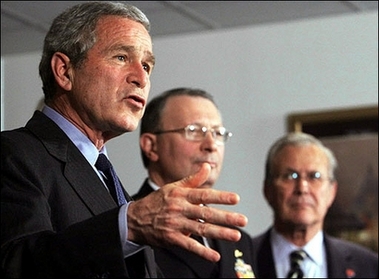



Standing with the Joint Chiefs of Staff, Bush said he and the nation's top military commanders had "a very candid and fruitful discussion about how to secure this country and about how to win a war that we now find ourselves in."
Bush made it clear that "there has been a lot of violence in Iraq. The violence has been horrific."
Although the White House had initially suggested that Bush would deliver his speech on Iraq strategy before Christmas, he has decided to delay it until early next year.
Defending that decision, Bush said, "I will not be rushed into making a difficult decision ... a necessary decision."
Joined by Vice President Dick Cheney, incoming Defense Secretary Robert Gates and outgoing Defense Secretary Donald H. Rumsfeld, Bush met with the military leaders and other members of his national security team at the Pentagon, where war commanders are calling for more U.S. trainers and equipment for beleaguered Iraqi forces.
He addressed some of his remarks to members of the nation's military, including some 140,000 now stationed in Iraq. "I appreciate their sacrifices, and I want them to know I'm focused on developing a strategy that will help them achieve their mission," the president said.
"I know there is a lot of debate at home, and our troops pay attention to that debate," Bush said. Directing his remarks to the troops, he said: "It means I'm listening to a lot of advice to develop a strategy to help you succeed."
Bush's meeting at the Pentagon lasted more than 90 minutes.
Bush said part of the reason for his putting off his speech to next year was to allow Gates to familiarize himself with the top defense job "and be part of this debate."
"At the appropriate time, I'll stand up in front of the nation and say, `here's where we're headed,'" Bush said.
Bush pledged anew to work with the Democratic-controlled Congress that convenes in January "to forge greater bipartisan consensus" on Iraq policy.
Asked by a reporter if recommendations made a week ago by the bipartisan Iraq Study Group included some of the bad advice he had cited, Bush said that his opinion of the report "hasn't changed."
"I thought it was interesting that Republicans and Democrats could work in concert to help achieve an objective," Bush said. The panel was headed by former Republican Secretary of State James A. Baker III and former Rep. Lee Hamilton, D-Ind.
On Tuesday, in similar discussions with field commanders, Bush heard Gen. John Abizaid, top U.S. commander in the Middle East, and Gen. George Casey, the top general in Iraq, ask the administration to pour increased funding into more armored vehicles, body armor and other critical equipment for the Iraqis, said a defense specialist familiar with the meetings. The source requested anonymity because the discussions were private.
Abizaid has told the Senate Armed Services Committee that troop levels in Iraq need to stay fairly stable and the use of military adviser teams expanded. About 140,000 U.S. troops and about 5,000 advisers are in Iraq.
The message to Bush, the defense specialist said, is that the U.S. cannot withdraw a substantial number of combat troops by early 2008, as suggested by the independent commission on Iraq, because the Iraqis will not be ready to assume control of their country.
Iraqi leaders, meanwhile, last month presented Bush with a plan for its troops to assume primary responsibility for security in Baghdad early next year and that US troops be shifted to the capital's periphery, The New York Times reported on its Web site Tuesday night.
Bush already has visited this week with State Department officials to review options, hosted a few outside Iraq experts, and met with Iraq's Sunni vice president, Tariq al-Hashemi. Last week, the president held talks with the leader of the largest Shiite bloc in Iraq's parliament, Abdul-Aziz al-Hakim, and with British Prime Minister Tony Blair, the president's staunchest war ally.
On Wednesday, Bush placed calls to Iraqi President Jalal Talabani, a Kurd, and Massoud Barzani, president of the Kurdish region.
Bush's discussions across Iraq's ethnic and religious lines come as major partners in the country's governing coalition are in behind-the-scenes talks to form a new parliamentary bloc and sideline supporters of the radical Shiite cleric Muqtada al-Sadr, a vehement opponent of the U.S. military presence and the main patron of Iraqi Prime Minister Nouri al-Maliki. There is discontent in Iraq and within the Bush administration over al-Maliki's failure to rein in Shiite militias and quell raging violence.
| ||
|
||
|
||
|
|